Še vedno genialen uvod v genialno, brezčasno pesem. Master Roger Waters
Author Archives: jpd
Kako je Kitajska tehnološko prehitela Zahod
Dobra nit Science Is Strategic (@scienceisstrat1) o tehnološkem vzponu Kitajske. Kitajska je na mnogih področjih prehitela ZDA (po številu top 1% člankov, po rankingu univerz glede števila in kvalitete člankov, po objavah glede umetne inteligence, po številu patentov, po dobavnih verigah glede proizvodov na področju obnovljivih virov energije, po proizvodnji baterij, po proizvodnji solarnih panelov itd.), drugje je le vprašanje časa, kdaj (po aplikacijah umetne inteligence). Pri čipih bo kmalu dohitela Tajvan, čeprav zaenkrat še zaostaja. Evropske unije v teh primerjavah ni nikjer niti približno blizu.
China is now a major science & tech superpower, with huge consequences for political, economic & military power.
Below is a 🧵on this dynamic from supercomputing to AI to quantum to green energy.
cc: @erikbryn @paulg @Noahpinion @amcafee @ramez @scmallaby @wolfejosh
China’s total spending levels on R&D have surpassed Europe, are dramatically higher than Japan and rival the spending levels in the US. 2/25 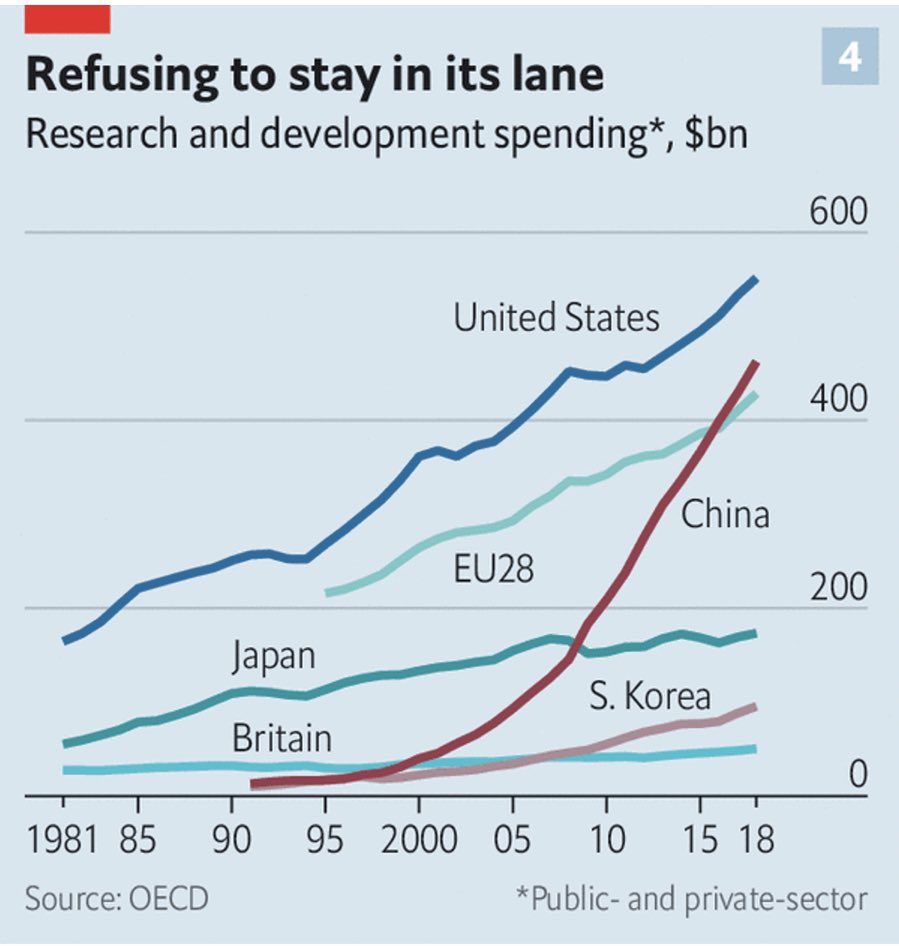
Ukraine: the invasion of capital
Never waste a good crisis, zahodne države načrtujejo, da bodo s to vojno zadovoljile interese zahodnih korporacij:
“As I explained in my previous post, the planned takeover of Ukraine’s resources partly provoked the conflict: the semi-civil war, the Maidan revolt and the annexation of Crimea by Russia. As the Oakland Institute has outlined, to limit unrestrained privatization, a moratorium on the sale of land to foreigners had been imposed in 2001. Since then, the repeal of this rule has been a main goal of Western institutions. As early as 2013, for instance, the World Bank provided an $89 million loan for the development of a deed and land title program needed for the commercialization of state-owned and cooperative land. In the words of a 2019 World Bank paper the aim was an “accelerating of private investment in agriculture.” That agreement, denounced at the time by Russia as a backdoor to facilitating the entry of Western multinationals, includes the promotion of “modern agricultural production … including the use of biotechnologies,” an apparent opening towards GMO crops on Ukrainian fields.
Despite the moratorium on land sales to foreigners, by 2016, ten multinational agricultural corporations had already come to control 2.8 million hectares of land. Today, some estimates speak of 3.4 million hectares in the hands of foreign companies and Ukrainian companies with foreign funds as shareholders. Other estimates are as high as 6 million hectares. The moratorium on sales, which the US State Department, IMF and World Bank had repeatedly called to be removed, was finally repealed by the Zelensky government in 2020, ahead of a final referendum on the issue scheduled for 2024.
Now with war grinding on, Western governments and corporations are stepping up their plans to incorporate Ukraine and its resources into the capitalist economies of the West.On July 4 and 5, 2022, top officials from the US, EU, Britain, Japan, and South Korea met in Switzerland for a so-called “Ukraine Recovery Conference.”
…
This plan advocated for an array of pro-capital measures, including “privatization of non critical enterprises” and “finalization of corporatization of SOEs” (state-owned enterprises) – identifying as an example the selling off of Ukraine’s state-owned nuclear energy company EnergoAtom. In order to “attract private capital into banking system,” the proposal likewise called for the “privatization of SOBs” (state-owned banks). Seeking to increase “private investment and boost nationwide entrepreneurship,” the National Recovery Plan urged significant “deregulation” and proposed the creation of “‘catalyst projects’ to unlock private investment into priority sectors.”
…
The takeover of Ukraine by capital (mainly foreign) will thus be completed and Ukraine can start paying back its debts and providing new profits for Western imperialism.”

Last week, Ukraine’s foreign private creditors agreed to the country’s request for a two-year freeze on payments on about $20bn of foreign debt. This would enable Ukraine to avoid defaulting on its overseas borrowings. Unlike other ‘emerging economies’ in debt distress, it seems that foreign bondholders are happy to help Ukraine out – if only for two years. The move will save Ukraine $6bn over the period, helping to reduce pressure on central bank reserves, which slid by 28 per cent year-to-date, despite significant foreign aid.
Ukraine’s economy is, not surprisingly, in a desperate state. Real GDP is projected to decline by more than 30% in 2022 and the unemployment rate is at 35% (Constantinescu et al. 2022, Blinov and Djankov 2022, National Bank of Ukraine 2022). “We are grateful for the private sector support of our proposal in such terrible times for our country,” responded Yuriy Butsa, Ukraine’s deputy…
View original post 1,647 more words
Ukraine: trapped in a war zone
Michael Roberts, 10 dni pred rusko invazijo na Ukrajino.
Ukrajina, takrat pod vplivom nacionalistične vlade še razpeta med zahodnim imperializmom (in pohlepom zahodnih korporacij) in ruskim pokvarjenim kapitalizmom. Zdaj je zadeva še bistveno slabša. In gre še na slabše.
“Above all, the IMF is insisting, with the support of the latest post-Maidan government, to carry out substantial privatisation of the banks and state enterprises in the interests of ‘efficiency’ and to control ‘corruption’. “The authorities remain committed to downsizing the SOE sector. Adopting an overarching state ownership policy would be a key step. Ultimately, corporatization and the concomitant improvement in performance of non-strategic SOEs should lead to their successful privatization. Preparations are also underway to execute the authorities’ strategy to reduce state ownership in the banking sector. Updated in August 2020, the strategy envisions a reduction in state ownership to below 25 percent of banking sector net assets by 2025.”
…
Most significant has been the move to privatise land holdings. Ukraine is home to a quarter of the fertile “black earth” soil (Chernozem) on the planet. It is already the world’s biggest producer of sunflower oil and the fourth-biggest producer of corn. Along with soybeans, sunflowers and corn are among the main crops grown in the Sunflower Belt, which stretches from Kharkiv in the east to the Ternopil region in the west.
The government is resisting allowing foreigners to buy land. But in 2024, Ukrainian legal entities will qualify for transactions involving up to 10,000 hectares and will apply to an agricultural area of 42.7 million hectares (103 million acres). That is equivalent to the entire surface area of the state of California, or all of Italy! The World Bank is positively drooling at this opening up of Ukraine’s key industry to capitalist enterprise: “This is without exaggeration a historic event, made possible by the leadership of the President of Ukraine, the will of the parliament and the hard work of the government.” So Ukraine plans to open up its economy even more to capital, particularly foreign capital, in the hope that this will deliver faster growth and prosperity.
…
The so-called Minsk accords of 2014-5, signed by the major powers and by a previous Ukraine government, cannot reconcile this division. So the Kiev nationalists, encouraged by the US, continue to press and the Russians continue to prepare for a possible invasion to force an agreement to divide the country permanently. Ukraine is trapped between the interests of Western imperialism and Russian crony capitalism.”
As the drums of war sound for Ukraine, what will be the impact on Ukraine’s economy and the living standards of its 44m population, whether war is avoided or not? I’ve posted on Ukraine several times before during the intense economic crisis that the country experienced in 2013-14 culminating in the collapse of incumbent government, the Maidan uprising and eventually the Russian annexation of Crimea and the predominantly Russian-speaking eastern provinces. The situation was dire for the people then. It improved a little for a while afterwards, but economic growth remains relatively low and living standards have stagnated at best. Average real wages have not risen in 12 years and collapsed severely after the 2014 crisis.

Ukraine was the hardest hit by the collapse of the Soviet Union and the ‘shock therapy’ of capitalist restoration in Eastern Europe and Russia itself. All the former Soviet satellites…
View original post 1,475 more words
Dva voditelja, s katerima nihče noče imeti opravka, sta Nemce posvarila pred njihovo energetsko norostjo. Zaman
Putin (2017): Nočete jedrske, nočete plina. Se boste greli na drva?
No, po okrog 250 miljardah evrov investicij v solarne sisteme, lahko Nemci pozimi, ko ne bo ruskega plina, premoga in drv, poskušajo kuriti sončne panele…
Trump (2018): Nemčija bo postala odvisna od ruskega plina
Ideologija je najhujša oblika norosti.
Kako pojasniti nizko stopnjo investicij v Sloveniji v zadnjem desetletju?
Jože Damijan, Jozef Konings, Črt Kostevc and Katja Zajc Kejžar
Spodaj je povzetek naše raziskave Explaining the Low Level of Investment in Slovenia, ki jo je naročila Evropska komisija in smo jo izvedli leta 2021. Evropsko komisijo je zanimalo, zakaj je stopnja investicij v Sloveniji, primerjalno glede na druge EU države, tako drastično upadla po letu 2008. V analizi smo vzroke za upad investicijske stopnje preučevali na treh ravneh: makro, sektorski in na ravni podjetij.
Zame sta ključni dve ugotovitvi: Prvič, stopnja investicij v Sloveniji trendno upada že od konca 1990. let, vendar je ta trend zakril val hiperinvestiranja v času pred finančno krizo (2004-2008). In drugič, v Sloveniji se investicije po finančni krizi niso pobrale navkljub izjemno nizkim obrestnim meram in navkljub pospešitvi gospodarske rasti po 2014 (kar je v nasprotju z ekonomsko teorijo, vendar v skladu s poslovnim obnašanjem podjetij), glavni razlog pa je process razdolževanja podjetij, ki so se preveč zadolžila pred 2008. Seveda pa so še drugi razlogi za upad investicij, med njimi predvsem neugodna gospodarska struktura, ki temelji na proizvodnji in izvozu sestavnih delov, namesto končnih izdelkov z višjo dodano vrednostjo. Oboje se pokaže relevantno na vseh treh ravneh naše analize.
Spodaj je povzetek analize na makro ravni (ugotovitve so vsebinsko enake tudi na bolj razdelani sektorski ravni in ravni podjetij). Upam, da vas ne moti, da je zadeva v angleščini.
Verjetnost jedrske vojne in opcije za Ukrajino
Odgovora na to vprašanje nihče ne pozna. Najbrž tudi ne sam Vladimir Putin. Nihče ne ve, kje je tista rdeča linija, po kateri bi Rusija začela z uporabo kemičnega ali jedrskega orožja. Nihče ne ve, ali je to močnejši neposredni angažma ZDA v Ukrajini, ukrajinski napad na cilje v Rusiji, ukrajinski napad na Krim ali možnost, da Rusija izgubi v ukrajinski vojni. Dejstvo je, da se zaenkrat tako Rusija kot ZDA držita neformalnega protokola, da prva v Ukrajini ne uporablja “prepovedanih” orožij, kot je kemično in da ne napada ciljev izven Ukrajine, druga pa, da izrecno pazi, da se vojaško neposredno ne angažira v Ukrajini in da v Ukrajino ne pošilja orožja, s katerimi bi slednja lahko napadla cilje v Rusiji. Denimo raketni sistem HIMARS ima doseg zgolj 300 kilometrov.
Dejstvo je tudi, da so ZDA – kljub močnemu povečanju vojaške in finančne podpore Ukrajini – močno ublažile retoriko glede ciljev v ukrajinski vojni. Ameriška retorika se je ublažila na tem, da si zdaj želi “demokratično, neodvisno, suvereno in uspešno Ukrajino“. Ne sprejema pa zahteve Ukrajine po vrnitvi vseh izgubljenih ozemelj, vključno z ozemlji, ki jih je Rusija zavzela leta 2014. V komentarju za New York Times je maja ameriški predsednik Biden naštel veliko stvari, ki jih ZDA ne bi naredile in ki so v prejšnjih komunikacijah bile postavljene zelo ostro ali dvoumno. ZDA si naj ne bi prizadevale odstaviti ruskega predsednika Putina. Ne bi poslale vojakov v Ukrajino ali se neposredno angažirale proti Rusiji. Ne bi spodbudile ali omogočile Ukrajini, da napade Rusijo. Prav tako naj ne bi “podaljševale vojne samo zato, da bi Rusiji zadal bolečino”.
Gibanje izdatkov za obresti, dodatne simulacije
Bine Kordež
Glede na predlog v komentarju na moj originalni tekst, da podam še oceno višine izdatkov za obresti glede na BDP, sem se še nekoliko poigral s številkami. Seveda imamo za tak izračun zelo veliko variant, ker so rezultati odvisni od štirih spremenljivk: višina obrestnih mer, kot sem jo simuliral v članku, realna rast BDP, inflacija in višina primanjkljaja, ki opredeljuje nominalno povečevanje javnega dolga. Dolgoročno sem upošteval varianto 2 % gospodarske letne rasti ter 2 % inflacije, kar je neka realna predpostavka, pri čemer sem za prva tri leta (2022-2024) za ti dve postavki upošteval napoved UMAR-ja. Nato pa sem simuliral različne obrestne mere (2 %, 2,5 % in 3 %) ob konstantnem proračunskem primanjkljaju 1 % BDP, ter še srednjo varianto dviga obrestnih mer (2,5 %) ob primanjkljaju 2,0 % BDP.
Lucas and Sargent on Optimization and Equilibrium in Macroeconomics — Uneasy Money
In a famous contribution to a conference sponsored by the Federal Reserve Bank of Boston, Robert Lucas and Thomas Sargent (1978) harshly attacked Keynes and Keynesian macroeconomics for shortcomings both theoretical and econometric. The econometric criticisms, drawing on the famous Lucas Critique (Lucas 1976), were focused on technical identification issues and on the dependence of […]
Lucas and Sargent on Optimization and Equilibrium in Macroeconomics — Uneasy Money
Problem s sončnimi elektrarnami
Problem s sončnimi elektrarnami (SE) ni samo ta, ki ga imamo prav zdaj, da omrežje ne prenese množičnega priključevanja razpršenih novih SE na omrežje in da morajo biti številne izključene, ker bi sicer omrežje klecnilo. Primarni problem s SE je, da so koristne samo v pomladno-poletnih mesecih, in to čez dan, ko sije sonce, saj niti približno nimamo dovolj hranilnikov, da bi to energijo shranili za čez noč, in nimamo tehnologije in infrastrukture, da bi jo shranili za jesensko-zimske čase, ko sonca ni. SE (in vetrne elektrarne) so koristne, vendar samo kot dodatek oziroma kot komplementarne ostalim, izdatnim, stabilnim in zanesljivim virom energije (to pa so delno hidro, predvsem pa termo in jedrske elektrarne). Potrebna je kombinacija obojega, nikakor pa SE ne morejo nadomestiti navedenih tradicionalnih stabilnih virov energije. Tudi zato je ideja sedanje vlade, da bi – v pogojih, ko omrežje ne prenese množičnega vključevanja novih razpršenih SE – izpad energije v primeru nadaljevanja izpada ruskih energentov reševali z velikimi skupnostnimi SE, skregana z zakoni fizike in logike.
Spodaj je plastičen primer problema iz Nemčije, kot so ga zabeležile Finance:


You must be logged in to post a comment.