Izjemna verzija izjemne pesmi Rolling Stonesov
Zakaj so kolapsirale borzne cene plina in ali bo plina dovolj tudi v 2023?
Medtem ko se “voditelji EU” pripravljajo na uvedbo cenovne “kapice” oziroma “ovratnice” za plin, so cene plina na referenčnih borzah (denimo nizozemska TTF) kolapsirale. V nekaj tednih so upadle za 80%, iz 338 €/MWh na vsega 63 €/MWh (kar je sicer 4-krat več kot pred dvema letoma). In še upadajo. Razloga sta manjše povpraševanje industrije zaradi prostovoljnega zmanjšanja proizvodnje vsled visokih cen plina (za 13%) ter zaradi drsenja v recesijo. Hkrati so evropske države že napolnile skladišča plina med 90 in 95%, kar zmanjšuje povpraševanje po plinu in zaradi česar se pred španskimi terminali za utekočinjen zemeljski plin (UZP) že delajo čakalne vrste tankerjev s plinom. Cene plina in nafte utegnejo v naslednjih dveh mesecih zaradi presežne ponudbe celo upasti na tako nizke ravni kot v času Covida. S tem postaja tudi dogovor glede cenovne kapice – ovratnice bolj ali manj irelevanten.
Spodaj je dobra nit Alexandra Stahela, ki pojasnjuje, zakaj je prišlo do kolapsa cen in ali bomo naslednje leto lahko nadomestili manjkajočih 60 mm3 plina. Letos smo lahko hvaležni prostovoljnemu zmanjšanju porabe plina zaradi visokih cen, Kitajski, ki se je odrekla delu LNG ter toplemu vremenu, toda naslednje leto mora Evropa zagotoviti dodatnih 60 mm3 plina, ki ga le letos še dobila iz Rusije.
Why has TTF collapsed? Is Europe out of the woods? What matters for commodity price formations? What will matter in 2023…?
1/n
European gas prices – both TTF & NBP – have collapsed right into the start of the winter season, down from its peak of €338/MWh post Nord Stream 1 sabotage news to now €63/MWh.
Mind you though, TTF was €13/MWh 2 years prior – up still 370%.
2/n 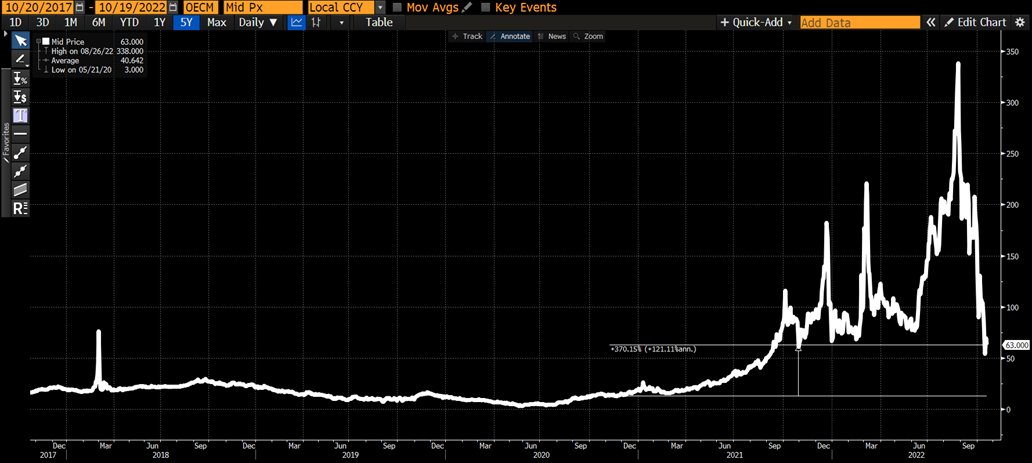
China: Xi’s third term – part 3: chips, dual circulation and imperialism
“The Russia invasion of Ukraine has given the US and NATO the excuse to intensify the economic, political and military encirclement of China with Taiwan as its hub. By the broadest definition of military intervention, the US has engaged in nearly 400 military interventions between 1776 and 2019, with half of these operations occurring since 1950 and over 25% occurring in the post-Cold War period. these interventions have revolved around economy, territory, social protection, regime change, protection of US citizens and diplomats, policy change, empire, and regime building. The US backed by an extended NATO, no longer confined to the Atlantic seaboard, sees China as the next area for ‘intervention’ down the road.
The Western media helps by continually talking of China’s so-called ‘aggressive behaviour’ and its crimes against human rights. Whatever the truth in those charges, they are easily matched by the crimes of imperialism in the last century alone: the occupation and massacre of millions of Chinese by Japanese imperialism in 1937; the continual gruesome wars post-1945 conducted by imperialism against the Vietnamese people, Latin America and the proxy wars in Africa and Syria, as well as the more recent invasion of Iraq and Afghanistan and the appalling nightmare in Yemen by the disgusting US-backed regime in Saudi Arabia etc. And don’t forget the horrific poverty and inequality that weighs for billions under the imperialist mode of production.
But the economic and political conflict between China and the US is the major geopolitical issue of the 21st century – much larger than the Russia-Ukraine war. US National Security advisor Jake Sullivan summed it up recently. “This is a decisive decade… in which the terms of our competition with the People’s Republic of China will be set.”He continued: “The PRC’s assertiveness at home and abroad is advancing an illiberal vision across economic, political, security, and technological realms in competition with the west,” China must be stopped because “It is the only competitor (to the US) with the intent to reshape the international order and the growing capacity to do it.””

Even as Xi Jinping was promising China’s Communist Party’s national congress that China would “resolutely win the battle” in key areas of technology, employees of technology companies in China and elsewhere were being told to down tools. Dozens of the hundreds of executives and engineers with US citizenship or green cards who work in or with China’s semiconductor sector, many of them born in China, have been told by their employers – whether those are foreign or Chinese companies – to stop work while their employers seek clarification of a new US rule that bars US citizens and residents from supporting China’s advanced chip-making industry without a licence.
It is now crystal clear that the US, enabled by a bipartisan consensus in Washington, is determined to stop China upgrading technologically. This has massive implications for Beijing’s ambitions in areas such as artificial intelligence and autonomous driving. The new Chips Act introduced…
View original post 1,697 more words
London Grammar – Strong
Dead on arrival: Ameriški polprevodniški dizaster
Bidenove sanje o skorajšnji ameriški prevladi v proizvodnji čipov na domačih tleh, so propadle, še preden so uspele poleteti. Vzporedno in navkljub visokoletečim ciljem ob lansiranju zakona o spodbujanju proizvodnje polprevodnikov in kljub predvisenim subvencijam v višini 280 milijard dolarjev, se je prodaja ameriških “dizajnerjev čipov” sesula, tržna kapitalizacija 30 največjih pa je upadla za 1,500 milijard dolarjev. Tudi perspektive niso rožnate, saj ameriški protekcionistični ukrepi (prepoved izvoza čipov in opreme za proizvodnjo čipiv v Kitajsko) škodijo predvsem ameriškim dizajnerjem čipov, ki izgubljajo največji trg, in koristijo le Kitajski, ki pospešeno ne samo razvija najbolj sofisticirane čipe (5 in celo 3 nm), ampak tudi pospešeno gradi kapacitete za proizvodnjo čipov ter opremo za njihovo proizvodnjo.
In the spring it was easy to be dreamy about America’s chip industry. The pandemic-induced semiconductor crunch had proved just how crucial chips were to modern life. Demand was still rising for all sorts of chip-powered technology, which these days is most of it. Investors were less gloomy on chips than on other tech, which was taking a stockmarket beating. The CHIPS act was making its way through Congress, promising to plough subsidies worth $52bn into the domestic industry, in order to reduce America’s reliance on foreign fabs and support projects like Intel’s Ohio factory.
ASML’s Secret: Inside the global semiconductor giant
China: Xi’s third term – part two: property, debt and common prosperity
“China needs to reverse the expansion of the private sector and introduce more effective plans for state investment, but this time with the democratic participation of the Chinese people in the process.”
In part one of my analysis of China’s economic future, I dealt with the claims that China would slow towards stagnation because its investment rate was too high, the working population was falling fast and the economy needed to become like mature Western capitalist economies based on consumption-led growth. I argued that the Western capitalist model was hardly great shakes, given its regular and recurring crises and the much lower levels of consumption growth. Anyway, in an economy, consumption does not lead investment and national output. On the contrary, it is investment that leads in capitalist economies just as much as in China.
The reason that Western analysts are so sceptical of the Chinese model is that they are seeped in a different economic model for growth. They are convinced that China can only be ‘successful’ (like the economies of the G7!) if its economy depends on…
View original post 1,691 more words
Evropa potrebuje nov “Whatever it takes”
Če kdaj, potem Evropa danes potrebuje nov “Whatever it takes“. Tisto glede možnosti razpada evro območja so bile mačje solze v primerjavi s tem, kaj čaka Evropo po tej zimi. Šok pred nami je po velikosti lahko enak gospodarskemu šoku zaradi Covid-19, vendar je bil Covid začasen, energetska kriza, v katero smo padli, pa bo trajala še nekaj let. V tem obdobju bo zaradi pomanjkanja energentov in zaradi visokih cen energentov precejšen del industrije propadel, precejšen del pa bodo podjetja morala trajno preseliti v države, ki lahko zagotavljajo nizke cene in dovolj energije.Evropa bo zaradi tega energetskega šoka deindustrializirana in trajno prizadeta.
Danes je zato, tako kot ob začetku Covida, marca 2020, potrebna usklajena akcija Evropske komisije in ECB. Prva mora začasno zaustaviti dvigovanje obrestne mere in uvesti nov paket odkupovanja obveznic, s čimer bo vladam pomagala premostiti letošnjo energetsko krizo (ker se bodo vlade morale močno zadolžiti, da bodo lahko omilile energetski šok za gospodinjstva in gospodarstvo) ter držala zahtevane donose na nizki ravni. Evropska komisija pa mora uvesti nov Energetski Načrt za okrevanje in odpornost oziroma okrepiti obstoječega, s katerim bo omogočila državam investicije v nove vire energije in hrambe energije (vodik, skladišča) in novo energetsko infrastrukturo (plinovodi, LNG terminali, nadgradnja prenosnega in distribucijskega omrežja). Kakršenkoli kaos ali neusklajenost različnih politik sta v situaciji, ki so jo evropski politiki sami zakuhali, lahko usodna.
Nekdo mora prevzeti odgovornost, iti pred kamere in reči, da bodo evropske institucije naredile “Whatever it takes“, da bodo Evropsko unijo prepeljali varno skozi to dolgo energetsko krizo. Jaz bi bil zelo pomirjen, če bi članice EU namesto sedanje predsednice Evropske komisije imenovale Maria Draghija ter mu dale pooblastila za pripravo rešitvenega načrta in pogajanja s ključnimi mednarodnimi deležniki.
China: Xi’s third term – part one: growth, investment and consumption
China’s Congress of the Communist Party takes place this week. This is an important event not only for China, but globally. The Western media have concentrated on the fact that current party leader Xi Jinping will be confirmed for an unprecedented third term as party leader and thus also continue as President of China when the National Congress meets next March.
Naturally, the Western pundits are strongly opposed to Xi having a third term. The FT’s Keynesian guru, Martin Wolf reckoned Xi’s continuation in power would ‘dangerous’ for China and the world. “It is dangerous for both. It would be dangerous even if he had proven himself a ruler of matchless competence. But he has not done so. As it is, the risks are those of ossification at home and increasing friction abroad… Ten years is always enough.. It is simply realistic to expect the next 10 years of…
View original post 2,053 more words
Se moramo bati plačno-cenovne spirale ali profitno-cenovne spirale?
Ekonomija in učbeniki ekonomije so polni mitov. Mitov, ki so večinoma ideološko pogojeni in nimajo nobene empirične podlage (od popolne konkurence, kvantitativne teorije denarja do škodljivosti minimalne plače). In ker nimajo empirične podlage, se nanje sklicujemo kot na “zdravo pamet”. No, in eden izmed teh mitov v ekonomiji je tudi plačno-cenovna spirala. V makroekonomiji se je bojimo kot hudič križa. Narativa gre tako: v času povišane inflacije je treba držati plače nazaj, sicer se stroški dela prenesejo v višje proizvodne stroške podjetij, ti pa posledično dvignejo cene izdelkov in storitev, kar vodi k še višji in še bolj trdovratni inflaciji, ki se je je težko znebiti.
Dokaz za to je … uganili ste – “zdrava pamet”. Nekaj dni nazaj se je natanko na to skliceval ugledni profesor Jason Furman, nekdanji vodja sveta ekonomskih svetovalcev Baracka Obame, z besedami “This follows from basic micro & common sense.”
No, problem je, da je ta narativa morda skladna z osnovami mikroekonomije in z zdravo pametjo, vendar pa zanjo ni nobenega empiričnega dokaza (glejte v nadaljevanju). Še več, če ne najdemo empirične potrditve, da plače poganjajo inflacijo, pa lahko v zadnjem letu najdemo empirično potrditev (tukaj, tukaj, etc.), da velik del inflacije poganjajo dobički podjetij (t.i. greedflation). Torej gre lahko tudi za profitno-cenovno spiralo.
 DAMIJAN blog
You must be logged in to post a comment.