Včeraj sem na X imel zanimivo razpravo z Bradom Setserjem (ki ga sicer zelo cenim) o kitajskem avtomobilskem izvoznem boomu, ki naj bi predstavljal “napad na evropski avtomobilski trg”. Zmotila me je hipokrizija v pozivanju na katastrofo in nujnost samoobrambe, čeprav Kitajska počne natanko to, kar so počele ostale azijske države in Nemčija po drugi svetovni vojni in kar so propagirale vse trgovinske doktrine, ki smo jih po drugi svetovni vojni predavali na podlagi mainstream univerzitetnih učbenikov. Spodaj je debata, če slučajno koga zanima.
Začelo se je s tem prvim tvitom Brada Setserja (in nadaljevanjem njegove niti):
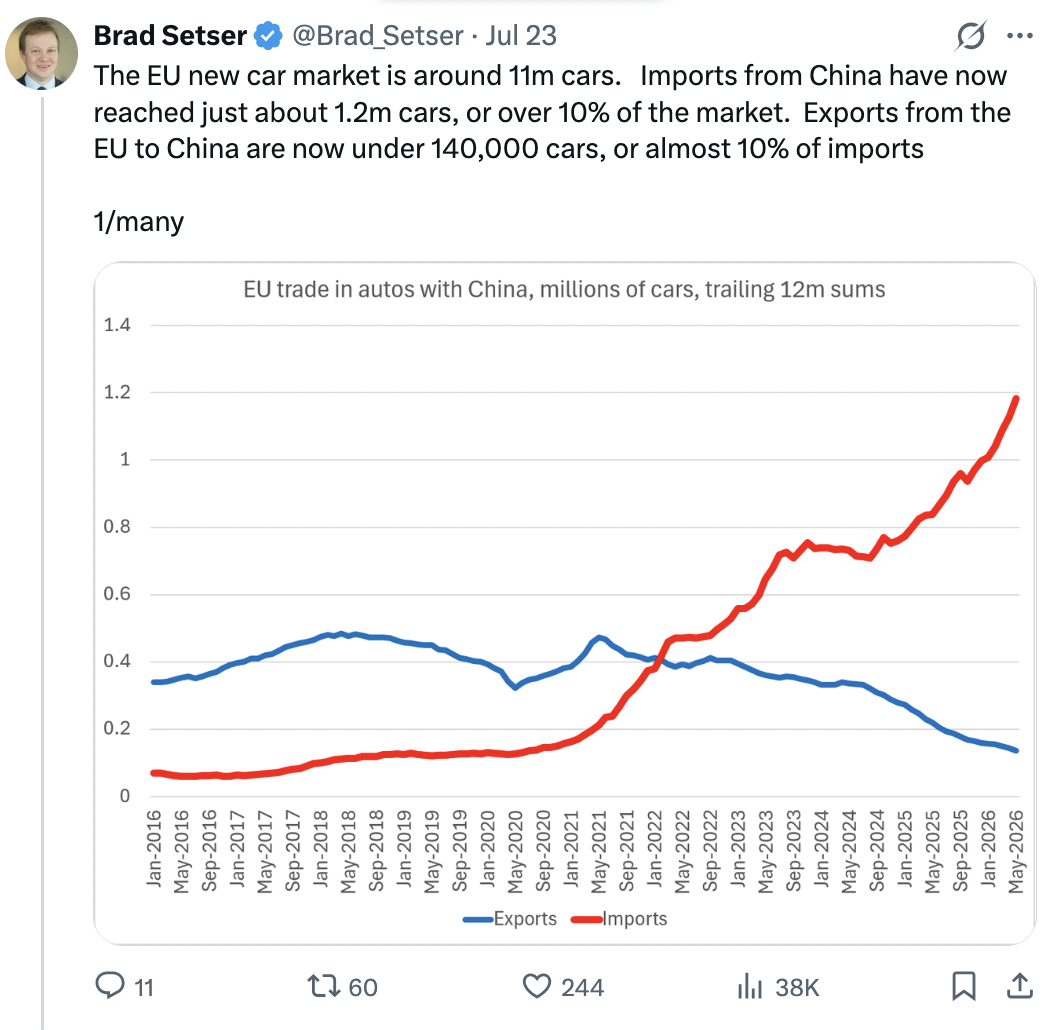
Moj odziv na Setserjev zapis:
This whole thing (“China’s assault on Europe’s car market”) is quite misguided. First, since when—and under what theory of international trade—does trade have to be balanced within the same sector (i.e. product category)? The theory of comparative advantage (Ricardo, Heckscher–Ohlin–Samuelson) is built on the idea that a country should be a net exporter of the goods in which it has a comparative advantage.
Second, the (new trade) theory of intra-industry trade (Helpman, Krugman) is based on countries exporting differentiated products within the same product category. China has found its niche—its product differentiation—in EV manufacturing, while the EU has specialized in ICE vehicles. Chinese car exports to Europe are overwhelmingly based on EVs.
Third, where exactly is the problem? The real problem is that European automakers failed to understand both the EU’s own regulatory framework (the ban on the sale of new ICE vehicles from 2035) and the market incentives created by the EU (subsidies for the purchase of EVs). How are Chinese manufacturers to blame for adapting to the EU’s regulations and incentives in a timely manner and for correctly interpreting the market signals?
Fourth, exports to the EU account for only about 10% of China’s total car exports, and Chinese brands hold roughly a 10% share of the EU’s new car market. How can this possibly be described as a “Chinese assault” on Europe’s car market?
Fifth, serious analysts should avoid ideology and remain objective. They should not invoke the mainstream trade theories taught in economics textbooks since the second half of the 20th century when those theories support their world view, only to retreat to 19th-century protectionist doctrines when actual trade patterns no longer fit their preferred narrative. That may be acceptable for politicians, but it is not how serious economists and analysts should approach the issue.
Setserjev odgovor:
This rebuttal in my view misses two things:
1) China’s exports globally (And to europe) are up, its imports globally of manufactures are flat (ex chips) and its imports from Europe are down. That isn’t Ricardo; there are no new export sectors to reallocate to. China’s global surplus is up
2) A shock is a sudden change, and there has been a true shock to European auto output as a result of the sudden rise of China as an export power. That is true even if it is all the result of short-sighted European auto executives. Magnitude and speed of change matters
Moj odgovor Setserju:
So?
When German industry (automotive, electrical engineering, etc.) experienced its export boom after World War II, or when Japan went through a similar export boom during the same period, or when any of the so-called Asian Tigers did it, was that beneficial for particular affected sectors in countries that were net importers of their manufactured goods? Or when China experienced its export boom before and after 2001 (the so-called First China Shock), was that considered beneficial for the countries that were net importers of Chinese manufactured products?
What is different today, when Chinese manufacturers dominate global exports in a new product segment (within the automotive product group) in which they are more competitive because they specialized earlier and secured a first-mover advantage? Why is it China’s fault that traditional European, Japanese, and Korean manufacturers were caught sleeping and failed to restructure their product mix in time?
Yes, this is a shock. But that is precisely part of the Heckscher–Ohlin theorem of comparative advantage (the first of 4 theorems in CA theory): under free trade, some sectors are adversely affected, while others—those in which a country has a comparative advantage—benefit from it. Affected countries need to work on how to reinvent their manufacturing sectors to stay competitive or to build new comparative advantages in new product segments.
Setserjev odgovor:
None of the classic trade theories that assume that trade leads to a reallocation across sectors that produce tradable goods/ services apply — EVERY study has shown that there is massive gap between Chinese import volumes (not growing, and this year is no exception if you adjust for gold/ chip prices) and export volumes. The needed framework has to incorporate ever more imbalanced trade, and a sectoral shift into non-traded good
I personally don’t think the first China shock was good for the US economy on net even if it did lower consumer goods prices, the years from 2002 to 2012 were not in fact years of good aggregate economic performance.
And China shock 2.0 clearly hasn’t led to good overall economic outcomes in Germany either
Moj odgovor:
So?
The Heckscher–Ohlin–Samuelson (HOS) model is built on a highly restrictive 2×2×2 framework (two goods, two factors, and two countries). Only within this stylized setting is bilateral trade necessarily balanced. Once the model is extended to multiple goods, multiple factors, and multiple countries, this result no longer holds—both theoretically and empirically. Yet this has never been regarded as a serious problem, except perhaps by a handful of trade theorists and professors (including myself) that taught international trade.
On the other hand, the Helpman–Krugman New Trade Theory is agnostic about the number of products and countries. It simply shows that the welfare of a country specializing in a particular differentiated good (variety) increases through exporting it. The theory does not penalize a country that becomes a net aggregate importer of all other varieties. On the contrary, it predicts that a country specializing in its own variety, while importing all other varieties, benefits both from lower prices and from greater product variety. This is precisely the insight for which Paul Krugman was awarded the Nobel Prize (plus the New Economic Geography).
So are we suddenly abandoning this framework simply because Chinese exporters have become more competitive and are beginning to displace traditional Western producers—even though they are competing in new segments (varieties) of the same broad product categories—simply because Western producers failed to innovate, invest, and restructure their traditional product mix in time?
If the theory was considered sound when it explained the rise of U.S. technological dominance or rise of German, Japanes, and later South Korean and Taiwanese manufacturing exports (in new varieties, such as computers, mobile phones, chips etc.), why should it suddenly cease to apply when the same process favors China?
The problem is that Western countries fell asleep. They assumed they would retain their dominant position in manufacturing and industrial exports indefinitely. In doing so, they neglected the importance of development and the role of industrial policy. The IMF remains skeptical of industrial policy even today, despite the fact that every major Asian economy built its post-war industrialization and export boom on precisely such policies.
Setserjev odgovor:
Need to include saving v investment and net exports to understand China over the last 6 years. Read some of my blogs on the IMF’s external sector report too; the needed framework goes beyond trade theory. Will leave it at that.
Moj zadnji odgovor:
I did. But where were you 15 years ago, when Germany was running a trade surplus of around 6% of GDP and lecturing other euro area countries—hamstrung by Germany-invented austerity doctrine—that it was not Germany’s fault if its manufacturing sector was simply far more competitive?
What is different today—apart from the fact that China is incomparably larger?
How are tariffs supposed to solve this problem? Western countries can stop importing Chinese products altogether and impose a complete trade embargo, but this would not halt China’s growth or their exports, at least not to any significant extent. Chinese producers compete in new product varieties that they can sell across the world, and they do so at a substantially higher level of competitiveness.
How are Western producers supposed to survive if they shut themselves off, fail to adapt to the new competitive landscape, and trade only with one another? Are we really going to invoke the infant-industry argument—again?
In še moj dodatek (kot odziv na komentar Policy Tensorja) o pomenu vmesnih proizvodov (komponent), ki so ključni za sodobne high-tech industrije in ki jih proizvajajo predvsem kitajska podjetja:
This—trade in intermediate goods—is a key feature of today’s globalized production system. My PhD, ages ago, was about extending the Krugman model to include intermediate goods as an additional factor of production. In doing so, I was able to show that larger countries are better off because of their larger scale and the resulting economies of scale (more varieties and lower costs). (This idea—the role of country size—later became a centerpiece of the New Economic Geography model developed by Krugman and Venables.)
In this model, countries engaging in free trade benefit through three channels: greater variety and lower prices of final goods, and greater variety of intermediate inputs at lower cost. Once protectionist measures are introduced, larger countries become better off than smaller ones simply because of scale and economies of scale.
Now apply this framework to China and add industrial policy together with deliberate specialization in selected technology-intensive sectors characterized by extensive supply chains, and you obtain today’s situation. Under a protectionist policy regime, there is simply no way for other countries to compete with such a large economy. Other countries maximize their welfare by engaging in free trade with a large country, thereby gaining access to a wide range of intermediate inputs at lower cost.
Of course, other countries can also build similar economies of scale, but only through active industrial policies, deliberate specialization and building of extensive supply chains, and by pooling of resources (e.g. jointly the EU and the U.S.). Unfortunately, I do not see such an approach emerging. Instead, Western countries appear to be trapped in a 19th-century protectionist mindset as their only option.
China would never have become an economic powerhouse by resorting to such an approach.


Ni kaj, politična klima na Zahodu gede Kitajske, nezavedno vpliva tudi na razmišljanje v ekonomski in drugih znanstvenih srenjah.
Všeč mi jeLiked by 4 people