By replacing Russian supplies with more distant and politically contingent sources, the EU has changed the route of its dependence rather than escaped it
Europe’s effort to reduce its energy dependence on Russia is ending in an awkward place: greater exposure to the US. When the EU embargoed Russian oil products in February 2022, it had to replace a supplier that accounted for roughly 40 per cent of its diesel imports, according to a contemporary Bruegel analysis. Trade flows moved, but refineries and demand did not disappear. Bruegel noted that third countries could consume Russian diesel at home and sell their own output to Europe. Sanctions therefore altered routes, intermediaries and costs more than they removed Europe’s vulnerability. When global supplies tighten, European buyers must still bid up the price of the remaining barrels.
Eurostat’s Comext data show how important Saudi Arabia and the US have become. In January 2026, Saudi Arabia supplied 41.6 per cent of the value of EU diesel imports, the US 23.7 per cent and India 10.5 per cent. By May, the American share had reached 35.3 per cent, with US deliveries worth €1bn. The pattern was volatile: the US share fell to 19.6 per cent in July. Yet a European Commission statement in September is more revealing. Energy spokesperson Anna-Kaisa Itkonen said the US had supplied about half of EU diesel imports in August. That is the core of Europe’s problem. A supplier with such a large share can materially worsen European supply conditions merely by restricting exports.
Figure 1 EU diesel imports in 2026 by value and supplier
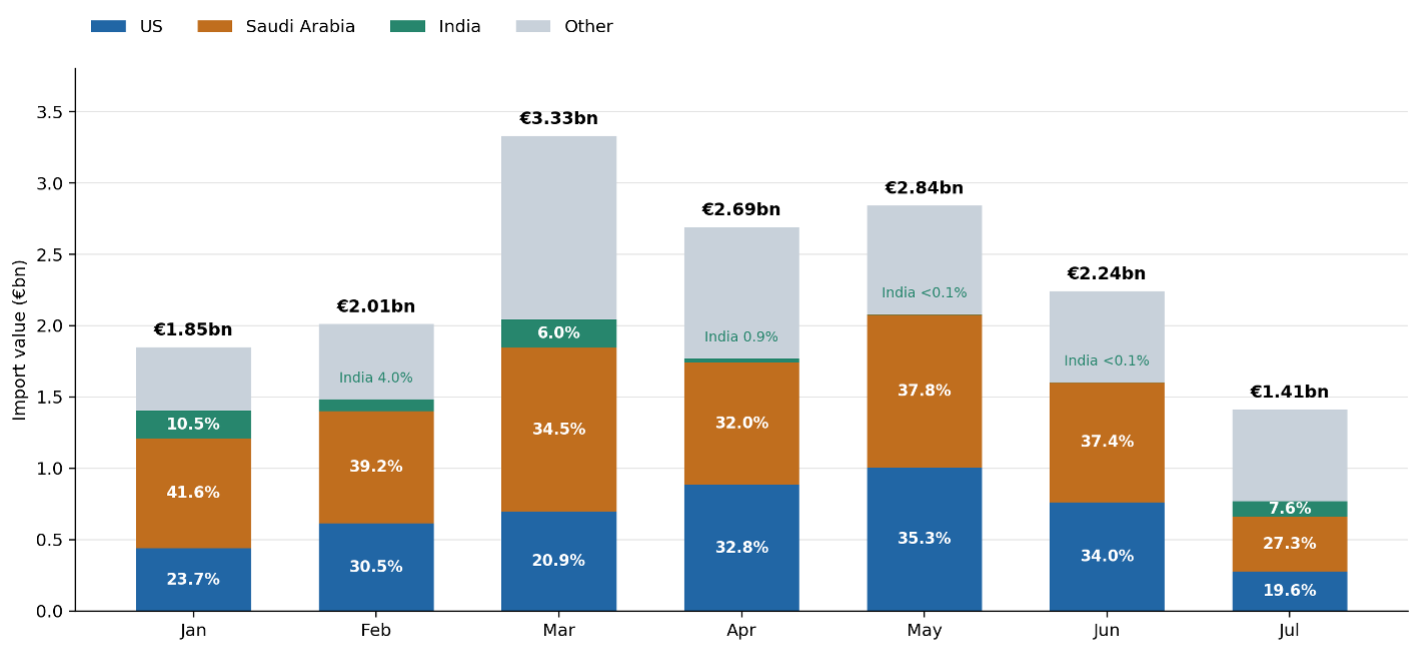 Note: EU27 imports from non-EU countries, CN 27101944 (diesel excluding biodiesel, sulphur content not exceeding 0.001%). Shares inside the bars are calculated from euro values; totals appear above each bar. Monthly data for August-September were not yet available.
Source: Eurostat Comext, DS-045409, data retrieved September 30 2026; European Commission statement reported by 2EU Brussels, September 24 2026. Author’s calculations.
The war against Iran has shown how quickly apparent diversification can become a common source of risk. Restricted traffic through the Strait of Hormuz reduced access to Gulf crude and refined products. A September attack on Saudi Arabia’s east-west pipeline then hit the alternative route to the port of Yanbu. Reuters reported that a corridor carrying about 4mn barrels a day was at risk. The Houthis later claimed attacks on facilities in Yanbu. Although Saudi exports partly recovered towards the end of the month, the sequence exposed the weakness of Europe’s supply strategy: an alternative route is not necessarily a secure one. When refineries and transport links fail, finding another seller of crude is not enough. Europe needs actual barrels of diesel that somebody can refine and deliver on time.
At precisely this moment, Ukrainian strikes are further reducing Russia’s output of refined products. The Financial Times estimated this summer that more than 30 per cent of actively used refining capacity, and about 45 per cent of nominal capacity, had been disabled. The strikes have also become more technically focused, targeting critical units that take time to repair and hitting them again during reconstruction. According to FT reporting cited by Meduza, US and French intelligence has helped identify air-defence gaps and target points. The military logic is clear: cut Russia’s revenues and fuel supply. But the economic effects do not stop at Russia’s border. Buyers deprived of Russian diesel turn to the same alternative suppliers as Europe. European governments are supporting operations whose costs return to them through higher fuel prices.
The bill has now reached the US as well. Reuters reported that US diesel exports were up by more than a fifth from a year earlier, while inventories stood at their lowest seasonal level in more than four decades. Retail prices reached about $6.50 a gallon. What is an opportunity for exporters is a cost for American hauliers, farmers and consumers. Ahead of the November midterm elections, it is also a direct political threat to Republicans. Donald Trump’s response was therefore rational: he backed the possibility of a diesel export ban, while the Treasury examined a full or partial restriction. In that calculation, European energy security competes directly with US pump prices and the electoral map.
The link with attacks on Russian refineries is more direct than the export-ban debate alone suggests. The Financial Times reported that Trump had asked Volodymyr Zelenskyy to halt the strikes because they were raising diesel prices and tightening supply. Pressure on Kyiv and the threat of export controls can therefore be read as two parts of the same priority: keep more fuel available for the US market before voters go to the polls. For European supporters of Ukraine’s strategy, the message is plain. Washington is unwilling to absorb unlimited domestic costs from the loss of Russian refining capacity. If it keeps fuel at home, importers – including its European allies – will bear more of the adjustment. It need not threaten European intelligence services explicitly. Control over supplies that Europe cannot easily replace is leverage enough.
European governments should finally reconcile their foreign policy with its economic balance sheet. Sanctions closed the direct Russian supply route. Several European allies also made bases and logistical support available for the US war against Iran, as Nato secretary-general Mark Rutte confirmed in comments reported by Reuters. Add European support for Ukrainian attacks that reduce the supply of refined products, and the contradiction becomes hard to ignore.
In economic terms, Europe is helping to create the very market risks to which it is most exposed. Higher diesel prices feed through transport, farming and manufacturing into food and other goods, squeezing real incomes. ECB vice-president Boris Vujčić has warned of precisely this danger. If the energy shock persists or intensifies, it will lift inflation and increase pressure on the central bank to tighten policy. Higher interest rates would then weaken investment and demand.
Europe risks repeating the experience of 2022-24: expensive energy weakens the economy, and the ECB’s fight against the resulting inflation weakens it again. A strategy that ignores these feedback effects leaves European households and companies paying a bill whose size is increasingly determined in Washington.
European voters will have their say too. In Germany, they are already presenting the bill. Elsewhere they will follow – and today’s political establishment is unlikely to enjoy the reckoning.


You must be logged in to post a comment.