TTF has more than doubled since the start of the year, while European storage is materially less well stocked than usual ahead of winter. This is not a repeat of 2022, but neither is it a temporary market disturbance without wider economic consequences.
Europe entered 2026 with gas prices low enough to support fairly optimistic predictions of a final normalisation of the energy market. The January TTF average was €27.6 per megawatt-hour, close to its level at the end of 2025. By early September, however, the prompt price had risen to roughly €70. This increase did not reflect a sudden surge in European demand. It resulted from the interaction of a geopolitical shock to the LNG market, depleted inventories after the winter of 2025–26 and more intense competition with Asian buyers.
It would be wrong to interpret the present situation simply as a replay of Europe’s 2022 gas crisis. That was a direct regional supply shock: Europe lost most Russian pipeline gas within a short period, before the infrastructure needed to replace it was in place. By 2026 the European system had become more diversified and physically more resilient. Norwegian imports are stable, LNG receiving capacity is larger and US cargoes have become central to European supply.
But the problem has not been solved; its nature has changed. Europe has reduced the probability of a physical shortage while becoming more exposed to the global price of LNG. Security of supply now depends on whether Europe is willing to outbid buyers in north-east Asia for flexible cargoes. The current TTF price therefore includes not only the cost of gas, but also a premium for geopolitical risk, constrained liquefaction and shipping capacity, and inadequate storage ahead of the heating season.
Figure 1. Monthly TTF index, January 2022–August 2026.
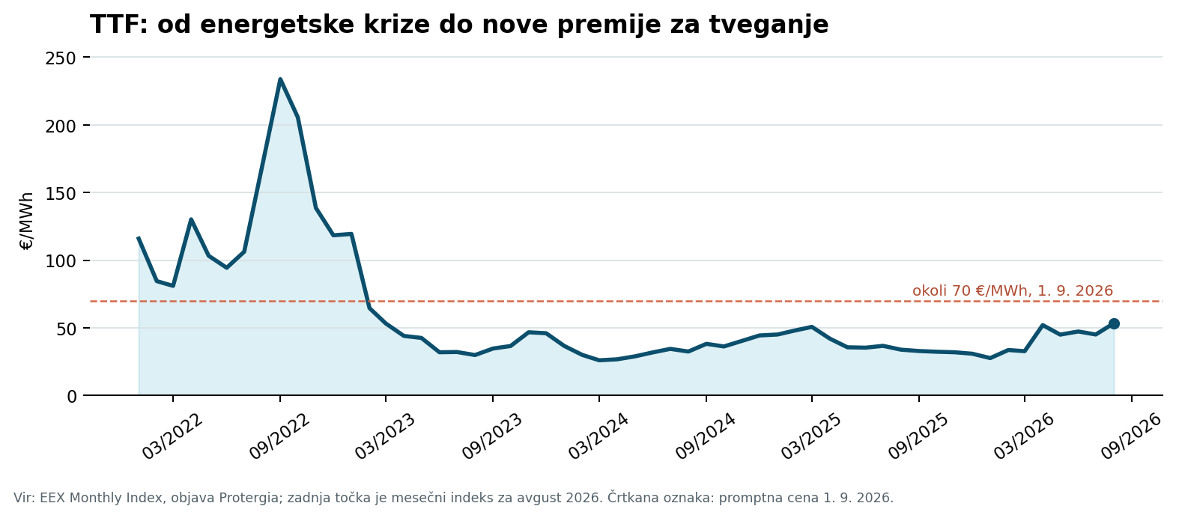 Source: EEX Monthly Index as published by Protergia; the prompt price on 1 September 2026 is shown separately.
Why TTF more than doubled in 2026
Price developments in 2026 can be divided into three phases. In January and February, the market assumed that high US production and the gradual expansion of global liquefaction capacity would prevent sustained price pressure. That assumption overlooked Europe’s poor starting position on storage. The winter of 2025–26 was colder, while gas use for heating and power generation was higher. By the end of the withdrawal season, stocks had fallen below 30 per cent of capacity, close to a nine-year low.
The second break came with the escalation of the conflict in the Middle East. Disruptions to Qatari export capacity and the growing risk to shipping through the Strait of Hormuz hit a market in which flexible supply was already scarce. ACER estimates that about 20 per cent of global LNG exports were exposed to the conflict. TTF rose by about 70 per cent in a single week, with day-ahead prices exceeding €60/MWh. The April monthly index reached €52.
The moderation in spring proved temporary. TTF moved back into a range of €45–47 in May and June, but the underlying supply constraint did not disappear. Qatar had not fully restored deliveries, US export terminals were operating close to available capacity, and European storage injections remained behind schedule. When Asian LNG demand increased in July and August, European prices began rising again. TTF exceeded €68 at the end of August and reached about €70 in early September, its highest level since early 2023.
The distinction between monthly averages and prompt quotations matters. The August index of €53.3 suggests a more moderate increase, but it incorporates the lower prices recorded during the first part of the month. For storage decisions, the price at the end of August is more relevant because the injection window is closing rapidly. This was precisely when gas became most expensive.
Out of the frying pan: Europe without Russian gas, between US supply and Asian demand
A comparison with the United States shows that Europe’s current price problem does not stem from a global shortage of natural gas in the narrow sense. The EIA forecasts Henry Hub at $2.87/MMBtu in the third quarter of 2026 and an average of $3.44 for the year. US production is at record levels, while end-October inventories are expected to be about 5 per cent above the five-year average. There is no comparable price pressure in the US domestic market.
The gap between Henry Hub and TTF is created along the export chain. US gas has to be liquefied, shipped, insured and regasified. More importantly, liquefaction capacity is limited and almost fully utilised in the short run. Cheap gas in the US pipeline system therefore does not translate automatically into cheap LNG in Europe. With Henry Hub near $3/MMBtu, the gas molecule itself costs less than €10/MWh, while TTF is close to €70. The difference reflects costs, but above all the rent generated by constrained export infrastructure and the associated risk premium.
US export capacity will expand. The EIA expects LNG exports to rise from 17.4bn cubic feet a day in 2026 to 18.6bn in 2027. This is the main reason why the forward market prices in lower levels from the second half of 2027 onwards. The effect will nevertheless be gradual. New terminals cannot make up Europe’s storage deficit within a few weeks, while maintenance at a large facility such as Freeport can remove a significant volume of supply at short notice.
Europe’s dependence on US LNG has meanwhile become substantial. According to ACER, the US supplied about 30 per cent of all EU gas imports in the winter of 2025–26 and roughly two-thirds of LNG imports. US deliveries increased by 45 per cent year on year. Diversification was necessary and, in physical terms, successful. Yet Europe’s political debate understates the new concentration of risk. Dependence on Russia has been replaced by greater dependence on US terminals, global shipping and the security of critical sea lanes.
At the same time, European gas prices are now roughly three times the pre-2022 price of Russian gas under long-term contracts in calm market conditions, four times higher during disruptions to global markets, and as much as seven times higher when such disruptions coincide with the need to refill European storage. Europe has replaced one dependency — on Russian gas — with another, on US LNG. Even under the most favourable conditions, it pays about three times as much; under the least favourable, up to seven times as much. If this is successful diversification, it is difficult to see much cause for champagne.
The other side of the equation is Asia. TTF and the Asian JKM benchmark moved closely together in 2026 because the two markets compete for the same flexible LNG. If the Asian price exceeds the European price after transport costs, cargoes are diverted east; if Europe offers the higher netback, they arrive at European terminals. Europe’s security of supply therefore depends to a considerable extent on its ability to displace the marginal Asian buyer. That reduces the risk of an outright volume shortage, but at the cost of potentially very high prices and forced reductions in industrial demand.
Storage refilling will determine the price of winter 2026–27
European storage was about 64.7 per cent full on 31 August, compared with a seasonal norm of roughly 82 per cent. A gap of about 17 percentage points is large, particularly because Germany, Europe’s largest storage system, was only slightly above half full at the end of August. With the injection season drawing to a close, reaching 90 per cent by the beginning of November is now virtually impossible without exceptionally high imports and a sharp reduction in current consumption.
ACER estimates that 80 per cent could be reached with average monthly LNG imports of about 11bn cubic metres, while 90 per cent would be considerably harder. Additional refilling could cost €10bn–€15bn. This is not an abstract cost: it will be paid by gas consumers, public budgets or both, depending on the chosen system of incentives and guarantees.
The unfavourable shape of the forward curve compounds the problem. Under normal conditions, the winter price is sufficiently above the summer price to cover financing, storage and losses. In 2026 the prompt or near-term price was often equal to, or higher than, the winter price. A trader buying gas in summer and selling it forward for winter therefore cannot cover all costs. The private incentive to inject is weak even though the social value of additional inventories is high.
This is a textbook divergence between private return and public interest, and the market will not correct it on its own. If governments require higher inventories for security of supply, they must also decide who bears the cost. Calling on traders to fill storage at a loss is not an energy policy. Subsidies and guarantees do not make refilling free; they merely transfer the cost to taxpayers or future network users.
Figure 2. Indicative TTF forward curve for winter 2026–27. Quotations from 28 August–1 September 2026;
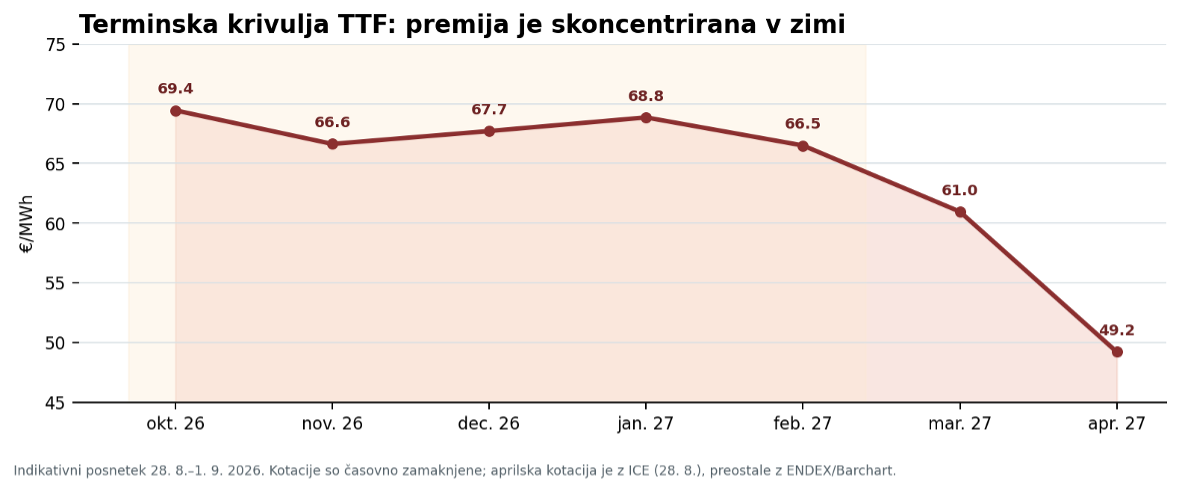 Sources: ICE Endex and ENDEX/Barchart.
Futures prices from October 2026 to January 2027 are in the upper €60s, falling towards €61 in March and about €49 in April. The market is therefore not pricing a repeat of the 2022 peak, but a tight winter followed by a material improvement in the balance. This is consistent with the expected growth in US LNG supply and the seasonal decline in European demand after winter.
The forward curve is not a reliable forecast, however, but the current price of protection against future risk. The base case for winter is a range of €60–75 if US deliveries remain stable, Qatari exports gradually normalise and the winter is not exceptionally cold. A mild winter combined with high wind and nuclear output could bring prices down towards €40–50 in the first quarter of 2027. If Qatari disruptions persist and Asian demand remains strong, TTF may temporarily need to exceed €100 to divert additional cargoes to Europe and suppress industrial demand. This is a stress scenario rather than the central forecast, but low storage means it cannot be dismissed.
High TTF prices are primarily a problem for European industry
At €60–70/MWh, an energy problem becomes directly an industrial competitiveness problem. The most exposed sectors are ammonia and fertilisers, chemicals, glass, ceramics, paper, steel and other metals. In these industries gas is not merely a fuel; it is often a feedstock or a technologically difficult-to-replace source of high-temperature process heat.
The gap relative to US prices is too large to be neutralised by efficiency improvements alone. European companies can hedge part of their consumption, reduce output or temporarily shut their least efficient plants. They cannot compete indefinitely with producers whose gas costs are several times lower. The consequences therefore appear not only in outright closures, but also in lower capacity utilisation, lost market share and the diversion of new investment to the US, the Middle East or Asia.
Europe’s energy-intensive industries have been under pressure since 2022. The renewed rise in TTF in 2026 means that the expected period of normalisation did not last long enough to restore investment predictability. Temporary subsidies may prevent immediate closures, but they do not remove the relative price disadvantage. Unless European policy addresses this through long-term contracts, faster electrification of industrial processes, more stable zero-carbon generation and quicker grid development, it will subsidise existing production without creating the conditions for new investment.
Gas remains an important driver of electricity prices
High gas prices feed into European electricity prices through marginal pricing. Bids in the day-ahead market are ordered by increasing marginal cost. The price of the most expensive plant still required to meet demand becomes the market price for all accepted generation in that hour and bidding zone. Because renewables and nuclear plants have low short-run marginal costs, gas-fired plants are often the last units accepted, particularly during hours of high demand, low wind output or after sunset.
With TTF at €65/MWh and a combined-cycle gas turbine operating at 55 per cent efficiency, fuel alone costs about €118/MWh of electricity. Adding roughly 0.36 tonnes of CO₂ per megawatt-hour and carbon allowances at €70–90 a tonne raises the cost by a further €25–32. Including other variable costs, the marginal cost of an efficient gas-fired unit is therefore about €145–155/MWh. It is higher for less efficient plants.
A useful rule of thumb follows: a €10/MWh increase in TTF raises the fuel cost of an efficient gas-fired plant by about €18/MWh of electricity. The pass-through to the average wholesale price is not identical in every hour because gas is not always the marginal technology. Even a limited number of gas-setting hours can nevertheless raise average supply costs and industrial forward prices substantially.
Marginal pricing is not itself the cause of high energy costs. Its purpose is to bring enough generation into the market and to reflect the cost of the final unit needed to meet demand. Europe’s problem lies in the supply structure: when renewable or nuclear generation is insufficient, the system still requires gas, whose price is set on the global LNG market. Proposals to separate gas and electricity prices administratively may redistribute costs in the short run, but they cannot eliminate the cost of marginal gas-fired generation. A durable solution requires more storage, more flexible demand, stronger interconnectors and more firm low-carbon generation, particularly nuclear and hydro.
Outlook for 2026–27
The most likely outcome for winter 2026–27 is high but manageable gas prices without a generalised physical shortage. Europe has sufficient import capacity and purchasing power to attract the LNG it needs. Low storage, however, means greater reliance on prompt deliveries and greater price sensitivity to cold weather, terminal outages and Asian demand.
The fundamentals for 2027 are more favourable. Additional US export capacity should loosen the global LNG market, and the forward curve already points to a material decline after the first quarter. The actual price will also depend on end-winter inventories. If Europe emerges from winter with storage again severely depleted, much of the additional supply will be absorbed by another refilling campaign. The decline in prices would then be slower than the current curve implies.
The central conclusion is therefore less reassuring than the official emphasis on successful diversification. Since 2022, Europe has reduced the risk of a direct interruption in supply, but it has not restored an energy model that is sustainable in price terms. The shift from Russian pipeline gas to global LNG has increased physical flexibility while exposing European industry to gas prices that are several times higher and more volatile. As long as gas-fired generation remains important in setting marginal electricity prices, the disadvantage will extend far beyond the gas market itself.
If this is what successful diversification of Europe’s gas supply after 2022 looks like, then Europe has not merely moved out of the frying pan and into the fire. It has weakened precisely those energy-intensive industries that supply the essential materials and components for clean technologies and digitalisation—the very sectors in which Europe aspires to compete with China—while locking in gas prices at three to seven times their previous levels and electricity prices at roughly twice their previous levels. Officials in Brussels may still be congratulating themselves and opening champagne. But sooner or later, they will have to confront the economic consequences of the policies they have pursued.


You must be logged in to post a comment.