In May, Sander Tordoir and Brad Setser published a widely discussed paper, China Shock 2.0: The Cost of Germany’s Complacency, arguing that Germany has become “ground zero” of a second China shock. Their case is powerful: rapidly expanding Chinese exports are squeezing German producers of cars, machinery, chemicals and aircraft not only in China, but increasingly in third markets and Europe itself. They estimate that the drag from falling net exports since 2023 amounts to roughly 3 per cent of German GDP, while Chinese car exports have already reached an annualised pace of 10mn vehicles — a level previously expected only by the end of the decade. But there is a danger in turning this diagnosis into a convenient monocausal explanation of Germany’s industrial malaise. Before concluding that Chinese industrial policy is killing German industry, we should ask a more uncomfortable question: how much of Germany’s present predicament was created by Germany itself?
Anyone presenting Germany’s industrial decline as primarily a China problem should first explain how Germany got here. The story did not begin with Chinese overcapacity or subsidised EVs. It began at home.
Wolfgang Münchau’s Kaput documents the increasingly dysfunctional nexus between German politics and its corporate establishment, which spent years defending a highly successful industrial model while underinvesting in the technologies that were about to disrupt it. Automation, software and digitalisation were treated less as an existential challenge than as something that could be accommodated within the old model. Adam Tooze has recently made a similar point about the car industry. German manufacturers were still earning record profits as late as 2023, yet had already fallen dangerously behind in the technological transition towards electric vehicles, batteries and software.
Germany’s failed Energiewende experiment compounded the problem. The decision to shut down its nuclear power plants while betting heavily on intermittent wind and solar power helped push electricity prices to roughly twice the levels German industry had previously enjoyed. This was followed by another major policy mistake: Germany’s support for Europe’s response to the war in Ukraine, which severed its industrial economy from cheap Russian gas and left German companies facing gas prices three to four times higher than before. In the space of a few years, Germany thus dismantled one of the foundations on which its industrial competitiveness had been built for decades: access to abundant and relatively cheap energy.
These were not external shocks imposed on an otherwise healthy industrial model. They were, to a considerable extent, the consequences of domestic and European policy choices. And they accumulated. Underinvestment in digital technologies, a delayed transition in the automotive industry, an increasingly expensive energy system and the loss of cheap Russian gas gradually undermined the foundations of German manufacturing competitiveness.
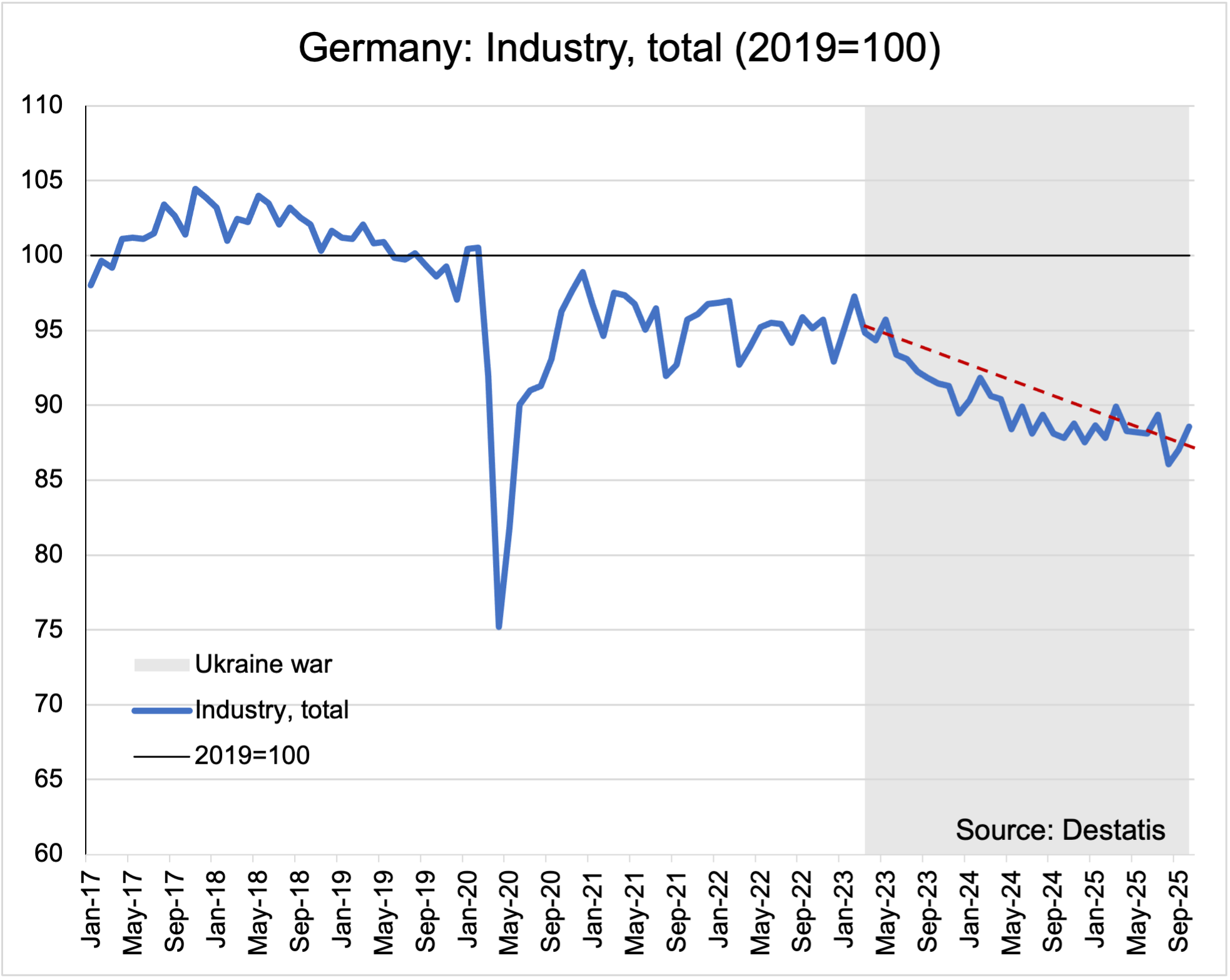
The resulting deindustrialisation did not start yesterday. The deterioration has been visible since around 2018 and has now developed into a much broader crisis of Germany’s export-oriented industrial model. What we are seeing today is therefore less a sudden Chinese assault on German industry than the delayed manifestation of weaknesses that Germany itself allowed to accumulate over many years.
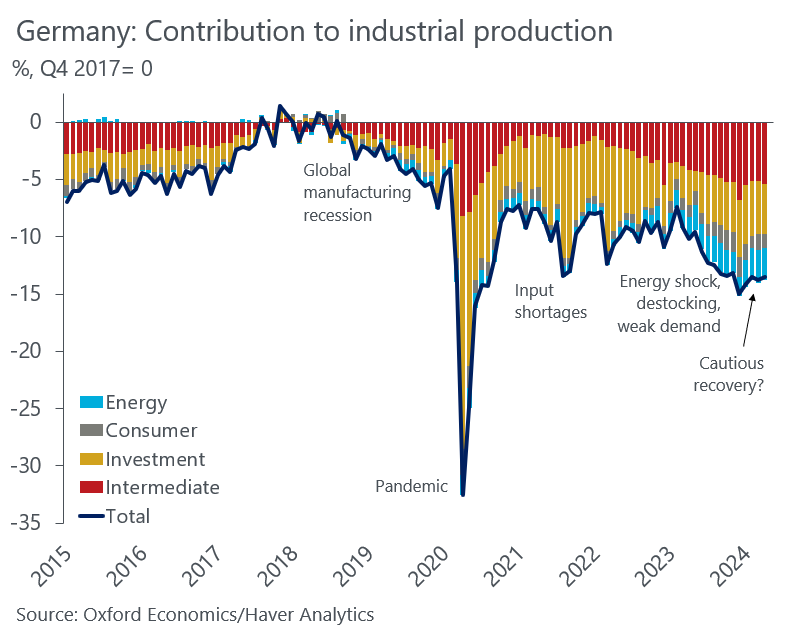
China certainly matters. Its extraordinary expansion in EVs, batteries, solar technology and advanced manufacturing is intensifying competitive pressure. But blaming China risks confusing the catalyst with the underlying disease. Beijing did not force Germany to close its nuclear plants, neglect digitalisation, delay the restructuring of its automotive industry or abandon the energy architecture on which much of its industrial competitiveness depended.
The obsession with Chinese “overcapacity” therefore serves a convenient political purpose. It shifts attention from a far more uncomfortable question: how much of Germany’s industrial crisis is actually the result of a remarkable sequence of self-inflicted German and European policy mistakes?


You must be logged in to post a comment.