Update: This "Super El Niño" will be perhaps the strongest in 500 to 1000 years, and could legitimately be the most extreme global weather or climate event experienced by humanity since the invention of the printing press. Only more extreme situation is a volcanic winter. https://t.co/OhilK9Dz5N pic.twitter.com/P3R8FUdvXo
— Ryan Maue (@RyanWeather) August 5, 2026
Hegemon na kredit: kako Amerika ogroža privilegij dolarja
Barry Eichengreen, profesor ekonomije in političnih ved na University of California, Berkeley, ter avtor knjige Money Beyond Borders: Global Currencies from Croesus to Crypto, velja za enega najbolj uglednih ekonomskih zgodovinarjev na področju mednarodnih financ, monetarnih sistemov in zgodovine globalnih rezervnih valut. V komentarju za Financial Times opozarja na na prvi pogled tehnično podrobnost nedavne skupne ameriško-japonske intervencije na deviznem trgu, ki pa po njegovem razkriva precej globlji problem: dolar kot globalna rezervna valuta ni več tako samoumevno varen in likviden instrument, kot je bil nekoč.
Povod je bila obsežna intervencija japonskih oblasti v podporo jenu, vredna približno 14 bilijonov jenov oziroma 88 milijard dolarjev. Eichengreen opozarja, da je tudi tako velik znesek glede na velikost globalnih finančnih trgov relativno majhen in da lahko brez spremembe temeljnih makroekonomskih pogojev povzroči le začasno apreciacijo jena. Če Bank of Japan ne bo hitreje zvišala obrestnih mer, bodo investitorji intervencijo preprosto izkoristili za prodajo jenskih vrednostnih papirjev in s tem ponovno pritisnili na jen. Japonska centralna banka se za zdaj zaradi šibkega domačega povpraševanja temu izogiba in ohranja ključno obrestno mero pri relativno nizkem 1 %.
Toda bistvo Eichengreenovega komentarja ni japonska monetarna politika, pač pa zanimivost, da se je intervenciji pridružilo ameriško finančno ministrstvo, prvič po več kot petnajstih letih. Še bolj zanimiv pa je način, kako je to storilo. Ameriško ministrstvo za finance je kupovalo jene s prodajo evrov in ne dolarjev oziroma dolarskih vrednostnih papirjev. Prav ta navidezno tehnična odločitev je po Eichengreenu ključna za razumevanje današnjega položaja dolarja.
Politični preobrat v Evropi na vidiku
Z antirusko, proizraelsko, militantno oboroževalno in “razogljičeno” energetsko in okoljsko politiko (t.j. protirazvojno politiko) ne moreš nahraniti ljudi. Lahko pa deindustrializiraš državo in pospešeno uničuješ delovna mesta (10,000 na mesec), spraviš ljudi na rob preživetja … in boostaš podporo t.i. “skrajnim” strankam z ljudem prijaznim programom (tipa AfD).
Evropska politična elita se bo sesula sama vase in čez kakšno leto bomo priča političnemu resetu s strankami, ki ne bodo ameriški in izraelski agenti, ki imajo rade Evropo in svoje državljane in ki jim želijo zagotoviti blaginjo. Ne pa služiti interesom ameriške finančne, orožarske in tehnološke oligarhije in interesom Izraela.
Tucker Carlson za precednika: Carlsonova vizija Amerike
Moj nadebudni nečak me že več kot pol leta, vedno, ko se srečava, prepričuje, da gre Tucker Carlson v predsedniško kampanjo. Običajno zamahnem z roko in rečem “pa kaj…”. Ampak zadeva se je začela odvijati z včerajšnjo najavo današnje objave ustanovitve novega političnega gibanja, ki bi lahko potencialno preraslo v tretjo resnejšo politično stranko v ZDA.
Že nekaj časa se špekulira, da naj bi se FBI lotil preiskovanja Carlsona, pred dvema letoma največjega medijskega podpornika Donalda Trumpa, zaradi Carlsonovih objav, ki naj bi bile v nasprotju z ameriškimi varnostnimi interesi. Toda Carlson si boljše kampanje ne bi mogel želeti. To, kar je zapor naredil za Janeza Janšo in zamenjava na čelu Gen-i za Roberta Goloba, bi preiskava (in morebiten zapor) lahko naredila za Carlsona. S tem bi avtomatsko preskočil finančno oviro pri medijskem pojavljanju in kontra kampanjo s strani izraelskega lobija.
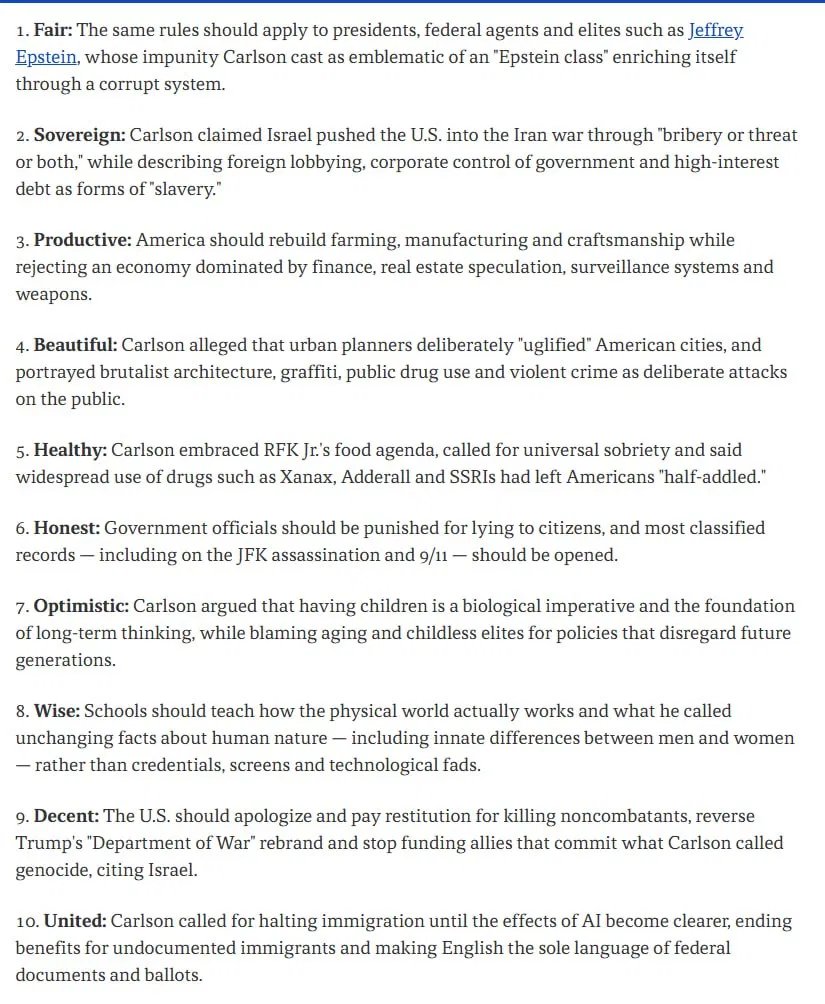
Axios je včeraj objavil 10 točk Carlsonovega programa (glejte spodaj). Jasno, program je zelo konzervativen – tudi za naše standarde, hkrati pa radikalen (odcepitev od interesov izraelskega lobija in proti podpori genocidnim politikam). Toda, kar se zdi najbolj fascinantno – in morda najbolj presenetljivo za tiste, ki nikoli niso bili v ZDA in imajo o “Ameriki” idealizirano predstavo iz starih ameriških filmov – je to, da se program zavzema za oblikovanje države, v kateri bi ljudje želeli živeti in v kateri bi lahko dostojno delali. Ja, Evropa (in sploh Slovenija) je za povprečnega Američana Indija Koromandija. Lepa, varna, zdrava in s socialno zaščito.
Carlsonov program je MAGA brez Trumpa in AIPAC.
China’s Development Success Exposes the Intellectual Limits of Faith in the Almighty Invisible Hand
The West calls China’s economic model “Leninist” now that it works. But China’s success reveals something far more uncomfortable: markets are exceptionally good at improving efficiency, but they cannot determine a country’s long-term development trajectory.
Is China Really Suffering from “Overcapacity”?
In a recent article, China won’t apologise for overcapacity, The Economist takes at a new paper by China’s Ministry of Commerce, in which Beijing rejects Western criticism of China’s alleged industrial overcapacity. The Chinese argument is straightforward: large export surpluses do not, in themselves, constitute evidence of overcapacity. The geography of global production has always changed over time – the United States once dominated global manufacturing, followed by other advanced economies, and today it is China. Nor is low capacity utilisation unique to China: more than one-fifth of industrial capacity in Europe and the United States is idle, yet nobody systematically describes this as an “overcapacity” problem. Likewise, export strength cannot in itself be proof of excess capacity; otherwise the same charge could be levelled at Boeing, which sells two-thirds of its aircraft abroad.
The Economist concedes that the Chinese ministry is also right to point to the genuine competitive strengths of China’s economy. A combination of innovation, large industrial clusters, economies of scale and extraordinarily intense competition in the domestic market has forced Chinese firms continuously to cut costs and improve quality. Companies that survive this competitive pressure in an enormous domestic market are exceptionally well prepared to compete globally. Nor can these achievements simply be dismissed as the result of subsidies. Chinese manufacturing and technological progress have, for example, contributed significantly to the dramatic decline in the global cost of electricity from solar and wind power. China’s industrial expansion has therefore generated substantial benefits for consumers around the world.
Nastaja tretja ameriška politična stranka (političnih superzvezdnikov)
Kitajski razvojni uspeh kot dokaz intelektualne inferiornosti vernikov v vsemogočno nevidno roko trga
The Economist v članku China won’t apologise for overcapacity izhaja iz novega dokumenta kitajskega ministrstva za trgovino, v katerem Peking zavrača zahodne kritike glede domnevnih presežnih industrijskih zmogljivosti. Kitajski argument je preprost: visoki izvozni presežki sami po sebi niso dokaz presežnih zmogljivosti. Struktura svetovne proizvodnje se skozi zgodovino spreminja – nekoč so v svetovni industriji dominirale ZDA, pozneje druge razvite države, danes Kitajska. Tudi nizka izkoriščenost proizvodnih zmogljivosti ni posebnost Kitajske, saj je več kot petina industrijskih zmogljivosti v Evropi in ZDA neizkoriščena, pa tega nihče sistematično ne označuje za problem »overcapacity«. Podobno visoka izvozna usmerjenost sama po sebi ne more biti dokaz presežnih zmogljivosti; sicer bi lahko enako očitali denimo Boeingu, ki dve tretjini letal proda v tujino.
Kitajsko ministrstvo po mnenju Economista upravičeno opozarja tudi na dejanske konkurenčne prednosti kitajskega gospodarstva. Kombinacija inovacij, velikih industrijskih grozdov, ekonomij obsega in izjemno ostre konkurence na domačem trgu je kitajska podjetja prisilila v nenehno zniževanje stroškov in izboljševanje kakovosti. Podjetja, ki preživijo takšno konkurenco na ogromnem domačem trgu, so nato izjemno dobro pripravljena na globalno konkurenco. Rezultatov ni mogoče preprosto odpisati kot posledico subvencij. Kitajska proizvodnja in tehnološki napredek sta denimo pomembno prispevala k več kot prepolovitvi globalnih stroškov električne energije iz sončne in vetrne energije. Kitajska industrijska ekspanzija torej za svetovne potrošnike ustvarja tudi velike pozitivne učinke.
Kako je Kitajska stabilizirala svetovni trg nafte po začetku vojne proti Iranu
Zgornji graf kaže “izginulo svetovno povpraševanje po nafti” po začetku ameriško-izraelske vojne proti Iranu, ki ga je generirala kitajska abstinenca pri uvozu nafte. Ta “abstinenčni šok” je bil tako velik (okrog 40 milijonov sodčkov do konca julija letos), da je preprečil eksplozivno rast cen nafte na svetovnem trgu.
Kitajska je po izbruhu vojne proti Iranu konec februarja 2026, ki je privedla do skoraj popolne zapore Hormuške ožine in izgube več kot deset milijonov sodčkov nafte dnevno, drastično zmanjšala uvoz surove nafte. Po podatkih carinskih organov in sledilnih podjetij, kot sta Kpler in Vortexa, se je kitajski uvoz zmanjšal s povprečnih 11,6 milijona sodčkov dnevno v letu 2025 na približno 7–8 milijonov sodčkov dnevno v drugem četrtletju 2026, pri čemer je dosegel najnižje ravni po letu 2016. Kumulativni primanjkljaj uvoza, kot ga prikazuje zgornji graf Javierja Blasa, bi lahko do konca avgusta presegel 450 milijonov sodčkov. To je pomembno prispevalo k ponovni vzpostavitvi ravnovesja med svetovno ponudbo in povpraševanjem ter preprečilo ekstremne skoke cen nafte nad 100 oziroma celo 200 dolarjev za sodček.
Ključni razlog za to prilagoditev so bile izjemno velike strateške in komercialne zaloge, ki jih je Kitajska sistematično gradila v prejšnjih letih, zlasti v letu 2025, ko so bile cene nizke, na voljo pa so bili tudi veliki popusti na sankcionirano iransko in rusko nafto. Ocene Ameriške uprave za energetske informacije (EIA) in drugih analitikov kažejo, da je Kitajska do konca leta 2025 razpolagala s približno 1,3–1,5 milijarde sodčkov rezerv – daleč največjimi zalogami na svetu, kar ustreza več kot stotim dnevom povprečnega obsega uvoza. Te zaloge so omogočile intenzivnejše črpanje komercialnih zalog (ocenjeno na 0,5–1 milijon sodčkov dnevno v posameznih mesecih) ter omejeno uporabo strateških rezerv, ne da bi bilo treba agresivno kupovati na svetovnem trgu.
Evropa je izgubila prihodnost, Slovenija je ne sme
Ko je Francis Fukuyama leta 1992 objavil znamenito knjigo Konec zgodovine in poslednji človek, se je zdelo, da je njegova teza povsem skladna z razmerami tedanjega časa. Razpad Sovjetske zveze, združitev Nemčije, širitev Evropske unije in nesporna gospodarska ter vojaška prevlada ZDA so ustvarjali vtis, da je liberalna demokracija postala univerzalni politični model, tržno gospodarstvo pa edina učinkovita organizacija sodobne družbe. Zahodne države so ustvarjale večino svetovnega BDP, obvladovale globalne finančne tokove, mednarodno trgovino, tehnološki razvoj in ključne mednarodne institucije. Svetovna trgovinska organizacija, Mednarodni denarni sklad in Svetovna banka so predstavljali institucionalni okvir globalizacije, ki je temeljil na pravilih, oblikovanih predvsem v Washingtonu in Bruslju. Zdelo se je, da bo nadaljnja liberalizacija svetovne trgovine postopoma razširila zahodni razvojni model tudi na preostali del sveta.
Razvoj zadnjih treh desetletij je pokazal, da je bila ta predstava iluzorna. Svet ni postal enopolaren, temveč se postopno preoblikuje v multipolarno ureditev, v kateri se gospodarska in tehnološka moč vse hitreje selita proti Aziji. Hkrati se spreminja tudi narava mednarodnega tekmovanja. Če je bila v obdobju hladne vojne odločilni element nacionalne moči predvsem vojaška sposobnost države, danes vse večjo težo pridobivajo tehnološko vodstvo, produktivnost, nadzor nad kritičnimi surovinami, energetska varnost, umetna inteligenca in sposobnost obvladovanja globalnih dobavnih verig. Geopolitika se zato vse bolj spreminja v geoekonomijo. Države tekmujejo predvsem s svojo sposobnostjo ustvarjanja novih tehnologij, organiziranja industrijske proizvodnje in zagotavljanja dolgoročne gospodarske konkurenčnosti.
Unable to escalate his way out, Trump tries to bluff his way out of the self-inflicted debacle
Odličen naslov, ki sem ga vzel iz tega komemtarja (seveda odličnega Trite Parsija):
Yet another apocalyptic threat, followed by another self-congratulatory climbdown. The pattern is becoming tiresome by now: Unable to escalate his way out of the self-inflicted debacle, Trump tries to bluff his way out.
Except, Tehran is not falling for it. Rather, it is confidently raising the stakes, calculating that Trump will only fully commit to a diplomatic solution once he has internalized that he does not have a military option.
It’s a risky strategy – with potential attacks in Egypt and cyber attacks in the US – but one that the new and far less restrained military leadership believes is more likely to achieve security than giving in to Trump.
So the next few days will undoubtedly be eventful and leave us with much to discuss. I am scheduling our next Q&A session for Friday, August 7, at 2.00 pm ET.


You must be logged in to post a comment.