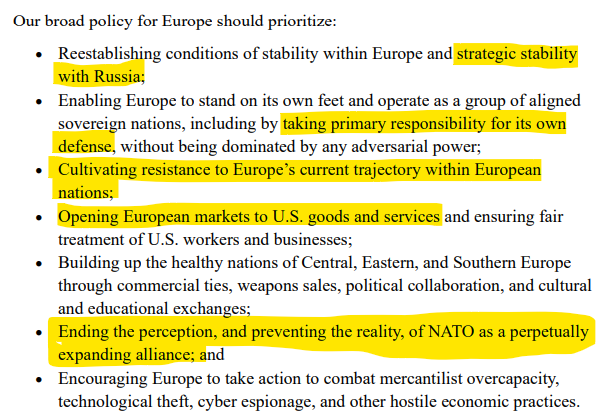
The new U.S. National Security Strategy creates conditions that should encourage Europe to assume greater autonomy, strategic maturity, and developmental focus. The American move away from EU-level federalisation towards supporting stronger national sovereignty provides EU member states with an opportunity to break from the Union’s overregulated, economically damaging, and increasingly militarised policy trajectory. These changes may also enable Slovenia to pursue a more pragmatic and balanced foreign policy — strengthening ties with the United States while re-engaging Eurasian partners in support of long-term stability and national competitiveness.
The new U.S. National Security Strategy for 2025 has triggered a wave of disbelief, criticism, and anxiety across many European political circles. Yet rather than a cause for alarm, this document represents an opportunity for Europe to finally assume responsibility for its own future. The strategy exposes a truth that Europe’s political class has pushed aside for decades: the United States has not always been a benevolent guarantor of European security, but a great power that used Europe as a platform for pursuing its strategic interests vis-à-vis Russia, while Europe itself remained intellectually and politically incapable of developing genuine strategic autonomy.
Contrary to the shocked and dismayed commentary circulating among political analysts, the new U.S. National Security Strategy does not, in my view, represent a negative development for Europe. Quite the opposite. This strategy offers Europe an opportunity — indeed, it compels Europe — to become more autonomous and finally grow up politically. This is an argument I have advanced repeatedly over the years.

 DAMIJAN blog
You must be logged in to post a comment.