Evropski politiki znajo lepo govoričit in se držati za rokce ter streljati odločne govore, nimajo pa niti toliko, da bi Ukrajincem plačali burek, kaj šele, da bi se šli tja borit in pregnat Ruse. Popolni bleferji in diletanti.
Author Archives: jpd
Kako ceneje zgraditi jedrsko elektrarno?
Drago Babič
Slovenija se na energetskem področju sooča s tremi izzivi:
- Kako zagotoviti dovolj energije za povečanje blaginje prebivalstva vsaj na povprečje Evropske Unije?
- Kako doseči podnebne cilje, predvsem zmanjšanje emisij toplogrednih plinov, ki nastajajo pri uporabi fosilnih goriv?
- Kako doseči navedene cilje ob zanesljivi in ekonomsko konkurenčni dobavi energije in s čim manjšim negativnim vplivom na okolje?
Da bi dosegli te cilje hkrati in usklajeno, bo potrebno v čim večji meri opustiti uporabo fosilnih energentov na osnovi ogljika in jih nadomestiti z viri energije, ki v proizvodnji in uporabi ne sproščajo toplogrednih plinov, kot je ogljikov dioksid (CO2), so torej brez ogljični. Najprimernejši tak vir je električna energija, ki jo zaradi svoje univerzalnosti lahko uporabimo za skoraj vse namene končne rabe energije, tudi v prometu, industriji in ogrevanju. Mora pa biti proizvedena iz brezogljičnih virov, to je obnovljivih virov (voda, veter, sonce) ali jedrske energije. Ti viri morajo biti optimalno izbrani in kombinirani, da dosežemo vse cilje energetskega prehoda.
Če pogledamo države, ki so pri tem najuspešnejše, prevladujejo tiste, ki imajo med viri za proizvodnjo električne energije tako obnovljive vire kot jedrsko energijo. Glede na specifične naravne pogoje imajo lahko v sestavi energetskih virov več obnovljivih virov, kot Brazilija, Švedska, Švica, ali večino jedrske energije, kot Francija. Države, kjer temelji oskrba z električno energijo samo na obnovljivih virih, so zelo redke in temeljijo pretežno na hidroenergiji (Norveška, Paragvaj), ne pa na soncu in vetru. Jedrska energija v mešanici virov zagotavlja osnovno energijo v pasu in stabilnost celotnega sistema, kar sami obnovljivi viri vetra in sonca ne zmorejo, kot se je izkazalo pred kratkim v Španiji.
New York Times o sistemski korupciji v Ukrajini in sistematičnem sabotiranju nadzora nad porabo donatorskega denarja
New York Times je objavil raziskavo o korupciji v Ukrajini in ugotovil, da je sistemske narave in da je Zelenski načrtno sabotiral nadzor nad porabo denarja oziroma koruptivnimi praksami. Oziroma da je s sistematskim saboriranjem oblikovanja nadzornih organov omogočil razcvet sistemske korupcije. Evropski politiki priznavajo, da je korupcija v Ukrajini ogromna, vendar da je to potrebno tolerirati, ker je v vojni z Rusijo.
When Russian troops invaded Ukraine, Kyiv’s Western allies faced a dilemma: how to spend billions supporting a government fighting Russia without watching the money vanish into the pockets of corrupt managers and government officials.
The stakes were high because Ukraine’s vital wartime industries — power distribution, weapons purchases and nuclear energy — were controlled by state-owned companies that have long served as piggy banks for the country’s elite.
To protect their money, the United States and European nations insisted on oversight. They required Ukraine to allow groups of outside experts, known as supervisory boards, to monitor spending, appoint executives and prevent corruption.
Over the past four years, a New York Times investigation found, the Ukrainian government systematically sabotaged that oversight, allowing graft to flourish.
President Volodymyr Zelensky’s administration has stacked boards with loyalists, left seats empty or stalled them from being set up at all. Leaders in Kyiv even rewrote company charters to limit oversight, keeping the government in control and allowing hundreds of millions of dollars to be spent without outsiders poking around.
O stimuliranju donosov na kapital in obdavčitvi visokih dohodkov iz dela
Bine Kordež
V zadnjem obdobju pogosto beremo o razvoju kapitalskega trga v Sloveniji. Običajno izhodišče tovrstnih člankov in izjav je v dejstvu, da imamo Slovenci ogromno finančnih sredstev na bankah, kjer po splošnem prepričanju ležijo »mrtve«. Z razvojem kapitalskega trga bi ta sredstva aktivirali in jih usmerili v razvoj, v financiranje potreb gospodarstva ter večjih infrastrukturnih naložb. Vse to naj bi pospešilo gospodarski razvoj, zaradi česar država takšna vlaganja spodbuja tudi z davčnimi razbremenitvami. Vsaj tako lahko razumemo pogoste objave in tudi nastope predstavnikov države.
Ob tej vsesplošni podpori kapitalskim vlaganjem, pa vseeno ni odveč še nekaj dodatnega vpogleda v učinke tovrstnih naložb. Značilno je namreč tudi, da prednosti teh naložb močno izpostavljajo razni finančni posredniki oziroma osebe zaposlene v finančni industriji posredništva. Najbrž se ne bomo veliko zmotili, če ocenimo, da prvenstveno najbrž zaradi lastnih zaslužkov in ne toliko zaradi skrbi za donose lastnikov premoženja. Drži, da je to sicer povezano, a posredniške provizije so praviloma na prvem mestu poplačila iz donosov, tudi če so ti minimalni.
Stoletje ponižanja v strategije izpraznjeni Evropi
We are on the eve of modern Europe’s most humiliating defeat. Donald Trump is pushing ahead with his peace plan for Ukraine, and there are no Europeans in the room. I am not surprised. The Europeans have no strategy of their own to end the war. All they want is to frustrate the peace process, for they have no agreed strategy to deal with post-war Ukraine.
How did Europe get in a position where it has no strategic choices left? It is quite a reversal. Machiavelli, an Italian, was one of the early architects of modern strategic thinking. Strategic diplomacy reached a peak with Metternich and Talleyrand, the foreign ministers of Austria and France: each played an instrumental role in the Congress of Vienna. This was the ultimate peace conference, one that provided Europe with stability and security for a century. After the Second World War, the diplomatic giants were mostly Americans such as George Marshall, George Kennan and Henry Kissinger.
Beside the chess-board type diplomatic strategist, there is another kind: the long-term strategic actor. The most successful modern example is China. China’s transformation began with the Third Plenum of the 11th Central Committee in 1978, at which Deng Xiaoping launched his economic reforms. It took three or four decades until these reforms translated into geopolitical power. During the transformation, uninformed Western opinion held that China was becoming more Western. The genius of the Chinese project was that it led others to underestimate it.
…
I find it personally painful to watch Kaja Kallas, the EU’s high representative for foreign and security policy, make a fool of herself with variably informed war-mongering discourse that lacks any strategic content. But she is not the only one. I have yet to identify a single official in any national capitals, including London, who has a strategy to end the Ukraine war. There is no one who has done the maths of the military capabilities Ukraine would need, on the logistics of how to produce or procure it. There is also no strategy whatsoever on how to finance it.
Belgija ne pomaga Rusiji. Belgija poskuša rešiti Evropo pred Evropo samo
EU se pripravlja storiti finančni samomor, obenem pa si domišlja, da gre za dejanje moralnega poguma. A napaka je misliti, da gre zgolj za to, da bo evro izgubil status rezervne valute. Ne. Gre za nadzorovano rušenje ostankov povojnega finančnega reda iz leta 1945.
In tragedija je: Rusija ni rabelj. EU je.
Zaseg zamrznjenih ruskih suverenih sredstev ni sankcija. Ni “pritisk”.
Ni moralno dejanje. Je najhujši napad na temelje globalnih financ po letu 1944 — in Evropa ga izvaja proti sebi.EU to imenuje “reparacije”. Zgodovina bo to imenovala ekonomska evtanazija.
Ko enkrat ukradeš centralne rezerve velike sile, uničiš koncept varnih suverenih sredstev povsod na svetu. Suverena imuniteta preneha obstajati. Nevtralno skrbništvo preneha obstajati. Verodostojnost evra se sesuje. Povojni red umre. In z njim zadnji preostali steber evropske moči.
Ruski simetrični in zakoniti protiukrepi — nacionalizacija zahodnega premoženja, likvidacija evropskih naložb — bodo boleči. Toda pravi ubijalec ne bo ruski odgovor, temveč nepopravljiv kolaps globalnega zaupanja v zahodne skrbnike kapitala.
En sam zaseg. En sam precedens. En sam trenutek, ko se trezor odpre na stežaj.
In vsak guverner centralne banke od Rijada do Jakarte si zamrmra isto misel:
»Če lahko to storijo Rusiji danes, lahko to storijo nam jutri.«
Strategic Implications of the New U.S. National Security Strategy for Europe and Slovenia
The new U.S. National Security Strategy creates conditions that should encourage Europe to assume greater autonomy, strategic maturity, and developmental focus. The American move away from EU-level federalisation towards supporting stronger national sovereignty provides EU member states with an opportunity to break from the Union’s overregulated, economically damaging, and increasingly militarised policy trajectory. These changes may also enable Slovenia to pursue a more pragmatic and balanced foreign policy — strengthening ties with the United States while re-engaging Eurasian partners in support of long-term stability and national competitiveness.
The new U.S. National Security Strategy for 2025 has triggered a wave of disbelief, criticism, and anxiety across many European political circles. Yet rather than a cause for alarm, this document represents an opportunity for Europe to finally assume responsibility for its own future. The strategy exposes a truth that Europe’s political class has pushed aside for decades: the United States has not always been a benevolent guarantor of European security, but a great power that used Europe as a platform for pursuing its strategic interests vis-à-vis Russia, while Europe itself remained intellectually and politically incapable of developing genuine strategic autonomy.
Contrary to the shocked and dismayed commentary circulating among political analysts, the new U.S. National Security Strategy does not, in my view, represent a negative development for Europe. Quite the opposite. This strategy offers Europe an opportunity — indeed, it compels Europe — to become more autonomous and finally grow up politically. This is an argument I have advanced repeatedly over the years.
Washington si želi spremembo političnega režima v Evropi
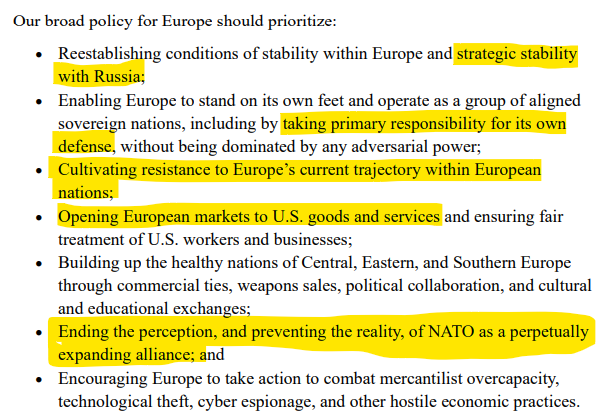
Nova ameriška strategija nacionalne varnosti je glede Evrope brutalno neposredna glede prioritete “kultiviranja odpora med evropskimi državami do trenutne usmeritve Evrope“. To efektivno pomeni cilj menjave kursa evropskih politik oziroma spremembo režima.
The section on Europe in the U.S. National Defense Strategy demonstrates just about zero respect for European sovereignty. In many ways it’s even more hostile than towards China.
In particular they will make it their priority to “cultivate resistance to Europe’s current trajectory within European nations”: how insane is that? The U.S. effectively wants to regime change Europe.
I’m the first guy to say that the current EU leadership is horrendous, but precisely because they’re just spineless vassals with no independent voice or respect for their own countries’ interests. If the U.S. wanted to genuinely help, it should pull back on interference, not double down…
Other priority: “Ending the perception, and preventing the reality, of NATO as a perpetually expanding alliance.” Which is an immense departure from the previous few decades (a welcome one IMHO).
They will also:
-
Pull back from defending Europe (Europeans should take “primary responsibility for its own defense”, also welcome IMHO)
-
“Open European markets to U.S. goods and services”, which is pretty comical just as the U.S. is closing itself down to others’ goods and services to reindustrialize…
-
“Build up the healthy nations of Central, Eastern, and Southern Europe”, which is a form of interference too because those are precisely the countries that are generally more friendly to the U.S. They undoubtedly do so as a way to balance the French and German.
-
Nova ameriška strategija nacionalne varnosti in priložnosti za Slovenijo
Za razliko od osuplih in zgroženih komentarjev v polju političnih analitikov se meni nova ameriška strategija nacionalne varnosti (2025) iz vidika interesov Evrope in Slovenije ne zdi slaba. Nasprotno. Menim, prvič, da ta nova ameriška strategija Evropi daje priložnost, bolje rečeno – jo prisiljuje, da se osamosvoji in da končno odraste. To, kar že nekaj let stalno poudarjam. In drugič, v skladu z mojimi številnimi razmišljanji menim, da je ameriški fokus stran od federalizacije pod bruseljsko taktirko k podpori večje nacionalne avtonomije in suverenosti dober iz razvojnega vidika za Evropo. Ta premik od dušečih enotnih evropskih politik, ki ubijajo konkurenčnost, inovativnost in razvoj, k večji vlogi nacionalnih politik pomeni priložnost za nov razvojni pospešek EU, ki je – kot zelo jasno kažejo številke – zastal prav z nastankom enotnega evropskega trga (1993) in evra (1999). Dokler je bila EU »samo« EGS (Evropska gospodarska skupnost), temelječa na carinski uniji in nekaj koordinacije ostalih politik (menjalni tečaji itd.) ter na avtonomnih nacionalnih razvojnih politikah brez dušeče regulacije iz Bruslja, je bila Evropa uspešna regija, ki je razvojno dohitevala ZDA. S »poglobitvijo« integracije je Evropa začela stagnirati in se danes razvojno povsem zaustavila.
Ta ameriška strategija nacionalne varnosti seveda pomeni oster odmik od “klasičnega” transatlantskega multilateralizma, na katerem sta EU in Slovenija zadnja desetletja gradili svojo vlogo. Jedro dokumenta je trda različica doktrine “America First”: ZDA bodo fokus zunanje politike drastično zožile na nekaj temeljnih interesov, obenem pa težo odgovornosti sistematično prelagale na zaveznice, ki naj prevzamejo “primarno odgovornost za svoje regije” in za svojo obrambo, tudi s ciljnim dvigom obrambne porabe Nata na 5 % BDP v okviru nove obrambne zaveze. To je za EU in manjše članice, kot je Slovenija, hkrati priložnost in šok terapija: priložnost, če znajo strateško izkoristiti prostor za večjo avtonomijo, in šok, ker se razbije udobna predpostavka, da bo ameriški varnostni dežnik avtomatsko pokril vsak evropski problem.
Radikalni premiki v novi strategiji nacionalne varnosti ZDA
Pravkar objavljena ameriška strategija nacionalne varnosti (2025) predstavlja radikalen premik v načinu, kako ZDA razumejo svojo vlogo v svetu in svoje temeljne nacionalne interese. Strategija izhaja iz ocene, da so se po koncu hladne vojne ameriški politični in diplomatski krogi ujeli v iluzijo, da je mogoče ohraniti globalno prevlado z visokimi stroški, razpršenimi cilji in napačno usmerjenimi zunanjepolitičnimi ambicijami. Dokument ostro kritizira pretekle strategije, ki so po oceni avtorjev izgubljale stik med cilji in sredstvi ter hromile sposobnost države, da se osredotoči na tiste izzive, ki resnično vplivajo na varnost in blaginjo ameriških državljanov.
Radikalnost te nove ameriške strategije je v popolnem prelomu z dosedanjo več kot 30-letno paradigmo enopolarnega sveta pod ameriško liberalno hegemonijo in prehod na Mearsheimerjevo paradigmo ravnovesja moči v multipolarnem svetu. V tem kontekstu je poudarjeno, da je predsednik Trump uvedel “nujen in dobrodošel popravek”, ki naj bi ameriško strategijo ponovno zasidral v konceptu nacionalnega interesa, suverenosti in pragmatične uporabe moči.
V osrednjem delu dokumenta je temu ustrezno jasno opredeljeno, da ZDA najprej zasledujejo lastno preživetje kot suverena republika, zaščito svojega ozemlja, prebivalstva, gospodarstva in načina življenja. Strategija izpostavlja popoln nadzor meja in popolno suverenost pri odločanju o migracijah kot osrednji varnostni temelj. Ob tem zahteva tudi obnovo robustne industrijske in energetske baze, ponoven vzpon proizvodnje ter tehnološko vodilno vlogo v svetu, saj je ameriška gospodarska moč ključna za uspeh vojaških in diplomatskih ciljev. Dokument poudarja potrebo po najmočnejši vojski na svetu, najsodobnejšem jedrskem odvračanju in razvoju obrambnega sistema »Golden Dome«, ki bi zagotavljal vrhunsko zaščito ameriškega ozemlja pred napadi.
Vloga ZDA v svetu je ponovno zamišljena skozi prizmo temeljnih nacionalnih interesov. Ti vključujejo stabilnost zahodne hemisfere, odprt Indo-pacifik s prostimi pomorskimi potmi, varnost Evrope, uravnoteženo ravnovesje v Bližnjem vzhodu brez ameriškega udejstvovanja v “večnih vojnah” ter globalno tehnološko vodstvo, zlasti na področju umetne inteligence, biotehnologije in kvantnih tehnologij. Opisano je, da je okoliščina, ki ZDA najbolj razlikuje od drugih velesil, njihova sposobnost povezovanja ekonomskih, vojaških in tehnoloških prednosti v koherentno strategijo, ki ščiti ameriške interese in oblikuje mednarodno okolje v ameriško korist.
 DAMIJAN blog
You must be logged in to post a comment.