Začela se igra medsebojnih obtoževanj v taborju izgubarjev. Angela Markel ima seveda prav. Vendar ne popolnoma. Igro so vodile ZDA, Poljska in baltske čivava države so zgolj koristni idioti v tej ukrajinski tragediji.
Merkel is absolutely right: Poland and the Baltic states enjoy a big responsibility for triggering the war by refusing to allow the European Council to engage in direct talks with Putin. But she forgets who was pulling the strings behind the scenes: Washington.
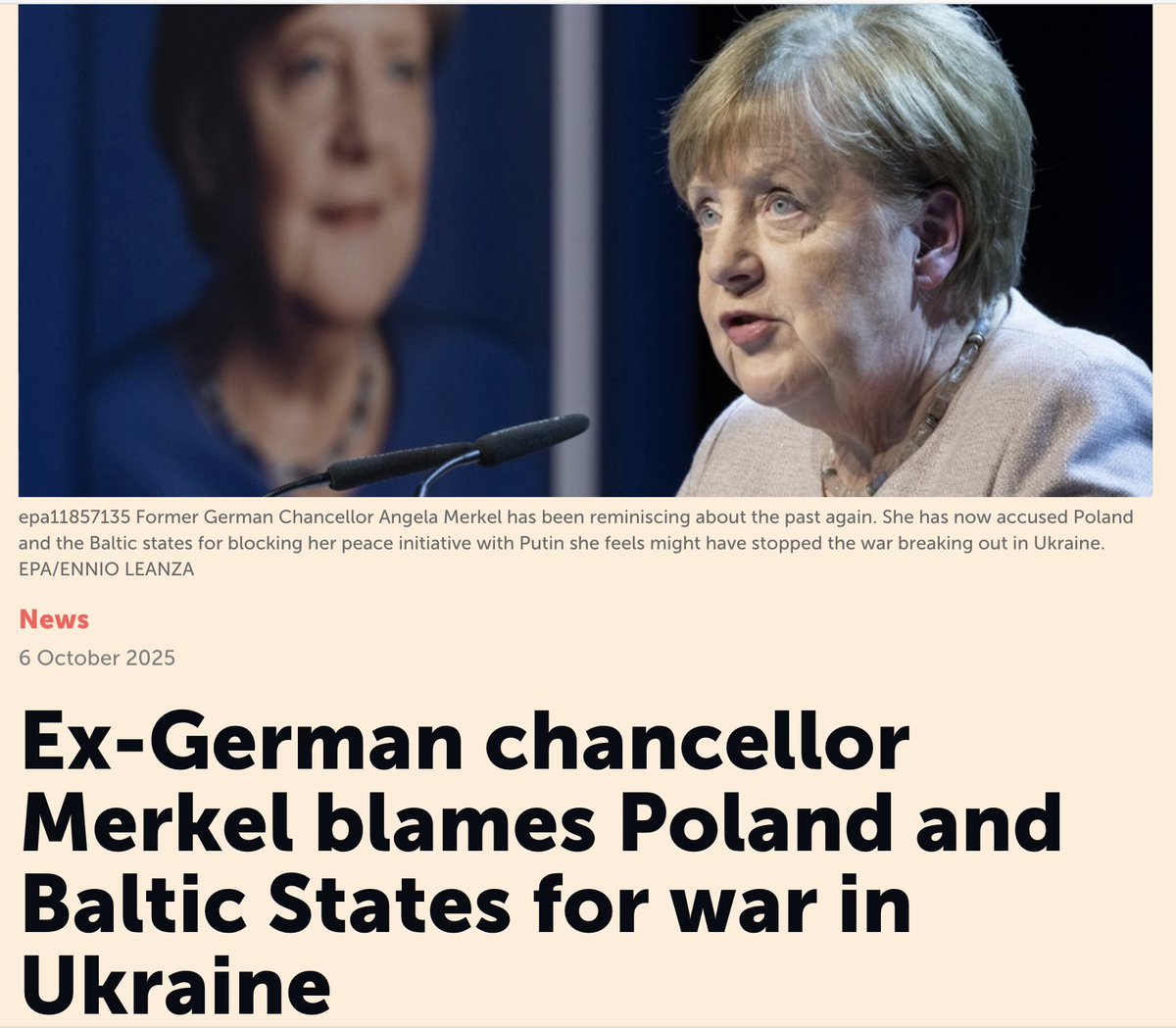
However, she mentions this in her memoir, which I reviewed a while back. In the book Merkel strongly defends her efforts to secure peace — or at the very least a ceasefire — in Ukraine. Her approach was grounded in the belief that “a military solution to the conflict, that is to say a Ukrainian military victory over the Russian troops, was an illusion”. She advised Ukraine’s new government that a resolution would not be possible without dialogue and diplomacy. This, she emphasised, did not mean “that Ukraine must not defend itself when its territory is invaded, but ultimately — and incidentally, this is not the only part of the world where this is true — diplomatic solutions must be found… I could even go so far as to say: there will be no military solution.”
However, it quickly became evident that the US had a different agenda. When President Obama informed her of plans to supply Ukraine with at least defensive weapons, Merkel voiced her “concern that any delivery of weapons would strengthen the forces within the Ukrainian government who hoped only for a military solution, even if that offered no prospect of success”. In her view, such actions risked emboldening extremist and ultranationalist factions within Ukraine — a development that, arguably, aligned with US strategic interests.
Her account also reveals that Putin was resolute in his desire to reach a diplomatic solution. However, it became increasingly clear that “the Minsk agreement wasn’t worth the paper it was written on”. Powerful forces — within Ukraine, the US and even Europe, particularly hawkish nations like Poland — were advocating for a military resolution to the conflict. Over time, these voices only grew louder.
Read the full article here
Vir: Thomas Fazi
 DAMIJAN blog
You must be logged in to post a comment.