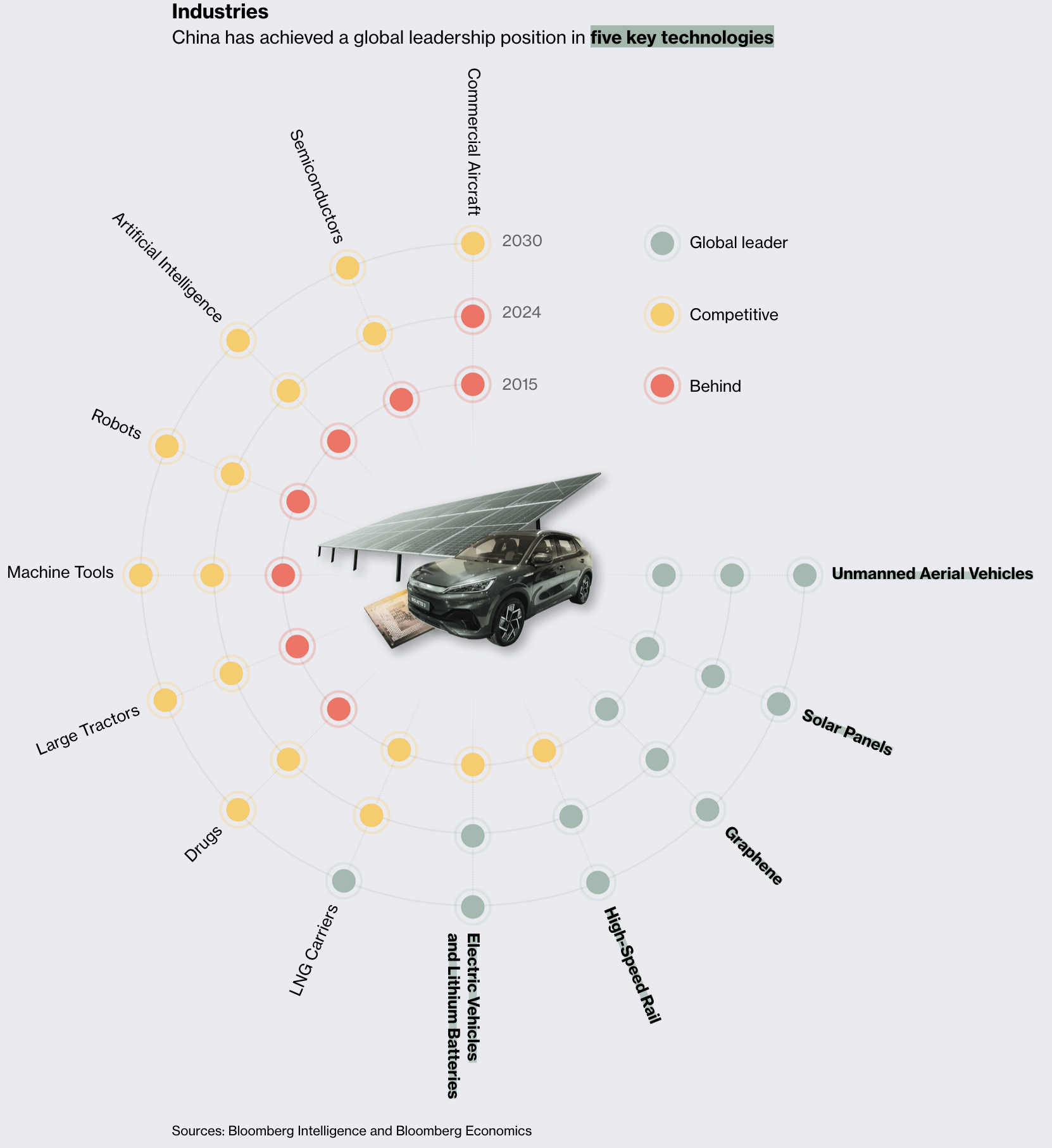
Zelo dober članek v Bloombergu izpred nekaj dni o kitajskem tehnološkem vzponu, ki ga ne Trumpovi in ne Bidenovi administraciji ni uspelo zaustaviti. Ne s carinami, ne s tehnološkimi sankcijami in prepovedmi izvoza tehnologije. Kitajski odgovor na to je bil oblikovan že pred Trumpom, imenoval se je Made in China 2025 iz maja 2015. V tem programu si je kitajska vlada zadala cilj, da pri 5 ključnih tehnologijah (od solarnih panelov do baterij in električnih avtov) v 10 letih (do 2025) postane vodilna v svetu. In te cilje je uresničila že v 8 letih. Kitajska strategija je bila: investiranje v znanje, raziskave in razvoj in tehnološka podjetja.
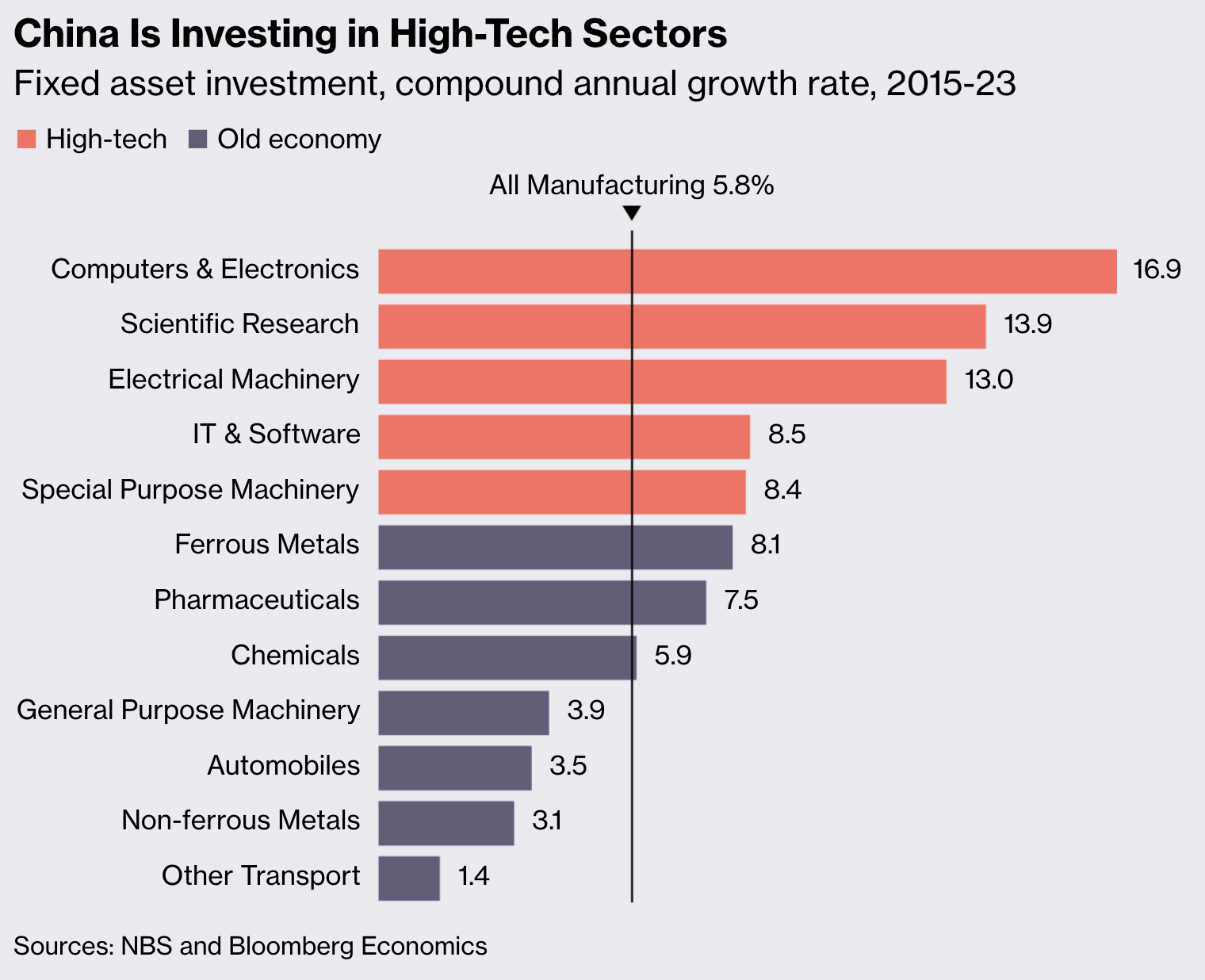
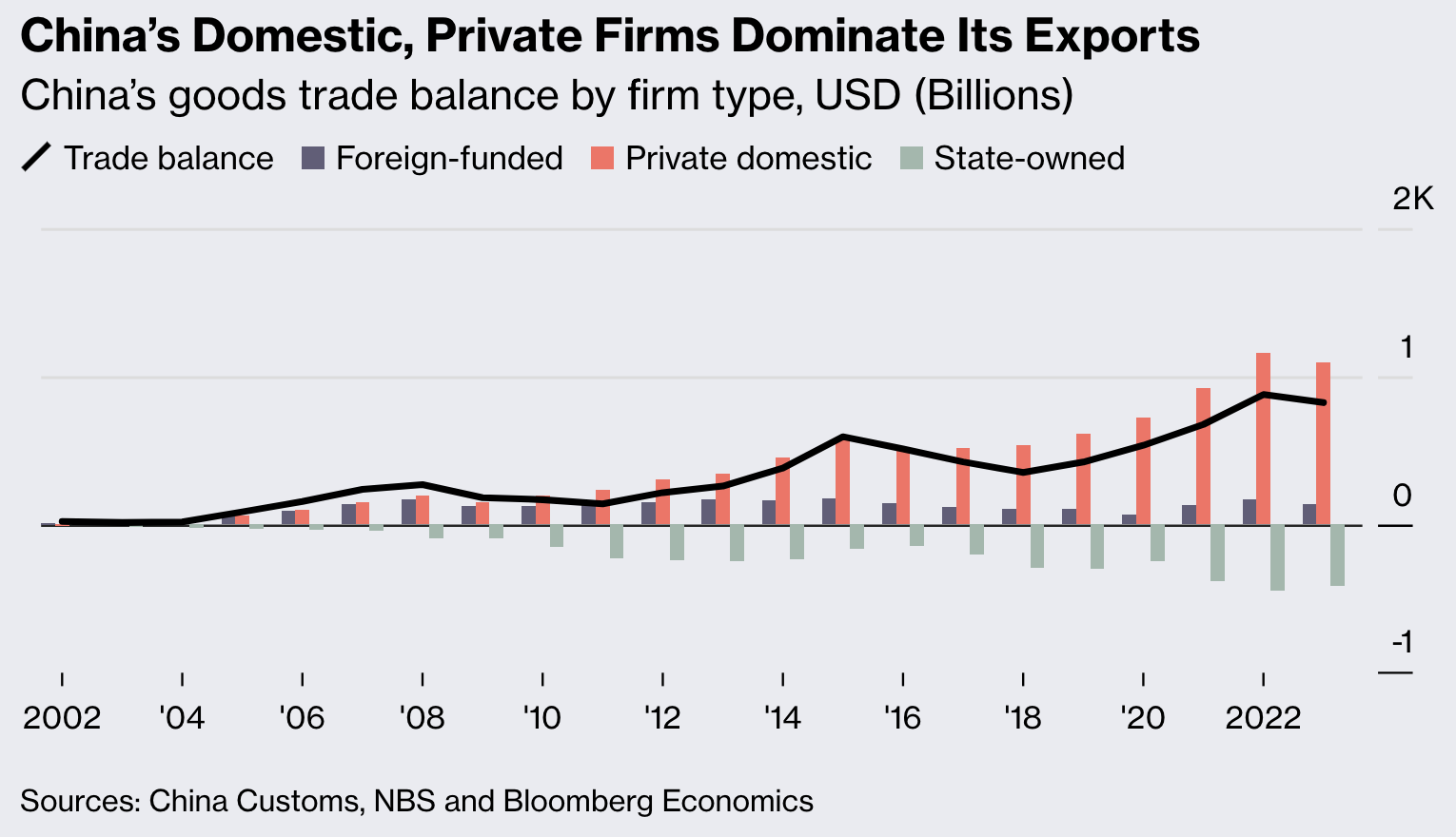
In ta kitajski tehnološki bum ne sloni na subvencijah ali državnih podjetijih, pač pa na vlaganjih zasebnih podjetij.
Game over za preostali svet. Game over, če upoštevamo velikost Kitajske – tako iz vidika absolutnega obsega znanja, absolutnega števila znastvenikov in inženirjev in velikosti domačega trga, ki omogoča ekonomije obsega na vseh področjih. Tudi če bi Kitajsko fizično zaprli znotraj njenih meja, bi ji njena velikost tudi v avtarkiji omogočila hitrejši razvoj. Seveda v primeru strategije in odločenosti oblasti, da razvojne cilje doseže.
Since Donald Trump hit Xi Jinping’s government with punitive tariffs in 2018, his push to cut the trade deficit has snowballed into a full-scale bipartisan effort to stop China from becoming the world’s biggest economy and obtaining technology that threatens American military superiority.
At a glance, the campaign appears successful. China’s economy is no longer on pace to overtake the US and is actually falling further behind. Its tech giants face difficulty obtaining advanced chips to develop artificial intelligence. And US allies are complying with requests to deny China access to the best chip-making equipment, including one-of-a-kind machines from Netherlands-based ASML Holding NV.
But despite more than six years of US tariffs, export controls and financial sanctions, Xi is making steady progress in positioning China to dominate industries of the future. New research by Bloomberg Economics and Bloomberg Intelligence shows that Made in China 2025 — an industrial policy blueprint unveiled a decade ago to make the nation a leader in emerging technologies — has largely been a success. Of 13 key technologies tracked by Bloomberg researchers, China has achieved a global leadership position in five of them and is catching up fast in seven others.
That means the world outside the US is increasingly driving Chinese electric vehicles, scrolling the web on Chinese smartphones and powering their homes with Chinese solar panels. For Washington, the risk is that policies aimed at containing China end up isolating the US — and hurting its businesses and consumers.
“China’s technological rise will not be stymied, and might not even be slowed, by US restrictions,” said Adam Posen, president of the Washington-based Peterson Institute for International Economics, who has conducted research for governments and central banks around the world. “Except those draconian ones that simultaneously slow the pace of innovation in the US and globally.”
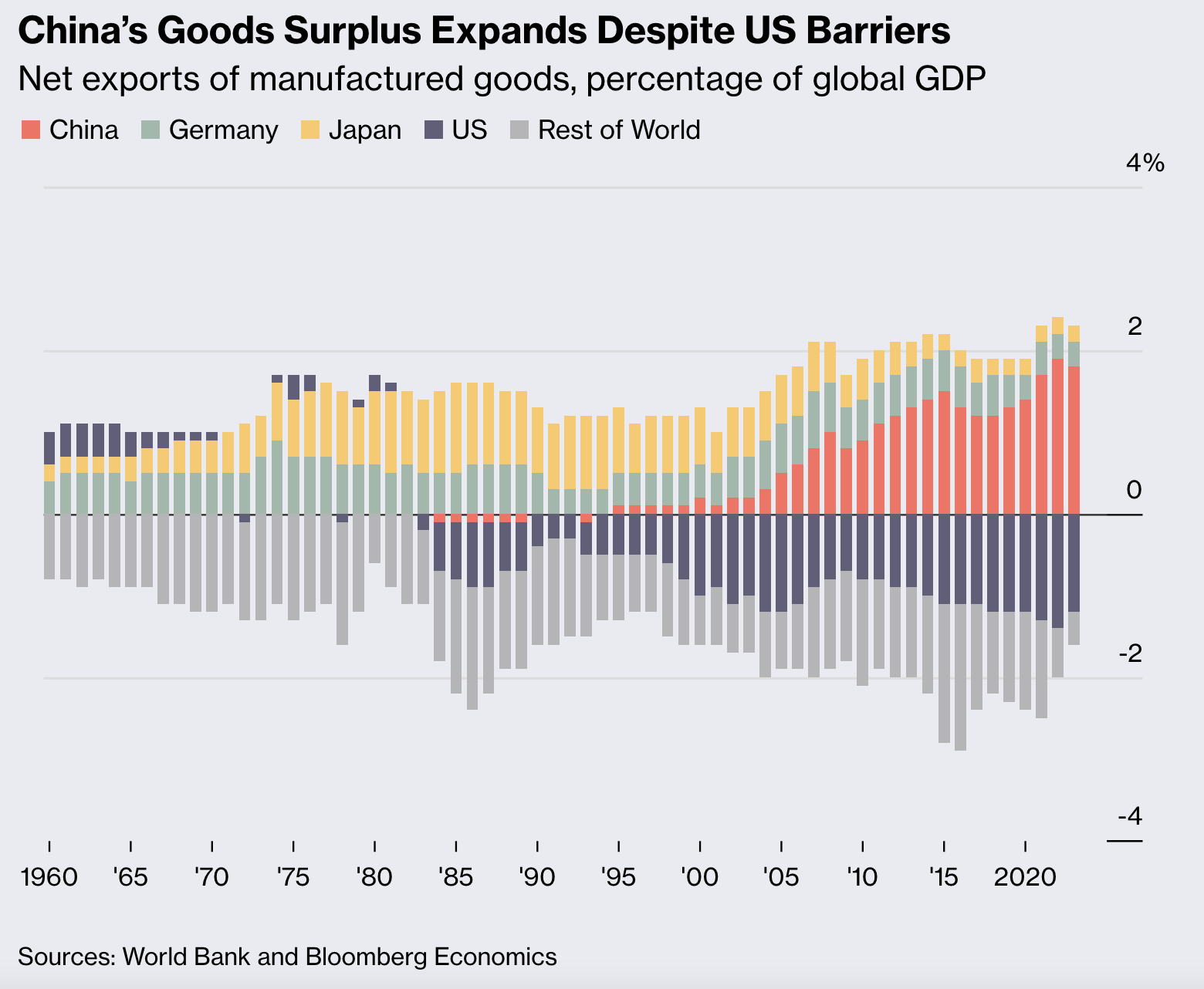
China’s production prowess is at historic heights: Its manufactured goods trade surplus is the largest relative to global GDP of any country since the US right after World War II. Chinese companies like BYD Co. and Contemporary Amperex Technology Co. Ltd., known as CATL, are world leaders in making goods such as EVs, batteries and solar panels — the pillars of Xi’s “new productive forces” to drive growth as authorities seek to deflate a property bubble.
While the Biden administration has stabilized US-China ties, the world’s biggest economies are set to remain locked in intense competition no matter whether Trump or Kamala Harris wins the White House on Nov. 5. The struggle now is focused on whether the US can prevent China from catching up in advanced technology like manufacturing the most cutting-edge chips used for AI, which are currently only made with equipment from ASML.
For policymakers in Washington and Beijing, the push to win the technology race is being driven by a number of considerations, including a desire to drive development, create jobs and secure supply chains. But officials in both capitals say another factor is playing a bigger role in economic policy these days: Preparation for a potential war, even if one isn’t imminent or planned.
The US has been explicit about this. In a landmark 2022 speech, National Security Adviser Jake Sullivan outlined a series of technologies — including semiconductors, clean energy and biotech — in which the US would seek to “maintain as large of a lead as possible.” He called export controls “a new strategic asset” that could be used to impose costs on adversaries and “degrade their battlefield capabilities.”
The Communist Party also increasingly views a strong manufacturing sector as essential for national security in an extreme scenario like a war. Officials in Beijing see the capacity to produce energy from sources like wind and solar power as necessary to keep the economy moving if the US and its allies were to ever block off oil and gas supplies in a conflict over Taiwan or competing territorial claims with nations such as Japan, India or the Philippines.
The possibility of an all-out conflict means China has no intention of degrading its manufacturing power, despite US demands that Xi’s government reduce overcapacity and rebalance its economy more toward consumption. The Communist Party has resisted cash handouts to bolster growth even as it unveils a range of stimulus measures that have helped underpin a recent surge in Chinese shares.
There’s also a domestic political imperative: Officials in Beijing assess that factory closures fomented social instability in the US and led to the rise of Trump. They point out that American policy makers are now racing to rebuild manufacturing strength with subsidies to lure domestic production from chipmakers like Taiwan Semiconductor Manufacturing Co., known as TSMC, and South Korea-based Samsung Electronics Co.
Vir Bloomberg
 DAMIJAN blog
“Tudi če bi Kitajsko fizično zaprli znotraj njenih meja, bi ji njena velikost tudi v avtarkiji omogočila hitrejši razvoj.”
Tako velike države kot je Kitajska, pa tudi Indija, Rusija, celo Iran se ne da izolirati. Iran je bil praktično sam, pa je ne le preživel, ampak postal upoštevanja vredna industrijska in znanstvena sila. Iran ima kljub sankcijam, ali prav zaradi njih, v zadnjih letih najhitrejši napredek znanosti na svetu (druga je Južna Koreja).
Rusija je 10 x manjša od Kitajske, a se je niti slučajno ne da obvladovati.
Kaj šele kombinacije Kitajska, Rusija, Iran, S. Koreja. Kombinacija pomeni vodilno vlogo v industriji, najmanj enakovredno v znanosti (predvsem v temeljnih znanostih ne podcenjevati Rusije in Irana, čeprav zaradi narave teh držav bistveno manj objavljajo). Imajo vso energijo in minerale, ki jo potrebujejo in skupaj z Rusijo tudi vso hrano. Skupaj so prva vojaška sila sveta (pozabi merjenje vojaške moči v izdatkih v USD). In kar je mogoče še bolj pomembno. Večini sveta ne predstavljajo grožnje. Jože je to zelo lepo povedal v članku – https://damijan.org/2024/05/25/je-kitajsko-sploh-se-mogoce-zaustaviti/
“Vendar pa ZDA lahko skupaj kontrolirajo zgolj okrog eno milijardo potrošnikov, preostalih 7 milijard pa je željnih poceni in kvalitetnih kitajskih izdelkov. In Kitajska se je potrudila, da ima dobre odnose z vsemi.”
In lahko bi dodal: “željni ruske hrane, energije, tehnologije (energetika, vojaška vesoljska tehnologija) in vojaške zaščite, In Rusija se je potrudila, da ima dobre odnose z vsemi.”
S to politiko se Zahod čedalje bolj izolira od sveta. Izgubil je tudi skoraj ves “sex appeal”. Če je bilo včasih še “cool” imeti kje nalimano ameriško zastavo, je danes ne boste več videli. Zato pa Afrika izpostavlja Putin-ove slike, ko demonstrira proti zahodnemu neokolonializmu. Nekoč je Zahod še impresioniral ostali svet s svojo tehnološko razvitostjo in življenskim standardom (s kulturo bistveno manj), danes je to Kitajska. Kitajska ne vsiljuje svojega načina življenja in svojih vrednot nikomur.
Nekoč, pred 1. in 2. s.vojno, je bil izhod iz izgubljene gospodarske tekme, vojaško uničenje nasprotnika. V 1. svetovni vojni s tem, da se največja rivala – Nemški Reich (v Evropi) in Rusko cesarstvo (V Aziji) medsebojno uničita. V 2.s.vojni je finta ponovno uspela. Tokrat z medsebojnim uničenjem Tretjega Reich-a in SZ ter Kitajske in Japonske.
Danes svet ne pada več na to finto. BRICS je skupna idejna fronta odpora proti zahodnemu hegemonizmu. Hočejo sodelovanja ne konflikta. Zahod tudi nima več industrijskih kapacitet, da bi ustavil Rusijo, kaj šele Kitajsko. Ko bo padel dolar (ko bo ostalemu svetu ustrezalo in bodo priprave na alternativo dovolj daleč), se bo Zahodna dominacija sesula kot hiša iz kart.
Poskus svetovne dominacije je še vedno propadel. Tudi tokrat bo. Vprašanje za nas, ki smo del zahodnega sveta je, kakšne bodo posledice.
Všeč mi jeVšeč mi je