Hipokrizija: Lahko pomorijo 30 tisoč brezimnih “osebkov nižje vrste”, toda ko ubijejo 7 belih civilistov iz Zahoda…

…dobijo ti civilisti nenadoma imena in priimke in pridejo na naslovnice in v prime time vseh velikih zahodnih medijev:

Takole je danes Vanessa Mobley, urednica komentarjev v New York Timesu, na katerega sem naročen, v newsletterju pospremila kolumno Joséja Andrésa, ustanovitelja World Central Kitchen, katerega sedem zaposlenih (volonterjev, ki so Palestincem razdeljevali hrano) je izraelska vojska (očigledno namerno in hladnokrvno) ubila:

When news of the killing of seven World Central Kitchen aid workers by an Israeli strike in Gaza broke this week, I was already asleep. But when I woke up Tuesday and learned what had happened, I knew that Times readers would want to hear from the chef José Andrés, who founded the organization.

Times Opinion strives, among other things, to bring readers the voices of individuals who are changing the world. As Op-Ed editor in charge of guest essays, I search for perspectives that will offer readers a view on events that is not available elsewhere.

In founding World Central Kitchen, Andrés has used his culinary, logistical and political ingenuity to bring millions of hot meals to people around the world. But now, that work has tragically run up against the violence of a conflict in which tens of thousands of civilians have died, and many, many others (some of whom we have heardfrom) have had lives shattered and upended.

After I made contact with Andrés’s team, and learned that he was willing to share his perspective on the deaths of Saifeddin Issam Ayad Abutaha, John Chapman, Jacob Flickinger, Zomi Frankcom, James Henderson, James Kirby and Damian Sobol, I immediately started thinking: how would the deaths of these humanitarian aid workers affect the people they died trying to help?

In the guest essay that was published yesterday, Andrés highlights the consequences of World Central Kitchen and at least one other humanitarian food aid group suspending operations while residents of Gaza are at risk of famine.

And he makes an eloquent case for the mission his slain colleagues lost their lives serving: “Their work was based on the simple belief that food is a universal human right.”

Da ne bo pomote, zgrožen sem nad izraelskim pobojem sedmih volonterjev, ki so Palestincem delili hrano in absolutno se strinjam s poantami iz Andresovega komentarja. Moti me le, da so New York Times in praktično vsi ostali veliki zahodni mediji ostajali tiho ob namernem poboju več kot 30 tisoč nedolžnih palestinskih civilistov, od tega več kot 15 tisoč otrok, ali pa njihove poboje pospremili z evfemističnimi naslovi in komentarji (da so “umrli” ali “izgubili življenje” namesto, da so bili “ustreljeni”, “pobiti”, “zmasakrirani” s strani izraelske vojske).

Moti me hipokrizija, da je 30 tisoč grozovito pobitih palestinskih civilistov zgolj amorfna gmota “osebkov nižje rase”, ko pa izraelska vojska na enak način pobije sedem belih civilistov, dobijo ti civilisti nenadoma imena in pridejo na naslovnice in v prime time vseh velikih zahodnih medijev.

In vendar: Je s tem pobojem sedmih belih civilistov Izrael le prestopil Rubikon in bodo zdaj proti njemu končno uvedene sankcije?
Evropska desnica je v vzponu. Toda Evropska komisija ima recepte in mehanizme, kako jo ukrotiti

Thomas Fazi je po mojem mnenju pravilno dojel, kako zna establishment znotraj EU z mehanizmi, ki jih obladuje Evropska komisija, duh evropske skrajne desnice, ki uhaja iz steklenice, ukrotiti in nevtralizirati. Primer Giorgie Meloni in Viktorja Orbana je dokaj nazoren. Recept se imenuje: denar oziroma evropska sredstva.

Evropska skrajna desnica je glasna, samo dokler je v opoziciji, ko pride na oblast, pa kot zdresiran slavček ubrano prepeva v evropskem zborčku.

With the European Parliamentary elections just two months away, the final result seems all but decided. “A far-Right takeover is underway,” warn the experts of Foreign Policy. “This time, the far-Right threat is real,” add the prophets of Politico. And, give or take their hyperbolic use of “far-Right”, these cautions are warranted. Even though the centre-right European People’s Party (EPP) will remain the largest group in the Parliament, the biggest winners are expected to be the two groups to the Right of the EPP: Identity and Democracy (ID) and the European Conservatives and Reformists (ECR). According to the latest polls, the latter two groups alone could account for more than 20% of MEPs, and have almost as many seats as the EPP alone.

Nadaljujte z branjem

Francija: Gospodarska rast in znižanje CO2

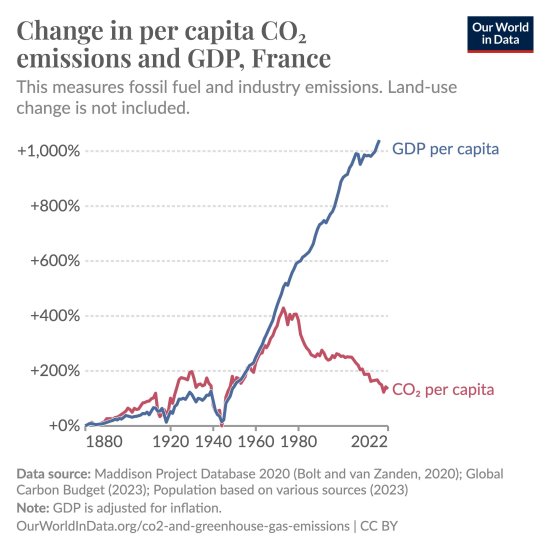
Poglejte spodnjo sliko: Dinamika BDP per capita in CO2 emisij per capita sta naraščali praktično skorajda popolno korelirani vse do sredine 1970. let. Nato pa se je zgodil popoln preobrat: rast BDP per capita se je še naprej nadaljevala s strmim trendom, medtem ko se je krivulja CO2 emisij per capita obrnila navzdol. Kaj se je zgodilo?

France-GDP and CO2 emissions per capita

Preden začnete razvijati kakšne divje teorije o kakšni tehnološki revoluciji, ki je vplivala na nenadno povečano energetsko varčnost francoske industrije ali da so Francozi nenadoma prenehali kuriti premog za ogrevanje ali se voziti z avtomobili z motorji na fosilna goriva, poglejte spodnjo sliko. Razlaga za preobrnitev trenda CO2 emisij per capita je zelo preprosta: Francija je dala v pogon svojih 56 jedrskih elektrarn in z njihovo proizvodnjo elektrike lahko nadomestila elektriko iz elektrarn na fosilna goriva. Jedrska energija torej omogoča razogljičenje, ki si ga tako želimo.

France -Energy mic 1960-2015

Ruske javne finance

…so precej boljše od pričakovanj. In v primerjavi z ameriškimi tudi precej bolj vzdržne. Spodaj je dober vpogled Bena Arisa v ruske javne finance. Koristno je to poznati.

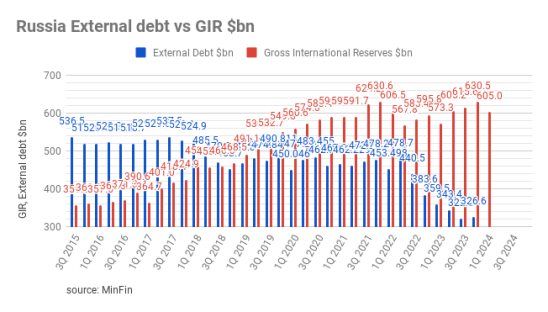
Russia external debt has been falling steadily and reached $326.6bn in December 2023, compared with $322.3bn in the previous quarter and $383.6bn at the end of 2022. It could pay the entire amount off tomorrow – in cash.

RU External debt and reserves

The Kremlin has been paying off its external debt. Low external debt means Russia doesn’t need to tap international capital markets so is not vulnerable to any sort of sanctions on bond issues, which are easy to apply and enforce.

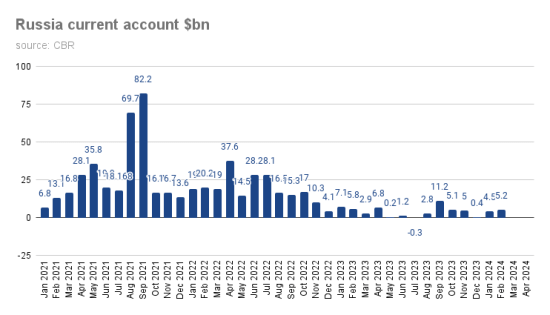
Coupled with Russia’s strong current account surplus, which was up to $5.2bn in February from $4.5bn in January, thanks to high oil prices, Russia can fund itself easily on this profit.

RU Current account

At the same time gross international reserves have been rising and are now hovering around $600bn at the end of the first quarter. Half of these reserves are frozen. About $150bn are in monetary gold (up from $135bn pre-war) and the rest in yuan.

Even counting out the frozen funds, Russia can cover its external debt dollar for dollar with cash, whereas everyone in the West is massively leveraged, including the Ukraine where the debt-to-GDP ratio is almost at 100%.

It is these rock-solid fundamentals – no one else in world has even remotely similar fundamentals – which is the essence of Putin’s Fiscal Fortress. It is a ridiculously strong basis, which means even if the West manages to reduce Russia income from oil and gas exports, it will still have a massive amount of wiggle room. And its ongoing commodity exports to the global south mean that it will continue to enjoy the raw materials subsidy for its economy. Because of their external debt (USA, Italy, much of G7, everyone in Africa and even China) everyone else is a lot more vulnerable to a global slow down. Russia is probably currently the least vulnerable on a macro fundamentals basis.

Nadaljujte z branjem