Ker stavim, da vas bo nocoj “popotresna drama” na 24kur na Pop tv bolj pretresla kot pa sam potres (stopnje 4.9), priporočam, da v tej zvezi preberete kakšno uvodno poljudno čtivo. Denimo 5. poglavje knjige Natea Silverja “The Signal and the Noise“. Čtivo o razumevanju pogostosti in možnosti napovedovanja potresov.
Potresov, kot kaže literatura, ni mogoče napovedovati. Ni teorije, ki bi to zmogla, kljub številnim poskusom. Vse, kar je možno napovedati, je (1) da obstajajo predšoki in postšoki in da bi aktualni potres z epicentrom jugozahodno od Ljubljane lahko bil predšok morebitnega kasnejšega večjega potresa; in (2) da je verjetnost, da bo nastopil morebitni kasnejši “pravi potres” za en red višje stopnje (6), 10-krat manjša od potresa stopnje 5. To napoveduje Richter – Gutenbergova zakonitost, ki sledi potenčni distribuciji.
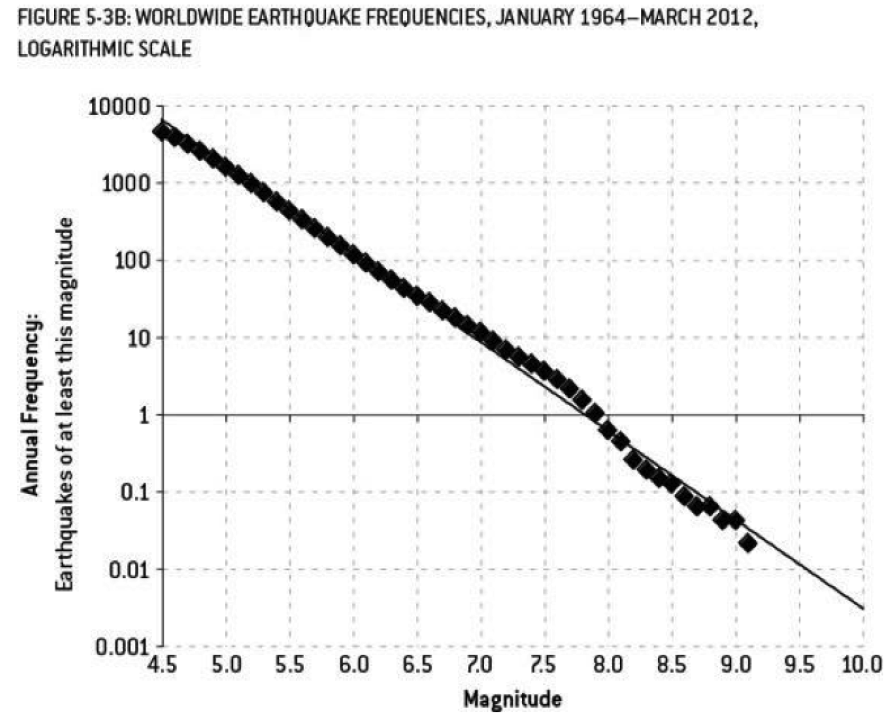 Vir: Nate Silver, “The Signal and the Noise“, 5. poglavje
In to je praktično edina statistično dobro veljavna zakonitost v zvezi s potresi. Kar pa seveda ne pomeni, da ni bilo veliko zelo resnih in tudi zelo šarlatanskih poskusov pri napovedovanju potresov. Toda do sedaj so očitno vse resne teorije tukaj odpovedale. Znanost je pri spoznanjih glede nastanka potresov približno tako nemočna kot pri poznavanju delovanja trgov. V poplavi šumov ne znamo odkriti pravega signala. Drobovje zemlje 15 km globoko je približno tako težko razumeti kot psiho homo sapiensov, ki se hočejo preleviti homo economicuse. Zato gresta “uspešnost” napovedovanja negotovosti glede ekonomskih aktivnosti in negotovosti glede potresov z roko v roki.
Za boljše razumevanje si velja prebrati vsaj ta odlomek iz Natea Silverja (priporočam pa, itak, celo knjigo):
There is another type of error, in which an earthquake of a given magnitude is deemed unlikely or impossible in a region—and then it happens. David Bowman, a former student of Keilis-Borok who is now the chair of the Department of Geological Sciences at Cal State Fullerton, had redoubled his efforts at earthquake prediction after the Great Sumatra Earthquake of 2004, the devastating magnitude 9.2 disaster that produced a tsunami and killed 230,000 people. Bowman’s technique, like Keilis-Borok’s, was highly mathematically driven and used medium-size earthquakes to predict major ones.However, it was more elegant and ambitious, proposing a theory called accelerated moment release that attempted to quantify the amount of stress at different points in a fault system. In contrast to Keilis-Borok’s approach, Bowman’s system allowed him to forecast the likelihood of an earthquake along any portion of a fault; thus, he was not just predicting where earthquakes would hit, but also where they were unlikely to occur.
Bowman and his team did achieve some initial success; the massive aftershock in Sumatra in March 2005, measuring magnitude 8.6, had its epicenter in an area his method identified as high-risk. However, a paper that he published in 2006also suggested that there was a particularly low risk of an earthquake on another portion of the fault, in the Indian Ocean adjacent to the Indonesian province of Bengkulu. Just a year later, in September 2007, a series of earthquakes hit exactly that area, culminating in a magnitude 8.5. Fortunately, the earthquakes occurred far enough offshore that fatalities were light, but it was devastating to Bowman’s theory.
After the model’s failure in 2007, Bowman did something that forecasters very rarely do. Rather than blame the failure on bad luck (his model had allowed for some possibility of an earthquake near Bengkulu, just not a high one), he reexamined his model and decided his approach to predicting earthquakes was fundamentally flawed—and gave up on it.
…
Bowman’s idea had been to identify the root causes of earthquakes—stress accumulating along a fault line—and formulate predictions from there. In fact, he wanted to understand how stress was changing and evolving throughout the entire system; his approach was motivated by chaos theory. Chaos theory is a demon that can be tamed—weather forecasters did so, at least in part. But weather forecasters have a much better theoretical understanding of the earth’s atmosphere than seismologists do of the earth’s crust. They know, more or less, how weather works, right down to the molecular level. Seismologists don’t have that advantage. “It’s easy for climate systems,” Bowman reflected. “If they want to see what’s happening in the atmosphere, they just have to look up. We’re looking at rock. Most events occur at a depth of fifteen kilometers underground. We don’t have a hope of drilling down there, realistically—sci-fi movies aside. That’s the fundamental problem. There’s no way to directly measure the stress.”
Without that theoretical understanding, seismologists have to resort to purely statistical methods to predict earthquakes. You can create a statistical variable called “stress” in your model, as Bowman tried to do. But since there’s no way to measure it directly, that variable is still just expressed as a mathematical function of past earthquakes. Bowman thinks that purely statistical approaches like these are unlikely to work. “The data set is incredibly noisy,” he says. “There’s not enough to do anything statistically significant in testing hypotheses.” What happens in systems with noisy data and underdeveloped theory—like earthquake prediction and parts of economics and political science—is a two-step process. First, people start to mistake the noise for a signal. Second, this noise pollutes journals, blogs, and news accounts with false alarms, undermining good science and setting back our ability to understand how the system really works.
Vir: Nate Silver, “The Signal and the Noise“, 5. poglavje
 DAMIJAN blog
You must be logged in to post a comment.