Ameriške vojaške baze so uničene
The New York Times — not a Telegram channel, not a Russian state broadcaster, the New York Times — has published satellite imagery confirming what Iran said it was doing while Washington was busy telling you it wasn’t working. Every major US base across the Gulf. Systematically and methodically.
Bahrain, Fifth Fleet headquarters, the nerve centre of American naval power in the region. Al Udeid Qatar — already missing its $1.1 billion AN/TPY-2 radar. Camp Arifjan Kuwait. Ali Al Salem. Prince Sultan in Saudi Arabia. UAE facilities. SATCOM terminals destroyed. Radomes cracked open. Satellite dishes gone. Missile tracking infrastructure — the AN/TPY-2 radar systems that coordinate every Patriot and THAAD battery in theater — targeted with what the imagery confirms was not luck but architecture.
Iran didn’t just strike US bases. It mapped the communication and coordination layer that makes American missile defense function as a unified system and then it peeled it apart, base by base, across five countries simultaneously.
This is not retaliation but doctrine. Thirty years of studying exactly how the American military machine sees, communicates, and coordinates and then, when the moment came, going straight for the eyes. The interceptors are blind. The magazines are depleted. The Navy can’t guarantee escorts in the Strait. Raytheon is being summoned to emergency meetings. South Korea is sitting exposed. And the New York Times just put the satellite pictures on the front page.
Washington built the most expensive military architecture in human history. Iran just showed you the blueprint for how to dismantle it. This is not going according to plan.
Tag Archives: politics
Čemu so stoje ploskali evropski politiki: Marco Rubio in ameriška vizija bodoče mednarodne ureditve po ameriški podobi
Temu so včeraj stoje aplaudirali najvišji evropski voditelji. Glede na tekst bi rekel, da ne zaradi vsebine, pač pa, ker je bil sekretar Marco Rubio manj agresiven in bolj vključevalen od podpredsenika J.D. Vancea lani. Ker je povabil evropske države, da sodelujejo v ameriški viziji bodoče mednarodne ureditve. Toda povabil jih je, da sodelujejo v ameriški viziji bodoče mednarodne ureditve – brez omejujočih mednarodnih institucij in pravil, brez proste trgovine in migracij, pač pa na podlagi ekskluzivne pravice Amerike, da si vzame, kar misli, da ji pripada.
Ta vizija je v fundamentu nasprotna od vizije, na kateri je nastala evropska integracija. Ne bi mogla biti bolj drugačna.
So evropski politiki ploskali povabilu, da sodelujejo v takšni ureditvi po ameriških pravilih ali pa zato, ker je bil Rubio bolj prijazen? Sami presodite ob poslušanju in branju spodnjega govora.
.
Glenn Diesen: Vladno financirane nevladne organizacije so skorumpirale civilno družbo
Tale članek spodaj od enega izmed vodilnih mlajših evropskih teoretikov mednarodnih odnosov, Glenna Diesna, je obvezno branje za droben uvid v to, kako vladno financirane “nevladne organizacije” pod krinko “civilne družbe” širijo vladno propagando in kako manjšina vladno financiranih osebkov v “nevladnih organizacijah” v javnosti preglasi veliko večino družbe. To vlogo so “nevladne organizacije” odigrale tudi glede vojne v Ukrajini – brezsramno so širile ameriško propagando.
“Nevladne organizacije” so oksimoron, ker so praktično vse financirane s strani vlade. Zaradi tega je masaker, ki ga Musk in Trump delata nad USAID in NED, glavnima financerjema nevladnih organizacij po svetu, dober, kajti razkril je hobotnico in mehanizem delovanja “nevladnih organizacij” in pripeljal do bankrota in in propada večine izmed njih, ker bodo izgubile vladno financiranje. Poglejte samo dretje v ukrajinskem medijskem kokošnjaku, ko je prejšnji teden usahnilo financiranje s strani USAID. Nenadoma je zmanjkalo denarja za razširjanje ameriške propagande.
_____________
Organisations operating under the banner of “human rights non-governmental organisations” (NGOs) have become key actors in disseminating war propaganda, intimidating academics, and corrupting civil society. These NGOs act as gatekeepers determining which voices should be elevated and which should be censored and cancelled.
Civil society is imperative to balance the power of the state, yet the state is increasingly seeking to hijack the representation of civil society through NGOs. NGOs can be problematic on their own as they can enable a loud minority to override a silent majority. Yet, the Reagan doctrine exacerbated the problem as these “human rights NGOs” were financed by the government and staffed by people with ties to intelligence agencies to ensure civil society does not deviate significantly from government policies.
The ability of academics to speak openly and honestly is restricted by these gatekeepers. Case in point, the NGOs limit dissent in academic debates about the great power rivalry in Ukraine. Well-documented and proven facts that are imperative to understanding the conflict are simply not reported in the media, and any efforts to address these facts are confronted with vague accusations of being “controversial” or “pro-Russian”, a transgression that must be punished with intimidation, censorship, and cancellation.
I will first outline my personal experiences with one of these NGOs, and second how the NGOs are hijacking civil society.
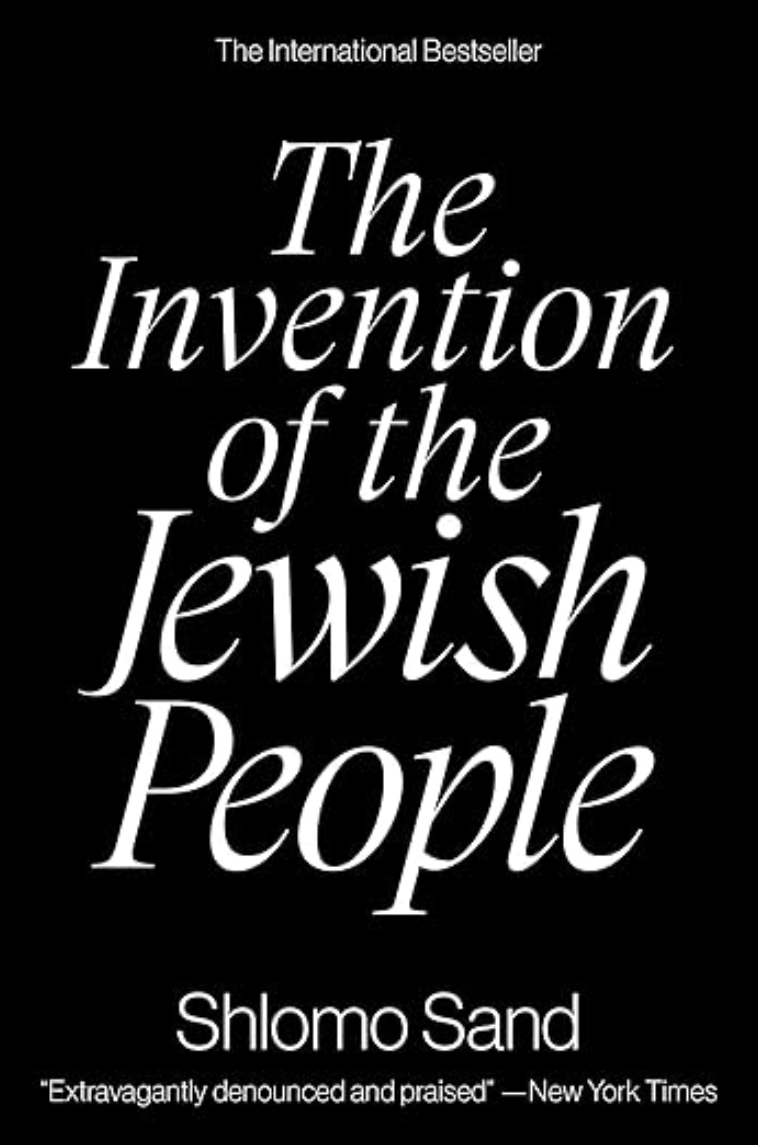
Shlomo Sand: Iznajdba judovskega ljudstva
Čas za osvežitev poznavanja zgodovine.
Main findings:
- The expulsion of Jews from Judea did not happen.
- Many Judean Jews accepted Islam and are the ancestors of today’s Palestinians.
- The “nation-race” of Jews with a common origin doesn’t exist and the “Jewish diaspora” is a modern invention.
- The ancestors of European Jews mostly converted to Judaism and have no origin in Palestine.
____________
Shlomo Sand is a Jewish Professor of History at Tel Aviv University
Chomsky je imel prav: Mit ameriškega idealizma
Spodaj je izvleček iz dobre recenzije zadnje knjige Noama Chomskega in Nathana J. Robinsona “The Myth of American Idealism”. Chomsky in Robinson še enkrat več razzbijata mit, da ameriško zunanjo poolitiko vodijo dobri nameni in moralna načela in da so slabe stvari, ki se zgodijo, zgolj nezaželene stranske posledice. Nasprotno – ameriška zunanja politika je to, kar se kaže tudi navzven: brutalno uveljavljanje ameriške globalne hegemonije z vsemi sredstvi.
Seveda ni zanemarljivo, da je recenzijo napisal Stephen M. Walt, profesor politologije na univerzi Harvard in eden izmed vodilnih teoretikov realizma v mednarodnih odnosih (sicer tudi skupaj z Johnom Mearsheimerjem soavtor knjige “The Israel Lobby”.
For more than half a century, Noam Chomsky has been arguably the world’s most persistent, uncompromising, and intellectually respected critic of contemporary U.S. foreign policy. In a steady stream of books, articles, interviews, and speeches, he has repeatedly sought to expose Washington’s costly and inhumane approach to the rest of the world, an approach he believes has harmed millions and is contrary to the United States’ professed values. As co-author Nathan J. Robinson writes in the preface, The Myth of American Idealism was written to “draw insights from across [Chomsky’s] body of work into a single volume that could introduce people to his central critiques of U.S. foreign policy.” It accomplishes that task admirably.
caption tk here
The Myth of American Idealism: How U.S. Foreign Policy Endangers the World, Noam Chomsky and Nathan J. Robinson, Penguin, 416 pp., $32, October 2024.
As the title suggests, the central target of the book is the claim that U.S. foreign policy is guided by the lofty ideals of democracy, freedom, the rule of law, human rights, etc. For those who subscribe to this view, the damage the United States has sometimes inflicted on other countries was the unintended and much regretted result of actions taken for noble purposes and with the best of intentions. Americans are constantly reminded by their leaders that they are an “indispensable nation” and “the greatest force for freedom the world has ever known,” and assured that moral principles will be at the “center of U.S. foreign policy.” Such self-congratulatory justifications are then endlessly echoed by a chorus of politicians and establishment intellectuals.
Obrisi Trumpove nove zunanje politike: Hitro stisniti Rusijo in Iran ter pomagati Izraelu, da bi se lahko lotil Kitajske
Trumpova bum-bum diplomacija, kot se kaže v obrisih glede na izbrane osebke za ključne pozicije (glejte Bloombergov newsletter spodaj), je najbolje opisana z zgornjim naslovom. Ključni cilj Trumpa naj bi bil hitra umiritev “nestrateških” konfliktnih področij (Ukrajina, Rusija, Gaza, Iran), da bi se lahko posvetil sovražniku št. 1 – to je Kitajski. Kitajska je edina, ki zares ogroža globalno (gospodarsko, tehnološko in politično) hegemonijo ZDA.
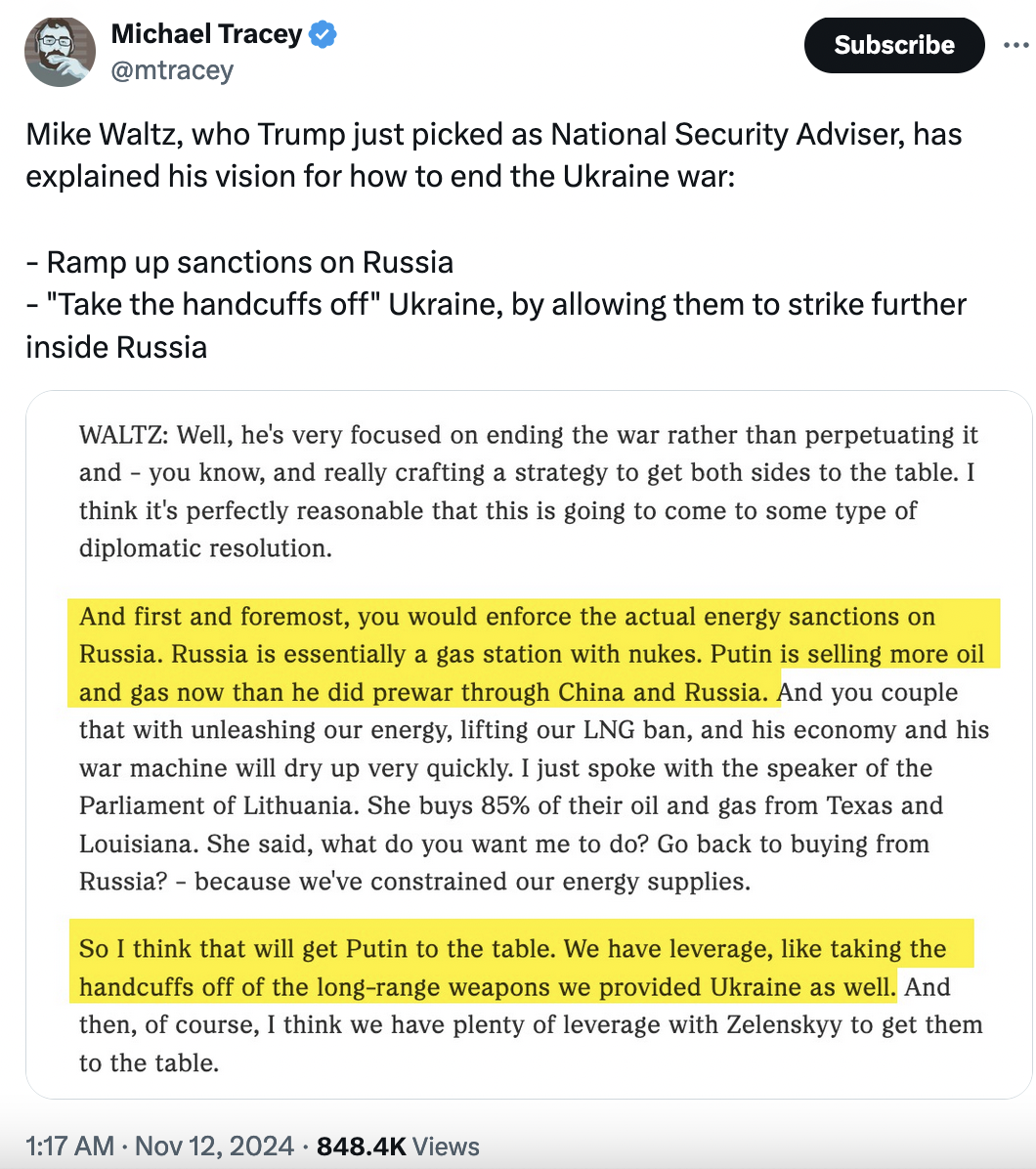
K temu je treba dodati še obrise napovedane strategije glede zaustavtve vojne z Ukrajino, kot jo je skiciral Mike Waltz, najverjetnejši bodoči svetovalec za nacionalno varnost. Ta strategija naj bi izgledala takole:
- v prvem koraku je treba stisniti Rusijo prek pritiska na Kitajsko in Indijo, da ne bi več kupovali ruskih energentov,
- hkrati bi evropske države prenehale kupovati naftne derivate iz indijskih rafinerij (kjer predelujejo rusko nafto) in
- hkrati bi ZDA začele prodajati večje količine utekočinjenega zemeljskega plina (LNG) v Evropo,
- v drugem koraku bi Ukrajini “sneli lisice” in ji dovolili, da z ameriškimi, britanskimi in francoskimi raketami dolgega dosega začne raketirati cilje globoko na ruskem ozemlju.
Na ta način naj bi Trump Rusijo prisilili v pogajanja in hkrati dal bonbonček Ukrajini, da bo lažje pristala na pogajanja.
Že prejšnji teden pa je pricurljal obris predloga iz Trumpovega kroga glede bodoče mirovne rešitve za Ukrajino. Ta bi v grobem izgledala tako:
- Razmejitev med Ukrajino in Rusijo se zamrzne vzdolž sedanje frontne linije,
- Med frontno linijo in preostankom Ukrajine se oblikuje demilitarizirano območje,
- Ukrajina pristane, da naslednjih 20 let ne bo prosila za vstop v Nato,
- ZDA Ukrajini še naprej vojaško pomagajo, kar bi ji dalo neke vrste varnostne garancije.
No, zanimivo bo videti ruski in evropski odziv na te obrise predlogov. Pomembno pa je, da se pogovori o mirni rešitvi vojne sploh začnejo. Naj diplomacija namesto orožja poišče rešitev.
Toda, če bi vsebinsko komentiral te idejne skice, bi bil prvi komentar: Good luck with that.
Kissingerjeva hegeljanska ocena Trumpa
Če poenostavim, je Kissinger Trumpa ocenil kot osebo, ki se občasno pojavi, da označi konec neke dobe in jo prisili, da opusti svoje pretveze, ne da bi se nujno sama tega zavedala. No, to razlago pa se da malce zakomplicirati, če jo prevedemo v filozofski jezik. Larpurlartizem per se, ampak zabaven.
Kissinger on Trump and ‘The Cunning of Reason.’
The Financial Times’s man in Washington Edward Luce took Henry Kissinger out for lunch in 2018. Luce tried every which way to corner Kissinger into a direct comment on Trump, but his aged quarry easily evaded the pursuit. Except for one evidently premeditated and striking, if cryptic, assessment that I wrote about at the time, under another blogging hat, here: naimisha_forest.silvrback.com/kissinger-hege…
Kissinger:
“I think Trump may be one of those figures in history who appears from time to time to mark the end of an era and to force it to give up its pretences. It doesn’t necessarily mean that he knows this, or that he is considering any great alternative. It could just be an accident.”
I make five points. Four are specific to Kissinger on Trump. The last is on the Hegelian model of historical change – the cunning of reason – that Kissinger rather casually deploys here while toying half-heartedly with his branzino (European bass) on a bed of green vegetables.
First, Kissinger thinks Trump may already be a substantial figure in world history, not, alas, some bizarre printer’s error that his opponents hope to erase from its pages.
Second, he’s not just any historical figure but one who marks the end of an era. This much should be apparent even from Trump’s critics, who denounce him for upending the post-war “liberal international order,” among other crimes.
Third, Kissinger hints that the era which is ending may indeed deserve to go. Trump is forcing it to give up its pretences.
Razlogi za Trumpov povratek
Andrew Korybko
Trump just beat Kamala despite the formidable odds that were against him. He survived two assassination attempts, withstood the government’s lawfare, and is on track to secure the popular vote even though the legacy media was fully in support of his opponent. Speaking of her, she’s infamous for repeating her phrase about America becoming “unburdened by what has been”, which means moving past the Trump era. Ironically, the country just moved past her, and here’s how it happened:
———-
1. “It’s The Economy, Stupid!”
Democrat consultant James Carville famously coined the abovementioned phrase in reference to the most important electoral issue for most Americans. It still rings true to this day since the majority of the country is worse off after four years of the Biden-Harris Administration than it was after Trump’s first term. It doesn’t matter what the reasons for that are since such developments strongly work against incumbents. Americans accordingly voted to bring back the golden economy that Trump ushered in.
2. Immigration, Both Legal & Illegal, Is Out Of Control
Immigration is always a hot button issue, but it was even more so during this election due to the unprecedented influx of illegal immigrants that invaded the country under Biden and viral reports of legal Haitian immigrants brought in by the government eating people’s pets in Ohio. Trump pledged to crack down on the illegal component and more properly vet those who come into the country via legal channels to ensure that they’ll assimilate and integrate. This approach is wildly popular with Americans.
3. Folks Are Afraid Of World War III
Americans have never been as afraid of World War III as they are now. The NATO-Russian proxy war in Ukraine and the back-and-forth Israeli-Iranian strikes, each of which have the potential to spiral into the apocalypse in the worst-case scenario, were unthinkable under Trump. He promised to do his utmost to bring peace to Europe and the Mideast if he’s re-elected while Kamala promised more of the same policies that brought the world to the brink of war. A vote for Trump therefore became a vote for peace.
Trumpova zunanja politika na Bidnovih ruševinah
Pulitzerjev nagrajenec Seymour Hersh ima dokaj podobne poglede tako na dizaster Bidnove zunanje politike (sponzoriranje vojne v Ukrajini in masakra nad Palestinci v Gazi in Zahodnem bregu) kot na konture bodoče (morebitne) Trumpove zunanje politike. Morda bo Trump pomagal hitreje končati vojno v Ukrajini, toda glede ravnanja Izraela bo kvečjemu enako ali bolj prizanesljiv. No, problem Kamale Harris kot protikandidatke je bil, da se glede zunanje politike ni znala distancirati of Bidna in ponuditi boljše vizije. Trump je znal ponuditi vsaj nekaj boljših rešitev (končanje vojne v Ukrajini, transakcijski odnos do Kitajske in Evrope), Kamala pa je v svoji vsebinski praznini izgledala kot bleda kopija katastrofalne zunanje politike njenega nekdanjega šefa. Kot pravi Hersh, Obama je slabo opravil svoje delo, ko je postavil Harrisovo za demokratsko predsedniško kandidatko.
___________
It wasn’t close.
Americans once again rejected a flawed female Democratic candidate in favor of Donald Trump, who comes to office with grievances and revenge on his mind, along with a welcome determination to end the war in Ukraine and a far less welcome commitment to continue the Biden policy of unfettered support for the murderous Benjamin Netanyahu, the Israeli prime minister.
Here are some day-after thoughts about an election I thought in my dotage that Trump would not win, especially because his campaign gave no sign of any regrets for his abysmal response to his defeat by Joe Biden four years ago.
There are lots of lessons here. First of all, Barack Obama continued a lousy precedent by picking a weak vice president after winning the primaries in 2008. Biden was considered by some of his peers in the Senate as a vain and lazy second-rater: a weak vice presidential choice who was publicly loyal but increasingly resentful of what he saw as Obama’s dismissive attitude toward him. Once elected to the presidency in 2020, he replayed the Obama mantra by selecting a vice president who posed no political threat. Kamala Harris, in turn, did the same by picking a political novice who added little to her campaign and, if elected, would be, at best, a White House liaison to high school football and America’s heartland.
Strategi, politiki in diplomati, ki so svarili pred širitvijo Nata v Ukrajino. In imeli prav
Da ne bo kdo rekel, da nismo vedeli, da bo ameriško forsiranje širitve nata v Ukrajino imelo tragične posledice. Predvsem za Ukrajino – tragično v vseh pogledih. Za Evropo – izjemno škodljivo gospodarsko, politično in varnostno. Za globalno varnost – dramatično škodljivo lansiranje nove hladne vojne. To ameriško forsiranje je bilo povsem nepotrebno in izjemno škodljivo.
Vedeli smo, da se bo to zgodilo. Vodilni intelektualci, strategi, politiki in diplomati so na to opozarjali. Spodaj je nabor njihovih svaril. Pa vendar smo Američanom pustili, da svojo igrico uresničijo in jim v Evropi služili in še vedno služimo kot koristni idioti.
I get asked this all the time, so I am reposting my famous thread of all the top strategic thinkers – from Kissinger to Chomsky – who warned for years that war was coming if we pursued NATO expansion, yet had their advice ignored (which begs the question: why?).
The first one is George Kennan, arguably America’s greatest ever foreign policy strategist, the architect of the U.S. cold war strategy. As soon as 1998 he warned that NATO expansion was a “tragic mistake” that ought to ultimately provoke a “bad reaction from Russia”.

 DAMIJAN blog
You must be logged in to post a comment.