Moralni bankrot Evrope in celotnega Zahoda

John Mearscheimer:

I think once you get outside of the West, almost everybody thinks that the United States and the Europeans are morally bankrupt.

I mean, we are supporting—and I’m choosing my words carefully here—we are supporting a genocide in Gaza.

It’s a genocide that people see on their computers and on their TVs on a daily basis.

So they know exactly what’s going on here, and the hypocrisy is just quite stunning.

Because the West makes a big deal of the fact that it is morally virtuous, that we are, you know, an exceptional Nation—we stand taller, we see further.

And when you think about the fact that we’re complicit in a genocide, I mean, it looks like hypocrisy in the extreme.

So I think outside the West, people understand full well that we are morally bankrupt.

And I think even inside the West, there are lots of people who have just begun to lose hope that we have our moral gyroscopes in place when it comes to dealing with the Middle East.

Trumpova zunanja politika na Bidnovih ruševinah

Pulitzerjev nagrajenec Seymour Hersh ima dokaj podobne poglede tako na dizaster Bidnove zunanje politike (sponzoriranje vojne v Ukrajini in masakra nad Palestinci v Gazi in Zahodnem bregu) kot na konture bodoče (morebitne) Trumpove zunanje politike. Morda bo Trump pomagal hitreje končati vojno v Ukrajini, toda glede ravnanja Izraela bo kvečjemu enako ali bolj prizanesljiv. No, problem Kamale Harris kot protikandidatke je bil, da se glede zunanje politike ni znala distancirati of Bidna in ponuditi boljše vizije. Trump je znal ponuditi vsaj nekaj boljših rešitev (končanje vojne v Ukrajini, transakcijski odnos do Kitajske in Evrope), Kamala pa je v svoji vsebinski praznini izgledala kot bleda kopija katastrofalne zunanje politike njenega nekdanjega šefa. Kot pravi Hersh, Obama je slabo opravil svoje delo, ko je postavil Harrisovo za demokratsko predsedniško kandidatko.

___________

It wasn’t close.

Americans once again rejected a flawed female Democratic candidate in favor of Donald Trump, who comes to office with grievances and revenge on his mind, along with a welcome determination to end the war in Ukraine and a far less welcome commitment to continue the Biden policy of unfettered support for the murderous Benjamin Netanyahu, the Israeli prime minister.

Here are some day-after thoughts about an election I thought in my dotage that Trump would not win, especially because his campaign gave no sign of any regrets for his abysmal response to his defeat by Joe Biden four years ago.

There are lots of lessons here. First of all, Barack Obama continued a lousy precedent by picking a weak vice president after winning the primaries in 2008. Biden was considered by some of his peers in the Senate as a vain and lazy second-rater: a weak vice presidential choice who was publicly loyal but increasingly resentful of what he saw as Obama’s dismissive attitude toward him. Once elected to the presidency in 2020, he replayed the Obama mantra by selecting a vice president who posed no political threat. Kamala Harris, in turn, did the same by picking a political novice who added little to her campaign and, if elected, would be, at best, a White House liaison to high school football and America’s heartland.

Nadaljujte z branjem

Vpliv vojne na izraelsko gospodarstvo

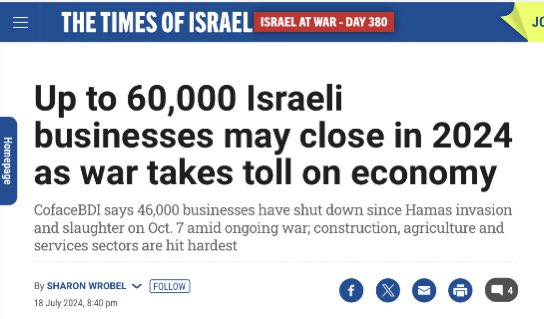
UP TO 60,000 ISRAELI BUSINESSES TO CLOSE IN 2024

“The economic fallout from the ongoing war was most immediately felt by businesses active in the construction, agriculture, tourism, hospitality, and entertainment sectors, according to Amir.

That’s as 85,000 Palestinian workers have virtually disappeared from Israel’s construction industry since the war’s start, as they have not been allowed into Israel to work due to security concerns, while many foreign workers working at building sites left the country. This has caused many building sites to shut down completely due to a lack of workers.

‘Agriculture but especially the construction industry suffers from a severe shortage of manpower causing significant delays of projects and in the handover of apartments,” said Amir. “We are seeing some influx of foreign workers who have returned to Israel, but the low supply has also led to an increase in salaries and higher costs of hiring.’”

See: timesofisrael.com/up-to-60000-is…Image

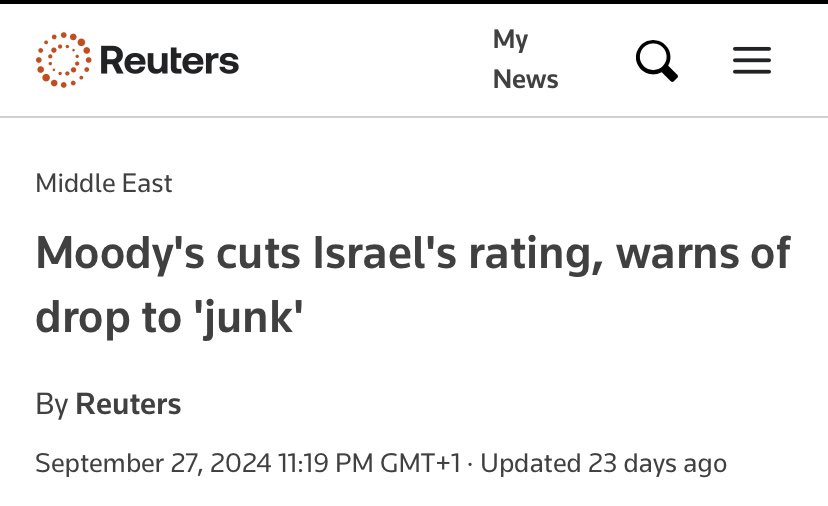
ISRAEL’S CREDIT RATING DOWNGRADED WITH FURTHER DOWNGRADING TO “JUNK EXPECTED

Moody’s: “The key driver for the downgrade is our view that geopolitical risk has intensified significantly further, to very high levels, with material negative consequences for Israel’s creditworthiness in both the near and longer term. The ratings would likely be downgraded further, potentially by multiple notches, if the current heightened tensions with Hezbollah turned into a full-scale conflict.”

See: reuters.com/world/middle-e…Image

Nadaljujte z branjem

Apologeti genocida: Tudi liberalni mediji so v postelji z Izraelom

I can’t put this strongly enough. Howard Jacobson’s article in today’s Observer newspaper may be one the vilest pieces of journalism published in Britain in living memory, arguing that any reporting of Israel’s documented slaughter of many thousands of Palestinian children in Gaza is a “blood libel” and antisemitic. It is pure genocide apologism.

But far worse is the fact that the Guardian Media Group signed off his column. This isn’t the work of one Zionist loon. A whole army of journalists brought it to print.

And note: Jacobson, odious as he is, isn’t responsible for the choice of photo. That is entirely down to the Observer newsroom.

I worked at both the Guardian and the Observer, its Sunday sister paper, for many years. The comment editor, the photo editor, the revise sub-editor, the Observer’s chief editor and all the section heads would have approved not only Jacobson’s text but that photo too.

Nadaljujte z branjem

J’Accuse: Zahodni mediji so sokrivi za masaker v Gazi in Libanonu

Poročanje Karmen Švegl iz Bližnjega vzhoda je simptom odnosa zahodnih medijev do leto dni trajajočega izraelskega genocida v Gazi, izraelskega masakra v Libanonu in velike regionalne vojne, ki se po izraelsko-ameriških notah kuha na Bližnjem vzhodu. Zahodni mediji so v postelji z Izraelom in ZDA.

The US and Iran are on the brink of war. Israel and the United States are planning a major attack on Iran, which according to Biden himself could entail strikes on Iranian oil sites. Iran is now saying that its days of “individual self-restraint” are over, and it is prepared to go all-in if the US and Israel keep ramping up escalations.

The IDF continues to slaughter civilians in Lebanon with US-backed airstrikes as news surfaces that Hezbollah leader Hassan Nasrallah had agreed to a 21-day ceasefire with Israel shortly before Israel assassinated him. The US reportedly knew about the deal.

And of course Israel is still killing dozens of civilians a day in its daily massacres in Gaza. Ninety-nine American healthcare workers who volunteered in the enclave have published an open letter to their president detailing the horrors that they have witnessed, and estimating the current death toll from this onslaught is over 118,908.

And at this juncture in history, I think it would be good for us to give the western press their due credit for helping to take us here by manufacturing consent for the political environment in which such western-supported atrocities are possible.

All the mass media personnel who’ve been lying and manipulating for Israel helped pave the way to this.

All the pundits and reporters who’ve been assigning far more weight to the Israeli deaths on October 7 than to the vastly greater number of Arab deaths before and since.

All the editors who’ve been running “Gaza child walks into bullet” passive-language headlines designed to mask Israel’s responsibility for the killings.

Nadaljujte z branjem

Po atentatu v Libanonu: Velika regionalna vojna ali zmaga Izraela?

In the past 48 hours, Lebanon has experienced a significant geopolitical event that may have far-reaching implications for the entire region. This moment is likely to be recorded as a decisive chapter in the region’s history. Why?

Firstly, the decision to assassinate Hassan Nasrallah, the leader of Hezbollah, was made while Israeli Prime Minister Benjamin Netanyahu was in the United States, specifically during the United Nations General Assembly session. The location and timing are symbolic for two reasons: it suggests that the decision was made with American consent, and it implies that the principles of international justice, as represented by the UN, are subordinated to Israeli interests. This signals that we are living in an era where power overrides justice.

Secondly, Nasrallah’s assassination would represent a significant blow to Hezbollah. Even the group’s most loyal supporters cannot ignore this reality. Nasrallah was a charismatic leader, a skilled military commander, and a master strategist. Replacing him would not be easy, as he was a unique figure within Hezbollah. His leadership style and capabilities would be difficult, if not impossible, to replicate.

Nadaljujte z branjem