Kapitalna poteza Kitajske: Izrinjanje ZDA, IMF in zasebnih skladov

Če morda niste bili pozorni v prejšnjih dneh, ste spregledali novico, da je kitajska banka v Saudski Arabiji izdala obveznico, denominirano v dolarjih. Čeprav je šlo za izdajo majhne vrednosti (2 milijardi $), je zadeva zanimiva iz večih vidikov. Obveznica je denominirana v dolarjih, povpraševanje je bilo 20-krat večje od vrednosti izdaje, obrestna mera je bila zgolj za dlako (1-3 bazične točke) višja kot pri ameriških državnih obveznicah (Nemčija plačuje 10-20 bazičnih točk več za svoje obveznice) in odpira vprašanje, kaj želi Kitajska s tem doseči ter kaj sporoča ZDA in svetu. Ena izmed razlag je, da Kitajska s tem Ameriki sporoča, da se lahko zadolžuje po isti obrestni meri kot ZDA in da lahko ustvari paralelni dolarski finančni sistem, na drugi strani pa državam globalnega juga sporoča, da jim – če imajo težave pri refinanciranju dolga po bistveno višjih obrestnih merah – pomaga s cenejšim denarjem v zameno za izvoz surovin in jih s tem še bolj naveže na svoj trgovinski in finančni sistem. Kitajska s tem signalizira, da lahko zruši monopol ameriškega finančnega sistema in ustvari večjo dovisnost držav globalnega juga od Kitajske.
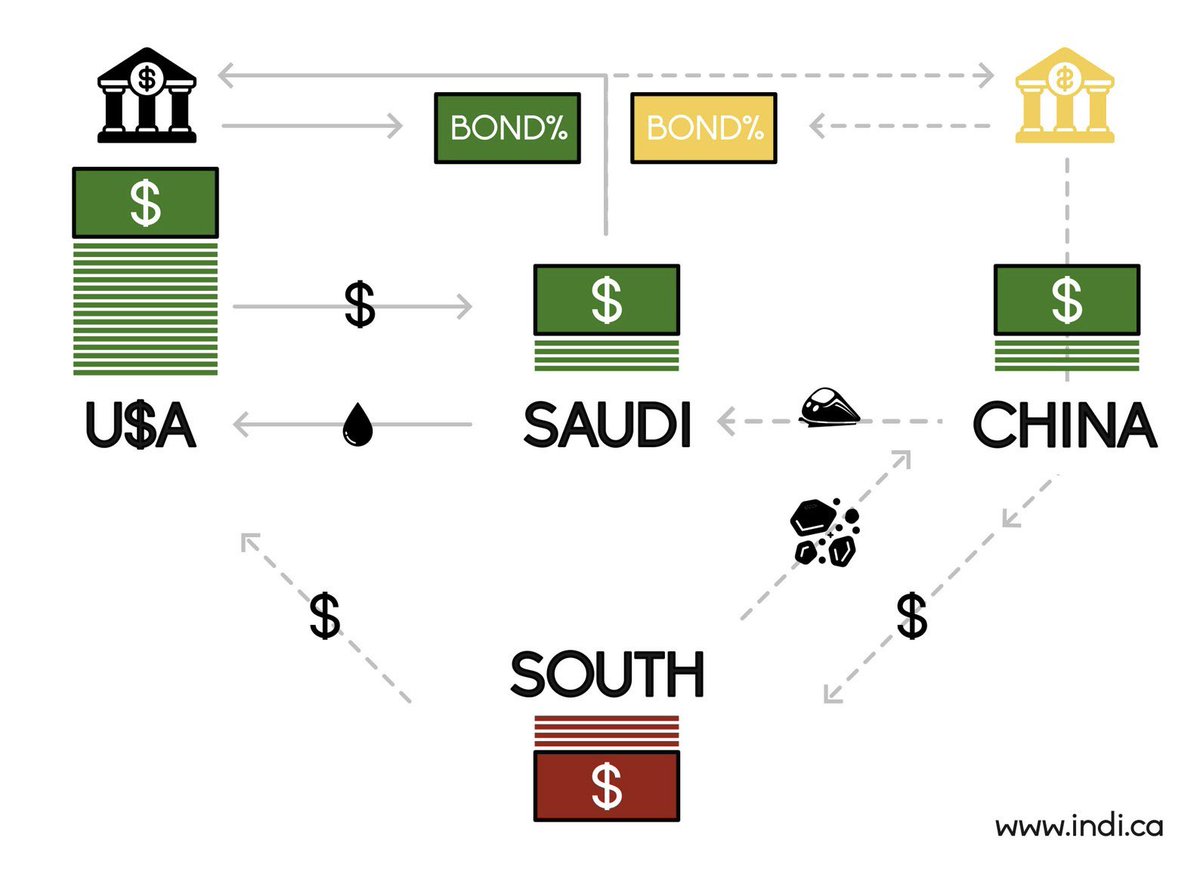
Spodaj sta dve zanimivi razlagi. Z nobeno se ni treba strinjati, splača pa se ju vzeti na znanje. Najprej Arnaud Bertrand:

At first glance, the mechanics are straightforward: China issued bonds, denominated in US dollars, that investors eagerly snapped up. The bonds were oversubscribed nearly 20 times, with over $40 billion in demand for just $2 billion in bonds. This level of interest dwarfs the typical 2-3x oversubscription seen in US Treasury auctions.

Even more striking is the interest rate. China secured rates just 1-3 basis points (0.01-0.03%) higher than US Treasuries—essentially matching the borrowing cost of the US government. For perspective, even AAA-rated countries like Germany or Japan typically pay at least 10-20 basis points above US Treasuries when issuing USD bonds.

The venue for this issuance—Riyadh—adds another layer of intrigue. Sovereign bonds are typically issued in established financial hubs like London or New York, not in the heart of the petrodollar system. By choosing Saudi Arabia, China appears to be subtly challenging the status quo, showcasing itself as an alternative player in the global dollar ecosystem.

A Subtle Signal to Washington

The timing and nature of this bond issuance seem less about financial necessity and more about strategic signalling. By successfully issuing dollar-denominated bonds in Saudi Arabia, China demonstrates it can compete directly with US Treasuries as a destination for dollar investments.

For decades, the US has enjoyed an “exorbitant privilege,” with countries like Saudi Arabia recycling their surplus dollars into US Treasury bonds, effectively subsidising US government spending. Now, China is introducing a rival option. The bonds give countries like Saudi Arabia an alternative, enabling them to park their dollar reserves with Beijing instead of Washington.

Nadaljujte z branjem

Did The Latest BRICS Summit Achieve Anything Of Tangible Significance At All?

Andrew Korybko

Over a week has passed since the latest BRICS Summit in Kazan so it’s possible to assess what exactly it achieved now that the dust has settled. The primary takeaway is the Kazan Declaration, which Director General of the prestigious Russian International Affairs Council (RIAC) Andrey Kortunov described as “a manifesto for the new world order”. His praise shouldn’t be taken lightly since he’s an archetypical realist who also earlier tempered expectations about what BRICS was capable of agreeing to.

Titled “What BRICS Cannot and What It Can Deliver”, Kortunov explained that: “BRICS cannot become a global economic integration project”; BRICS will not turn into a multilateral political or security alliance of an anti-Western nature”; BRICS is not likely to contribute a lot to resolving disputes between its members or disputes between its members and third parties”; and “BRICS will never become an analogue to G7.”

He then juxtaposed these assessments with his expectations that “BRICS can promote trade and investments among its members, as well as contribute to economic and social development of these members”; “BRICS could help to shape common non-Western approaches to global problems”; “BRICS is capable of contributing to the dialogue of civilizations”; and “BRICS can become an important source of ideas and proposals for UN, G20 and other universal bodies.”

Nadaljujte z branjem

Kaj prinaša nov BRICS plačilni sistem?

Spodaj je odlična ocena sklepov zadnjega srečanja skupine BRICS+, ki se je končalo ta teden v ruskem Kazanu. Francoski ekonomist Jacques Sapir ocenjuje, da bi nov plačilni (klirinški) sistem (imenovan BRICS Clear), ki bi zajemal bilateralno trgovino med 22 BRICS partnerskimi državami, in nova družba za zavarovanje trgovinskih tokov vodili k večji medsebojni trgovini med BRICS državami in diverziji trgovinskih tokov stran od zahodnih držav (podobno se je zgodilo z evropsko trgovino: v začetku 1950-let je bilateralna trgovina med šesterico EGS držav znašala eno tretjino skupne zunanje trgovine, nato pa je v 50 letih narasla na dve tretjini). Če danes trgovina med BRICS državami pomeni okrog 30 % svetovne trgovine in če bi v nekaj letih 80 % te trgovine šlo prek sistema BRICS Clear, bi se dobra petina svetovne trgovine de-dolarizirala. Hkrati to pomeni, da BRICS države več ne bi potrebovale toliko dolarskih rezerv, kar bi močno zmanjšalo povpraševanje po ameriških obveznicah in dolarskih imetjih. To pa lahko zamaje globalni trg z ameriškimi obveznicami in povzroči težave za ameriško finančno ministrstvo pri refinanciranju dolga Združenih držav. Temu ustrezno je treba razumeti grožnje Donalda Trumpa, da bo sankcioniral vse države, ki bi svoje mednarodne transakcije prenesle v ne-dolarske valute.

The conclusion of the 16th BRICS summit held in Kazan from October 22-24 resulted in important decisions.

It should be noted that BRICS (Brazil, Russia, India, China, South Africa), joined by 4 new countries (Egypt, Ethiopia, Iran, United Arab Emirates), now represent more than 33% of global GDP compared to the G7’s 29%.

Among these decisions, three stand out: the institutionalization of a “partner countries” category within BRICS, the creation of the BRICS-Clear system to facilitate exchanges between members and partner countries, and the establishment of the BRICS (Re)Insurance Company.

The consequences of these decisions will be very significant, not only for BRICS and their associates but also for the Western world. The movement toward global “de-Westernization” is accelerating.

One of the most emblematic decisions taken at the Kazan summit was the institutionalization of the “partner countries” category within BRICS. This creates a “BRICS zone” around the core members.

The presence of Indonesia, Malaysia, Thailand, and Vietnam in this “partner” category implies that BRICS, already dominant in Asia due to China and India’s membership, could become hegemonic in this region.

The second essential decision of the 16th BRICS summit is the creation of BRICS Clear, a settlement and clearing system for both intra-BRICS trade and trade between BRICS and “partner” countries.

One of BRICS Clear’s key objectives is to create an alternative to the SWIFT system. Within the BRICS Clear system, the use of national currencies as instruments for settling international transactions will be prioritized.

Transaction clearing will be handled through a “stablecoin” managed by the New Development Bank. The clearing issue is important since trade will be multilateral (22 countries: 9 BRICS members and 13 partner countries).

Nadaljujte z branjem