Zelo zanimiva nit o umetno ustvarjeni paralelni resničnosti z namenom vplivanja na narativo in politične spremembe v želeno smer. Splača se prebrati.
Kitajska strategija za Trumpa: Počakati, da Trump samouniči ameriško hegemonijo, nato pa zasesti njeno mesto
Ne pravim, da se povsem strinjam s člankom Yun Suna v Foreign Affairs, ima pa zelo dobre, logične poante. Kajti Kitajski res ni treba narediti nič, samo počakati mora, da Trump postopno razgradi ameriško globalno moč in njen položaj v svetu, v vmesnem času pa Kitajska nadaljuje s krepitvijo svoje tehnološke in gospodarske prednosti ter krepitvijo odnosov z državami izven OECD z več kot 6.7 milijard prebivalcev (82 % svetovnega prebivalstva). To je v skladu s krilatico, ki jo pripisujejo Napoleonu Bonaparteju: Ne moti nasprotnika, ko dela napake.
Kitajska je svojo “Trumpovo strategijo” zastavila že v prvem Trumpovem mandatu in preusmerila precejšen delež svojega neposrednega izvoza v ZDA posredno preko ASEAN držav (predvsem Vietnama) in Mehike. Spodnja slika kaže, da se je delež ZDA v kitajskem izvozu med 2018 in 2024 zmanjšal iz 19 % na dobrih 14 %, medtem ko se je delež izvoza v države ASEAN + Mehiko povečal iz 14 na 18 %…
 .. hkrati pa se je delež držav ASEAN + Mehike v ameriškem uvozu povečal iz 20 % na dobrih 30 %.
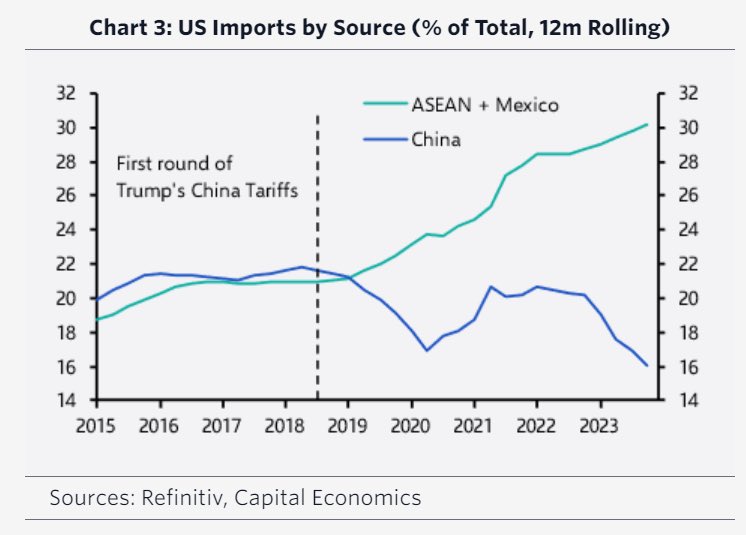
Kitajska ve, kaj dela. Diverzificira svoj izvoz in danes njen izvoz v ne-OECD države že presega izvoz v OECD države. Trumpove carine bodo sicer v določeni meri prizadele kitajski izvoz, toda ta udarec je obvladljiv.
Trump je izvrstna priložnost tudi za Evropo, da končno odraste in se osamosvoji od ZDA: politično, vojaško in tehnološko. Hkrati bi morale države EU kot strateško alternativo poglobiti gospodarske odnose s Kitajsko, pa tudi z Rusijo (zaradi energentov in ključnih surovin za evropsko industrijo).
USAID kot krinka Cie za širjenje propagande
John R. Stockwell (born 1937) is an American former CIA officer who became a critic of United States government policies after serving seven tours of duty over thirteen years.
In December 1976, he resigned from the CIA, citing deep concerns for the methods and results of CIA paramilitary operations in Third World countries and testified before Congressional committees. Two years later, he wrote the exposé In Search of Enemies, about that experience and its broader implications. He claimed that the CIA was counterproductive to national security, and that its “secret wars” provided no benefit for the United States. The CIA, he stated, had singled out the MPLA to be an enemy in Angola despite the fact that the MPLA wanted relations with the United States and had not committed a single act of aggression against the United States. In 1978 he appeared on the popular American television program 60 Minutes, claiming that CIA Director William Colby and National Security Advisor Henry Kissinger had systematically lied to Congress about the CIA’s operations.
Books
- The Praetorian Guard: The US Role in the New World Order. Boston: South End Press (1991). ISBN 0896083950.
- Red Sunset. New York: William Morrow & Co. (1982).
- In Search of Enemies: A CIA Story. New York: W. W. Norton & Co. (1978). ISBN 0393009262.
Filmography
- The C.I.A. Case Officer: John “Bob” Stockwell. Institute for Policy Studies (1978).
- The Secret World of the C.I.A: The Testimony of John Stockwell. Cambridge, Mass.: Insight Video (1988). OCLC 18296714
Vir: Wikipedia
MËSTIZA & friends en tablao flamenco
Internews Network, projekt USAID za urjenje za množično medijsko dezinformiranje
Kolateralna korist od Muskovega in Trumpovega lomastenja po institucijah je tole razkrivanje mehanizmov in institucij ameriškega vladnega medijskega obvladovanja globalne proizvodnje “pravih” medijskih vsebin. Eden izmed teh mehanizmov je projekt Internews Network:
USAID has pushed nearly half a billion dollars ($472.6m) through a secretive US government financed NGO, “Internews Network” (IN), which has “worked with” 4,291 media outlets, producing in one year 4,799 hours of broadcasts reaching up to 778 million people and “training” over 9000 journalists (2023 figures). IN has also supported social media censorship initiatives.
The operation claims “offices” in over 30 countries, including main offices in US, London, Paris and regional HQs in Kiev, Bangkok and Nairobi. It is headed up by Jeanne Bourgault, who pays herself $451k a year. Bourgault worked out of the US embassy in Moscow during the early 1990s, where she was in charge of a $250m budget, and in other revolts or conflicts at critical times, before formally rotating out of six years at USAID to IN.
Bourgault’s IN bio and those of its other key people and board members have been recently scrubbed from its website but remain accessible at http://archive.org. Records show the board being co-chaired by Democrat securocrat Richard J. Kessler and Simone Otus Coxe, wife of NVIDIA billionaire Trench Coxe, both major Democratic donors. In 2023, supported by Hillary Clinton, Bourgault launched a $10m IN fund at the Clinton Global Initiative (CGI). The IN page showing a picture of Bourgault at the CGI has also been deleted.
IN has at least six captive subsidiaries under unrelated names including one based out of the Cayman Islands. Since 2008, when electronic records begin, more than 95% of IN’s budget has been supplied by the US government (thread follows)
Več podrobnosti na Wikileaks
Kako zmagati proti Trumpovi norosti
Ameriški predsednik Trump je udarno začel svoj mandat z začasno prekinitvijo tuje pomoči, z deportacinami ilegalnih pribežnikov, z napovedjo takojšnje uvedbe carin na izdelke iz Kanade, Mehike in Kitajske ter nato še za države EU itd. Nakar je uvedbo carin začasno zamaknil in nakazal, da se hoče pogovarjati. Nekateri so to interepretirali kot tipično Trumpovo norost. Vendar ne gre za norost, pač pa za pogajalsko taktiko.
Trumpova pogajalska taktika je, da z brutalnim prvim dejanjem nasprotno stran šokira in vrže ob steno in ta je nato v strahu pripravljena narediti karkoli, da bi se izognila brutalnosti mnogo večjega nasprotnika.
Trumpova strategija ustrahovanja Rusije bo težko delovala
V financah velja pregovor, da so trgi lahko dlje časa iracionalni, kot vi lahko ostanete solventen. Nekako tako bi lahko presodili tudi o Trumpovem poskusu ustrahovanja Putina z napovedjo sankcij in zniževanja cen nafte prek “savdskih prijateljev” v OPEC. Prvič, ruska naftna industrija lahko ob nizki ceni nafte ostane dlje časa nad vodo kot ameriški naftni sponzorji Trumpa, ker deluje s precej nižjimi stroški. Savdski prijatelji pa imajo ogromno odprtih projektov, da bi si lahko privoščili daljše obdobje cen nafte pod 40 dolarjev za sodček. In drugič, pri Rusiji gre v vojni v Ukrajini za eksistenčno vprašanje in za specifičen nacionalni karakter, zato lahko Putin ostane dlje časa iracionalen, kot lahko ameriški in savdski Trumpovi prijatelji ostanejo solventni.
Spodaj je dober komentar Scotta Ritterja glede Trumpovega poskusa strategije ustrahovanja Rusije. Ritter, nekdanji inšpektor OZN, sicer goji določene simpatije do Rusije in je bil v času te vojne tudi na obisku v Rusiji, zato velja biti pozoren na določeno stopnjo pristranosti.
Ritter: Trump is trying to play “tough,” but it’s not working against Russia
US President Donald Trump is deluding himself into believing that he can dictate terms to Russia through threats and sanctions, said former US intelligence officer Scott Ritter in the Judging Freedom show.
He emphasized that Trump wants to present himself as a leader who can quickly end the conflict in Ukraine, but does not accept the reality that the conflict will end under the conditions set by Moscow.
Trump’s main mistake
According to Ritter, Trump’s biggest mistake lies in his approach to Russia – he believes he can continue with pressure and sanctions, but this, according to the former intelligence officer, will not work.
“He is deceiving himself.” “He promised to end the war, but he cannot accept the fact that it will be on Russia’s terms,” Ritter said.
One example of Trump’s policies, Ritter argues, is his intention to manipulate oil prices to put economic pressure on Moscow.
However, according to him, this would have the opposite effect – while Russia would continue to profit from oil production, the American energy industry would suffer serious consequences.
“He is trying to play with economic pressures against Russia, whose oil industry operates with low production costs.” If the market price falls to $45 per barrel, they will still make money. On the other hand, the American energy industry would take a serious hit,” Ritter explained.
Jure Lesar – Drugačen
John Mearsheimer o evropskih političnih vazalskih psih
Tri nore slike: eksplozivna rast DeepSeek, sesutje prodaje Tesel in propad nemške industrije
Slika 1: DeepSeek je potreboval le 7 dni, da je dosegel 60 mio uporabnikov. ChatGPT pred njim je potreboval 60 dni, Google 515 dni itd.
Slika 2: Januarja se je v Evropi sesula prodaja Tesel, medtem ko so se ostali e-avti prodali v enakih količinah kot pred letom dni. Špekulacije so, da gre za evropski odziv na obnašanje Elona Muska. Lahko pa, da so Teslo samo izrinili Kitajci.
Slika 3: Nemška industrijska prizvodnja je že šesto leto v prostem padu, trend se je močno zaostril navzdol po začetku vojne v Ukrajini in energetski krizi. Konec 2014 je bil obseg nemške industrijske proizvodnje za 20 % nižji kot konec leta 2017. Ameriška napoved carin za EU ne obeta umiritve trenda propadanja, ker so ZDA največji izvozni trg Nemčije.
 DAMIJAN blog
You must be logged in to post a comment.