James Hansen declared that the global temperature in 2025 would be the “acid” test of his interpretation of the unprecedented warming in 2023, expecting it to be ≳ 1.5 °C. His theory just failed the test, as the UK MetOffice shows.https://t.co/zke6IfoEdvpic.twitter.com/VDPKElDtbI
Po temperaturnem rekordu 2024, se je povprečna globalna temperatura leta 2025 (anomalija glede na povprečje 1991-2020) spet znižala. Roy Spencer (ex-NASA):
2025 was the 2nd warmest year (a distant 2nd behind 2024) in the 47-year satellite record
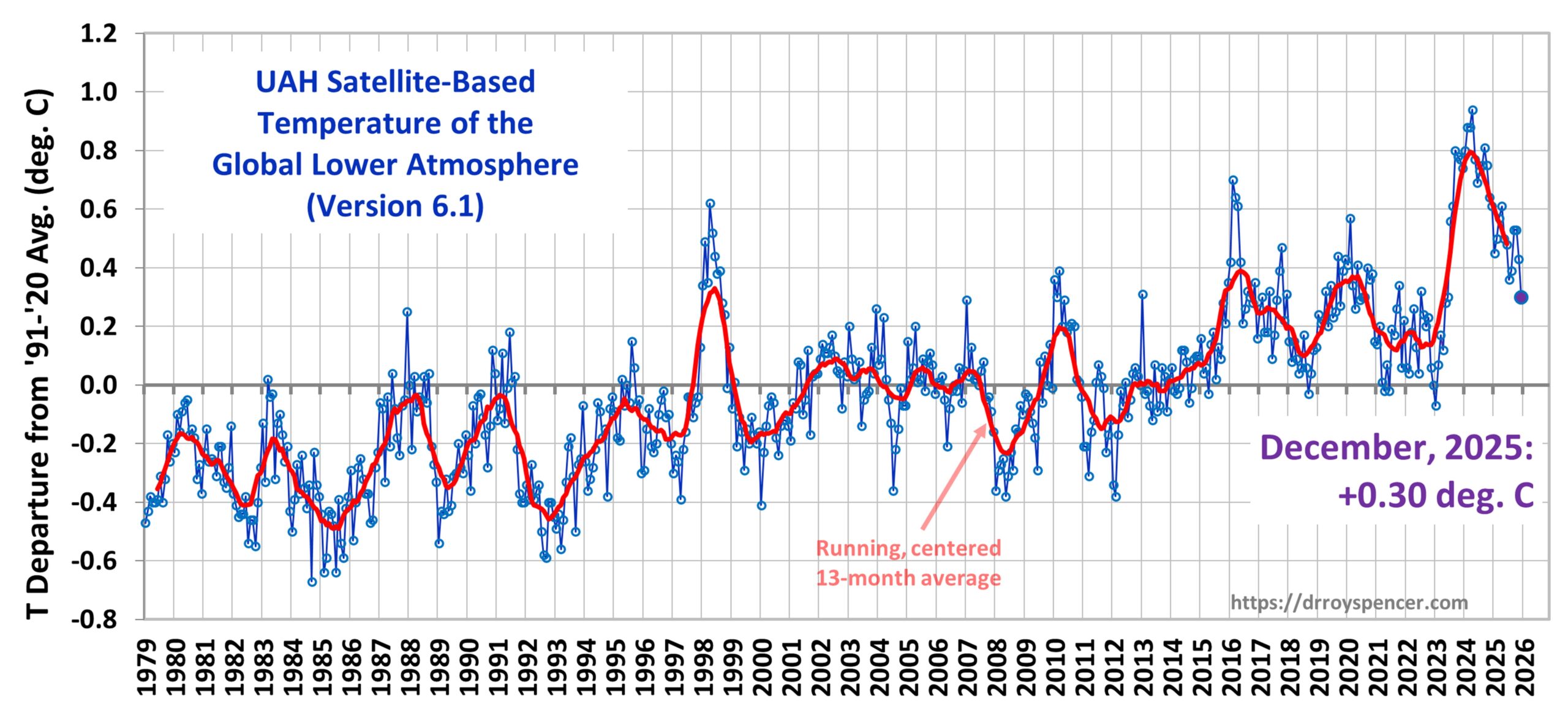
The Version 6.1 global average lower tropospheric temperature (LT) anomaly for December, 2025 was +0.30 deg. C departure from the 1991-2020 mean, down from the November, 2025 value of +0.43 deg. C. (In the following plot note that the 13-month centered-average trace [red curve] has now been updated after several months of not being updated).
The Version 6.1 global area-averaged linear temperature trend (January 1979 through December 2025) remains at +0.16 deg/ C/decade (+0.22 C/decade over land, +0.13 C/decade over oceans).
Razlogi za temperaturne rekorde 2023-2025 so številni, pri čemer ni konsenza med znanstveniki. Čeprav se zdi, da so trije glavni kandidati med razlogi predvsem erupcija podvodnega vulkana Hunga Tonga leta 2022, učinek segrevanja zaradi periodičnega pojava El Nino (segrevanje površine morja v Pacifiku) in znižanje planetarnega albeda (manjši odboj dohodnega sončnega sevanja), ki naj bi bil povezan s spremembami odeje oblakov in zlasti s spremembami nizkih oblakov. Pešanje učinka prvih dveh leta 2025 naj bi zato pripomoglo k znižanju temperatur v 2025, medtem ko naj bi se zniževanje nadaljevalo tudi v 2026 zaradi nasprotnega periodičnega pojava La Nina (ohlajanje površine morja v Pacifiku).
Nekdanji vodja podnebnih znanstvenikov pri NASA James Hansen je leta 2023 objavil članek, kjer je predstavil svojo teorijo razlogov za dolgoročni trend ogrevanja, ki je v nasprotju z večino stroke. Hansen pravi, da je učinek žveplenih aerosolov – ki so stranski produkt gorenja fosilnih goriv, povzročajo kisli dež in imajo močan, a kratkotrajen hladilni učinek z zmanjšanjem dohodnega sevanja – veliko večji, kot se na splošno navaja. Hansen zato pravi, da imajo ukrepi za znižanje izpustov fosilnih goriv kontradiktoren učinek – zaradi zmanjšanja žveplenih aerosolov zraku naj bi prišlo do zmanjšanja njihovega hladilnega učinka in s tem do porasta temperature.
Hansen je tako napovedal, da bo sredina 2020-tih let “kislinski” test njegove interpretacije razlogov za segrevanje – torej ali bo zaradi zmanjševanja izpustov iz fosilnih goriv prišlo do nadaljevanja trenda segrevanja. Zaenkrat se – glede na podatke iz leta 2025 in nadaljevanje trenda v 2026 – zdi, da njegova interpretacija glavnih razlogov za rekordno segrevanje v zadnjih treh letih morda ni najbolj ustrezna in da so ključno vlogo igrali trije učinki, omenjeni zgoraj.
Čas bo seveda pokazal, kaj so bili glavni razlogi in kaj dejansko poganja segrevanje planeta. Spodaj je ena dokaj dobra razlaga dogajanja glede tega vprašanja v znanstveni srenji.
____________
The record-breaking warming years of 2023 (1.5°C) and 2024 (1.6°C) were above expectations and shocked scientists. Their responses and the subsequent research are a good example of how quickly the physical reality is changing, driving new and contested understandings.
In late 2023, as global and ocean temperatures soared, the most upfront assessment came from Zeke Hausfather: “Staggering. Unnerving. Mind-boggling. Absolutely gobsmackingly bananas.” It was a widely-shared view, with responses such as “unprecedented” and “frightening”. “We’re not as aware of what’s coming as we thought we were,” said Sarah Perkins-Kirkpatrick of the University of NSW.
As well, the decline in Antarctic sea-ice extent was much greater than model projections, leading Walt Meier of the National Snow and Ice Data Center to exclaim: “It’s so far outside anything we’ve seen, it’s almost mind-blowing.” The same was true for North Atlantic sea surface temperatures (SSTs), which were literally off the chart. The 2023 recording-breaking heat was widely explained as a consequence of an El Niño which had developed during the year; plus small contributions from reduced aerosols due to cleaner shipping fuel policies, the massive eruption of Hunga Tonga–Hunga Haʻapai, and increased solar activity (<0.1°C in toto); and unknown factors or a “gap” of 0.2°C.
By January 2024, CarbonBrief proffered: “While there are a number of factors that researchers have proposed to explain 2023’s exceptional warmth, scientists still lack a clear explanation for why global temperatures were so unexpectedly high… researchers are just starting to disentangle the causes of the unexpected extreme global heat the world experienced in 2023.”
El Niño conditions impact ocean and atmospheric circulations, producing a short-term spike in temperature. There was a general expectation amongst scientists that 2024 would not be as hot as 2023 because the El Niño would fade, as it had by April 2024. But 2024 ended up being even hotter, with global average warming of 1.6°C.
One scientist who did have an explanation from the beginning was former NASA science chief James Hansen, who in March 2024 wrote that “for all practical purposes the 1.5°C global warming level has been reached in the mid-2020s”. Whilst many disagreed, within a year the tone of the conversation had changed, with headlines such as “Earth is already shooting through the 1.5°C global warming limit, two major studies show”.
Hansen’s views are sometimes portrayed as outliers because he defies group-think, yet he has an impeccable record. For a long time, Hansen has been saying that the impact of sulphate aerosols — which are a byproduct of burning fossil fuels, cause acid rain, and have a strong but short-term cooling effect by reducing incoming radiation — is much greater than generally stated. A higher aerosol forcing implies higher climate sensitivity, which is a measure of the Earth’s temperature response to increase greenhouse gases, and a higher forcing means more future warming than in conventional climate modelling.
Whilst the orthodox estimates for the aerosol impacts are around 0.5°C of cooling, Hansen and his colleagues say it is likely above 1°C. More on Hansen’s analysis may be found in the 2023 paper “Global warming in the pipeline”, which former UK Chief Scientist Sir David King says is “one of the most important published on the state of the climate crisis in years”.
In Hansen’s view, the efforts to clean up maritime shipping emissions by mandating emissions with much lower sulphur content resulted in the “Faustian bargain” being exposed: as the sulphate cooling impact has reduced — particularly in the North Atlantic which is the world’s busiest shipping route — greater warming has been revealed.
Then, in late 2024, researchers announced that the unexpected jump in warming could be primarily explained by “a record-low planetary albedo” (less reflection of incoming solar radiation) that is “quite obviously linked to cloud changes and, in particular, low cloud changes” in the northern mid-latitudes and tropics, in continuation of a multi-annual trend, due to “internal variability, reduced aerosol concentrations, or a possibly emerging low-cloud feedback”.
Aerosols boost reflectivity by increasing low-cloud brightness and their coverage. And that impact is stronger and non-linear in relatively pristine ocean air, such as over the North Atlantic which has been the location for both the greatest surge in SSTs and the greatest decrease in shipping aerosols. Hansen said the new findings affirm that a key driver of the unprecedented warming is the reduction of sulfate aerosol pollution over Northern Hemisphere oceans.
So now there is a real contest of analyses between Hansen and his colleagues, and the many scientists who maintain that the aerosol impact on recent warming is relatively minor, and climate sensitivity lower than Hansen’s analysis.
We have reached what Hansen has called an “acid” test of his interpretation, which will be “provided by the 2025 global temperature: unlike the 1997-98 and 2015-16 El Ninos, which were followed by global cooling of more than 0.3°C and 0.2°C, respectively, we expect global temperature in 2025 to remain near or above the 1.5°C level”, due to both the reduction of sulfate aerosols over the ocean remaining in place, and to high climate sensitivity which implies that the warming from recently added forcings is still growing significantly.
That is contrary to the more conservative, orthodox view which would suggest that during the current period without an El Nino and with a relatively small impact from declining aerosols, warming should drop back to 1.2 to 1.3°C.
The evidence so far in 2025 leans Hansen’s way. January was 1.75°C, February was 1.59°C and March 1.6°C, an average of 1.65°C for the first quarter of the year. Even though the El Nino was fading by April 2024, the 12-month period of April 2024 – March 2025 was 1.59°C above the pre-industrial level.
This recent history shows how vexed is the debate about the events of 2023-24, opening up very different opinions of what is and will occur in the future. If for practical purposes we are now at 1.5°C and acceleration means 2°C by around 2040, that has profound implications for the future of AMOC, and how long and by what means we can respond to many elements of the climate system approaching their tipping points.
The “Pipeline” paper warns that “we are in the early phase of a climate emergency” and that acceleration in warming is “dangerous in a climate system that is already far out of equilibrium. Reversing the trend is essential – we must cool the planet – for the sake of preserving shorelines and saving the world’s coastal cities” (emphasis added).
 DAMIJAN blog
You must be logged in to post a comment.