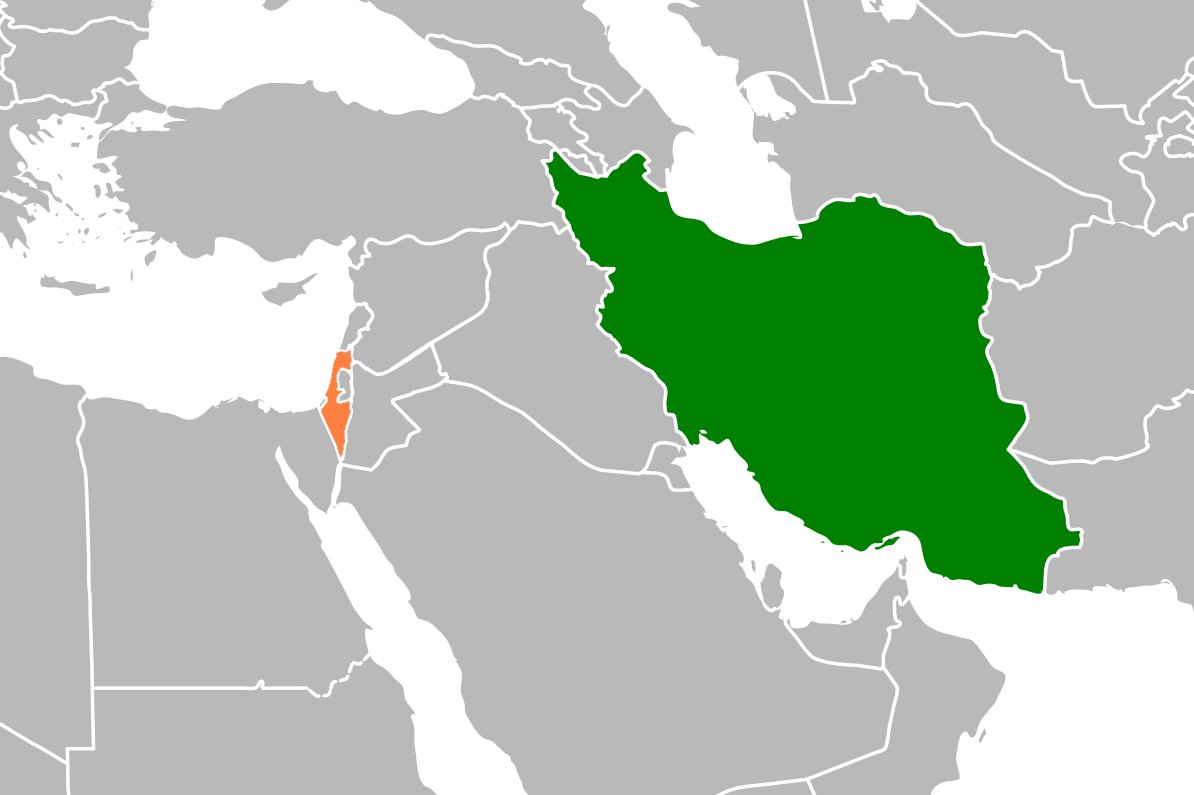
Who can take the blows longer? Let’s look at a very “outer bound,” absolute metric. Israel’s total land area is 8100 sq mi of which only 1200 mi is inhabited, once you subtract the Negev (4700 sq mi) and agricultural land.
That’s it. 1200 sq mi.
Iran possesses on the order of 5-8,000 missiles. More drones. And the ability to produce these entirely domestically at hundreds of missiles a month.
So that means 7 ballistic missiles and maybe 16-20 drones per square mile of inhabited land in Israel.
Or a delivery capacity of about FIVE METRIC TONS of explosives PER square mile.
Iran’s land area is 636,000 sq miles.
Quite a bit more.
Vir: Amir Husain
______________
The numbers Amir Husain lays out reveal a structural truth Israel has tried to obscure through doctrine, deterrence theatrics, and borrowed reach. Israel’s true strategic surface, the 1,200 square miles that matter, is terminally small. Strip away the uninhabited Negev and unstrikeable agricultural belts, and what remains is a hyper-dense, fragile lattice of power, industry, and C4I nodes stacked atop civilian density. No strategic depth, no room to maneuver, and no capacity to absorb. Every hit is a system hit.
Meanwhile, Iran operates from a defense-in-depth paradigm, 636,000 square miles of sovereign volume, dozens of hardened redundancies, and decades of war-conditioned infrastructure. But more importantly, Iran manufactures its missile inventory domestically at industrial scale. Israel does not. The Israeli war machine is a proxy scaffold: F-35s from Lockheed Martin, interceptors from Raytheon, C4I firmware with NSA backdoors, and kill-chain logistics that begin and end in the Pentagon.
This is why Tel Aviv’s confidence is not self-derived. CENTCOM is the real command spine, and the entire Israeli escalation posture is designed with one core assumption: the Americans will step in before the ammo runs out. But the calculus flips if the U.S. blinks, delays, or decides, under resource pressure from the Pacific or domestic unrest, that a second-hand war with a nuclear-threshold state isn’t worth it.
Israel can’t afford a war of endurance. Its war doctrine is blitzkrieg underwritten by U.S. stockpiles, U.S. satellites, U.S. fuel, and U.S. political shielding. In a pure volume exchange, it collapses, not tactically, but systemically. Which is why every Iranian salvo isn’t just a test of Iron Dome. It’s a test of how far America is willing to bleed for a client with no room to miss.
Vir: Thomas Keith
 DAMIJAN blog