Uršulin načrt za oborožitev Evrope (ReArm), oziroma od kod številka 800 milijard evrov, sem ta teden sicer večkrat razložil večim novinarjem in kolegom, tudi v včerajšnji kolumni, in sicer:
ReArm predvideva posojila v višini do 150 milijard evrov za oborožitev, kar bi ob predpostavki povečanja izdatkov za obrambo posameznih držav za do 1,5 % BDP lahko mobiliziralo skupaj do 800 milijard evrov za evropsko obrambo.
Vendar pa je potreben dodaten komentar realističnosti tega načrta, ki naj bi EU rešil pred “rusko nevarnostjo”. Kajti, kot slišim, ljudje res mislijo, da gre za realno številko, da se bo poraba zgodila v tem letu in da bomo takrat “odporni na Rusijo”, Trumpa in vse druge sovrage, ki nam jih bodo predstavili kot sovrage.
Ta načrt je, kot vsi ostali Uršulini načrti, seveda bullshit. Ta načrt ne bo rešil problema evropske vojaške podhranjenosti. In tudi če bi porabili teh dodatnih 800 milijard evrov, in to v enem letu, in oblikovali evropski jedrski ščit, sodoben panevropski protizračni sistem, dodali 500 novih najboljših evropskih letal in 3,000 novih najboljših evropskih tankov ter dodatnih 700 tisoč za boj pripravljenih vojakov, vse to v enem letu, ne pa v 10 do 15 letih, kar je realistično, še vedno ne bi bili “odporni na Rusijo”.
Še vedno ne bi imeli obrambe pred ruskimi hipersoničnimi raketami, ker pač te obrambe nima niti ameriška vojska. Ker je prepustila razvoj teh podjetij zasebnim podjetjem, ti so porabili milijarde dolarjev za razvoj, vendar brez uspeha pri razvoju primerljivih hipersoničnih raket z ruskimi. Rusija ima bogat arzenal hipersoničnih raket s hitrostmi do 20 machov (glejte spodaj tabelo), ki jih ni mogoče prestreči. Obstaja sicer hipotetična diskusija, ali je mogoče prestreči najpočasnejši ruski hipersonični raketi (iskander in kinžal, s hitrostmi med 6-7 in 10 machov) v terminalni fazi leta z ameriško protizračno raketo Patriot, ki dosega hitrosti le med 2.1 in 5 machov (no Ukrajinci se hvalijo, da naj bi s patriotom prestregli enega kinžala, ampak Ukrajincem ne gre nič verjeti, ker so po pravilu poročali da so sestrelili več ruskih raket, kot so jih Rusi sploh izstrelili; ameriških patriotov pa v Ukrajini ni več, ker so jih ruski kinžali vse potamanili, in tako ne bomo vedeli, ali ta hipotetična možnost obstaja).
| Missile Name | Speed (Mach) | Speed (km/h) | Description |
| 3M22 Zircon | 8–9 | 9,800–11,025 | The 3M22 Zircon is a hypersonic cruise missile capable of reaching speeds up to Mach 9. It can engage both sea and land targets within a range of approximately 1,000 km. |
| Kh-47M2 Kinzhal | 10 | 12,350 | The Kh-47M2 Kinzhal is an air-launched ballistic missile with a top speed of Mach 10. It has a range of 1,500–2,000 km and can carry either conventional or nuclear warheads. |
| 9K720 Iskander | 6–7 | 7,350–8,610 | The 9K720 Iskander is a mobile short-range ballistic missile system with a speed of Mach 6–7. It has a range of up to 500 km and can carry various types of warheads, including conventional and nuclear. |
| RS-28 Sarmat | 20+ | 24,700+ | The RS-28 Sarmat, also known as “Satan 2,” is an intercontinental ballistic missile (ICBM) with a speed exceeding Mach 20. It is designed to deliver multiple nuclear warheads over intercontinental distances. |
| Oreshnik | 10 | 12,350 | The Oreshnik is a recently tested intermediate-range ballistic missile with a speed of Mach 10. It has been used in combat situations and is capable of carrying both conventional and nuclear warheads. |
| S-400 Missile System | Up to 14 | Up to 17,150 | The S-400 Triumf is an anti-aircraft weapon system equipped with missiles that can reach speeds up to Mach 14. It is designed to engage a variety of aerial targets, including aircraft and ballistic missiles, at ranges up to 400 km. |
Vir: Generirano s ChatGPT
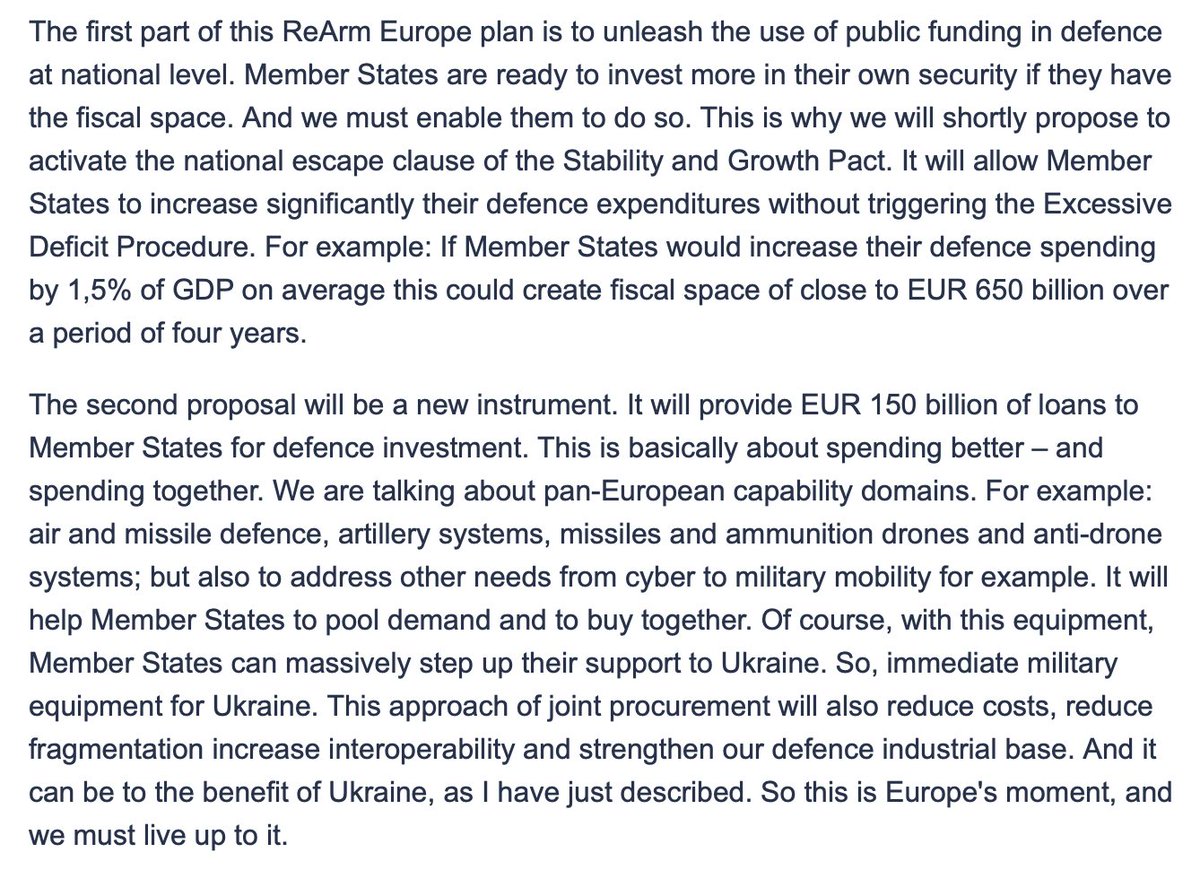
Toda v Evropi imamo problem že v prvem koraku. Uršulin načrt je piarovski fejk. Teh 800 milijard evrov je izsesanih iz prsta. Teh 800 milijard evrov je potencialna možnost, če bi vlade EU držav želele uporabiti posojilo iz posojilnega mehanizma v skupni višini 150 milijard evrov za nakup vojaške opreme in preostalih 650 milijard evrov, če bi se odločile, da povečajo vojaške izdatke za 1.5 % BDP (v tem primeru bi lahko zaprosile za začasni suspenz fiskalne omejitve glede proračunskega deficita (3 % BDP) za ta namen. In teh 800 milijard evrov naj bi se hipotetično in potencialno mobiliziralo v 4 letih.
Torej če če če … v 4 letih. Lahko se mobilizira tudi 0 evrov (v 4 letih), če se članice ne odločijo, da bi zvišale vojaške izdatke in v ta namen vzele posojili Komisije ali zaprosile za suspenz fiskalnega pravila v ta namen. Niti en dodatni evro za orožje ni zagotovljen. Vse so le besede.
Uršulini piarovski triki so … Ah, ne bom si umazal rok s tem.
Spodaj je sočen komentar Philippa Lemoina na to temo.
___________
Do you remember the headline about how the EU had agreed on a plan to spend 800 billion euros more on defense? A document that was published today by Von der Leyen’s office (https://ec.europa.eu/commission/presscorner/detail/sv/statement_25_673) explains how they arrived at that number.
First, they created a new instrument that will make available 150 billion euros in loans, which member states may or may not avail themselves of. Second, they decided that, if that’s to increase defense spending, member states could invoke the national escape clause of the Stability and Growth Pact.
The Pact ordinarily commits member states to limit their deficit to 3% of the GDP. In theory, if they exceed that limit, they can be subject to penalties. With that decision, if they increase their deficit because they raised their defense spending, it won’t count toward the 3% rule.
To illustrate the idea, the Commission explains that if member states increase their defense spending by 1.5 points of GDP (it’s just a totally arbitrary example, they don’t give any reason to think member states will do that and they sure as hell haven’t committed to doing so), it will amount to 650 billion euros of extra defense spending.
Since 150 billion euros + 650 billion euros = 800 billion euros, that’s apparently where the 800 billion figure comes from – I know it sounds like a joke but that really seems to be the explanation for the headline figure.
They say that, by exempting defense spending increases from the Stability and Growth Pact (frankly it’s not even clear exactly how this will work, because it’s not as obvious as it seems once you start thinking about it), they will create fiscal space.
Of course, that’s complete nonsense, because fiscal space is not primarily determined by EU rules on the deficit (which many countries, such as France, have been systematically violated for 30 years), but by the market. There is no reason to think that member states will actually increase their defense spending by 650 billion euros.
Even the 150 billion euros in loans is nothing more than a possibility that is given to member states. There is no guarantee that it will actually be used and, even if they do use it, it will be counted in defense spending, so the other 650 billion euros would have to come on top of that.
Moreover, even if they do spend an extra 800 billion euros on defense (which to be clear has virtually zero chance of happening), this figure is apparently for a period of 4 years.
Since last year defense spending in the EU amounted to ~326 billion euros (https://consilium.europa.eu/en/policies/defence-numbers/), it would result in a ~60% increase, barely enough to raise the bloc’s defense spending to the 3% that Macron and other European leaders mentioned, which in fact may be the reason why they chose a 1.5% of GDP increase — again it’s purely ad hoc — to illustrate their decision on the national escape clause.
They mention a few other things, but they’re even more vague and don’t include any figures, not even bullshit figures like the 650 billion euros one. Once again, all the talk about how they see the war in Ukraine as “existential”, the virtue signaling and the chest thumping is complete bullshit, nothing fundamental is going to change.
Vir: Philippe Lemoine via X
 DAMIJAN blog
You must be logged in to post a comment.