Prva dva izmed spodnjih grafov sta uporabna pri evaluaciji ali je bila kitajska high-tech industrijska politika uspešna ali ne. ostali so bolj tako, nekateri (RCA) celo napačno interpretirani
It has been ten years since the People’s Republic of China launched its ‘Made in China 2025’ initiative — a decade-long plan to make China dominant in high-tech manufacturing across a range of sectors — including IT, new energy and robotics. To the best of our knowledge, Fathom’s recently updated RiCArdo dataset is the only existing dataset designed specifically to assess China’s progress in the sectors targeted by the plan. It shows that MIC-related sectors combined accounted for 18.8% of China’s total goods exports in 2023, up from 15.6% when the plan was first announced.

China has achieved a high degree of success in many of the sectors targeted by the Made in China 2025 plan. As the chart below shows, between 2005 and 2023 China increased its global export market share in each of the nine target sectors. Moreover, it is also the market leader in four of these nine sectors, being either second- or third-placed in three more.
However, this achievement is synonymous with China’s position, more broadly, as a world leader in manufacturing. To assess whether China has achieved greater specialisation in these sectors we must look at its revealed comparative advantage, or RCA (a measure of how specialised a country is in a particular product). On this metric, China’s progress has been less impressive, holding a comparative advantage in only five of the nine high-tech sectors targeted by the MIC 2025 plan — with the ‘new energy’ sector being the only addition since 2015.
Ordinarily, you would expect that, as China became more integrated into the global economic system, it would increasingly specialise in the sectors where it is comparatively more efficient (typically goods), and rely on imports for those in which it is comparatively less efficient (typically services). However, China’s broad-based export expansion suggests that it does not adhere to this pattern; instead, China appears to be attempting to dominate export markets in all sectors simultaneously.
Within the Made in China plan, progress has proved difficult in some sectors, particularly IT. China’s RCA in MIC-related IT goods, which are predominantly made up of intermediate IT products (particularly semiconductors), is only slightly above one — a score indicating that the country is only slightly more specialised than the global average. Moreover, progress in this sector appears to have actually slowed since President Xi took office in 2013. This contrasts with China’s RCA scores for finished IT products, such as phones and computers, which are several times higher.
Despite being the second largest exporter of MIC-related IT products globally, after Taiwan, China continues to be far from self-sufficient. China has consistently run a trade deficit in IT every year, as far back as 2003, when our data begin. As a result, on aggregate, it had a $250 billion deficit in the MIC sectors in 2023 — although this deficit has declined in recent years, suggesting progress is being made.


Vir: LSEG
Dodal sem še grafa glede kitajske dominacije v proizvodnji in izvozu avtomobilov:
China now dominates global car production. Second place isn’t even close. In 1998, China accounted for 1.4% of global car production. In 2023, China accounted for 38.4% of global car production.

Vir: Jostein Hauge via X
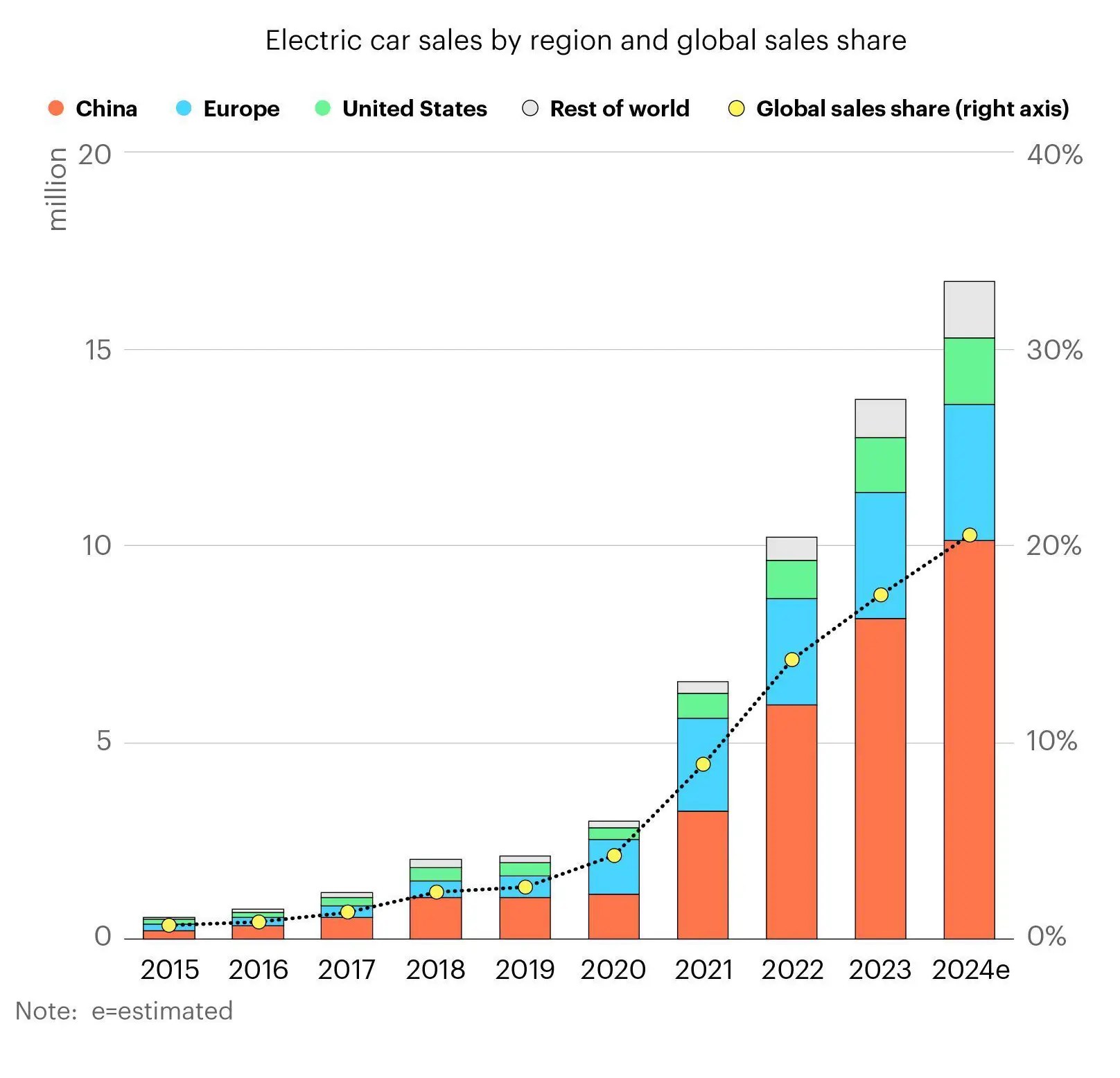
China share in globals sales of EVs
Delež Kitajske v prodanih e-avtih je več kot 60 %.
 DAMIJAN blog
Ker je kitajska vizija postati in ostati tovarna sveta. Vizija EU je pa political correctness in uvoz delovne sile za ohranjanje status quo oz. polnjenja delovnih mest, ki jih ustvari kapital v storitveni dejavnosti, kar je delala tudi Amerika v zadnjih 30 letih. Ampak brez vizije kaj in kako naprej v naslednjih 25 letih in predvsem brez cilja ohranjanja dobre bilance trgovanja z ostalim svetom. Je pa seveda vprašanje časa kdaj bodo tudi Kitajci padli v situacijo, ko se bo njihova inovativnost ustavila zaradi visokih stroškov vzdrževanja status quo in želje Kitajcev po lagodnem življenju oz. preživljanju prostega časa tako kot se je na zahodu, če mogoče že niso tam.
Všeč mi jeVšeč mi je