Se Evropa še lahko vrne k razumu in prepreči svoj zaton?

Gospodarski zaton in socialni kolaps Evrope je v tem trenutku morda še mogoče preprečiti. Predpogoj pa je, da bi se v Evropo vrnili razum, racionalni pogled na situacijo in posledična vojaška in politična osamosvojitev od ZDA in diverzifikacija gospodarskih odnosov (večja povezava z Evrazijo in državami globalnega juga).

Glenn Diesen:

I had a conversation with Jeffrey Sachs and Alexander Mercouris about the political changes in Europe. The optimism of the European project as a region of peace and prosperity is long gone. The objective had been to resolve conflicts on the continent peacefully and use collective bargaining power to establish greater economic and political independence. Instead, the continent is experiencing war, de-industrialisation, socio-economic and political instability, excessive dependence on the US, and growing irrelevance in the wider world. What went wrong and can the decline be reversed?

The rest of the world adjusts to the emerging multipolarity with a multivector foreign policy by diversifying economic connectivity to improve economic competitiveness and enhance political autonomy. In contrast, the Europeans have subordinated themselves completely to the US and thus suffer from economic decline and political subordination. Declining rationality is also a clear problem as the Europeans pursued policies towards Russia that they knew would put them on a collision course with Russia. Instead of pursuing course correction, the proxy war with Russia increased the security dependence on the US, which enabled Washington to impose bloc discipline. The recovery of Europe requires reversing the militarisation of dividing lines in Europe, and diversifying economic ties to avoid excessive dependence on any one state or region.

Merklova o ameriškem sabotiranju Severnega toka

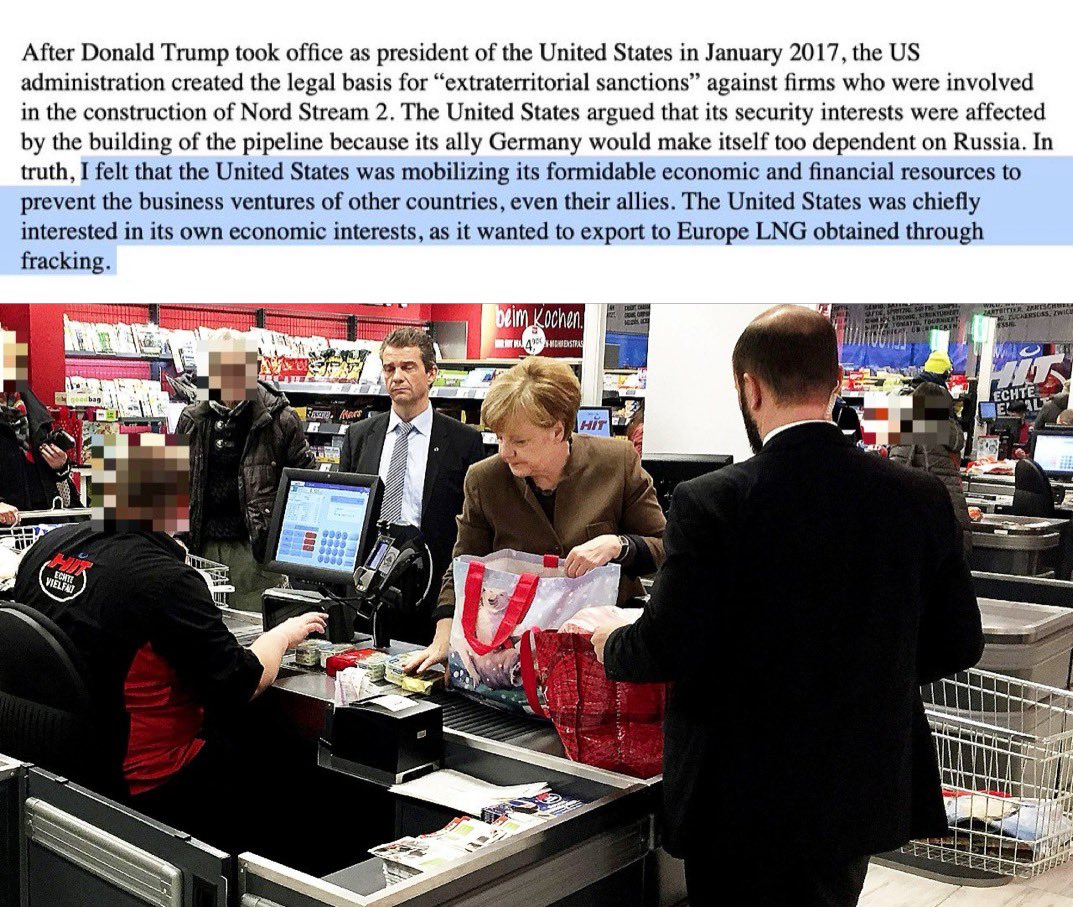
Objavljeni Spomini Angele Merkel so in bodo zanimivo branje. Glede na do sedaj objavljene navedbe sta se mi vtisnili v spomin predvsem dve. Prva je na temo nasprotovanja Merklove vključitvi Ukrajine v Nato, ker bi to privedlo do vojne v Ukrajini že bistveno prej. Druga pa se nanaša na ameriško nasprotovanje gradnji plinovoda Severni tok. Ameriška administracija je imela tukaj dva interesa. Prvi je bil, da se Nemčija ne naveže na Rusijo, drugi pa ekonomski interes, ker so želeli delati posel z izvozom ameriškega utekočinjenega plina v Evropo (ki je seveda bistveno dražji od ruskega).

I felt that the United States was mobilizing its formidable economic and financial resources to prevent the business ventures of other countries, even their allies. The United States was chiefly interested in its own economic. The United States was chiefly interested in its own economic interests, as it wanted to export to Europe LNG obtained through fracking.

Trump je najboljše upanje Ukrajine za mir

Morda zveni kot cinizem, morda celo je cinizem, vendar je res. Kajti Biden Ukrajini ni prinesel miru in ji ga tudi ne bi, tudi če bi dobil še en mandat. Biden je Ukrajino pahnil v vojno in jo držal v njej, dokler ji ne zmanjka moških in ozemlja.

While Putin’s caution during previous crises suggests he’s not about to reach for the nuclear button just yet, his dramatic response has complicated any path to a peace deal. Meanwhile, some liberal voices have predicted that Trump’s looming presidency, far from hastening an end to the conflict as Trump has promised to do, will prolong it. If Trump were to cut off arms to Ukraine, he’d remove an important incentive for Putin to call it quits, according to Ben Rhodes, a former White House official under Barack Obama. Among conservatives who advocate foreign policy restraint, there is worry that Trump’s hawkish cabinet nominees portend a departure from the peace agenda he campaigned on. Meanwhile, many hawks on both left and right believe that Trump may end the war by just giving away the farm to Putin.

These concerns are valid. But Trump has good reasons to try proving the doubters wrong. He understands that foreign policy debacles can crater a president’s approval ratings, and he has staked his reputation on being able to end a conflict that started and continues to escalate on President Joe Biden’s watch. “I’m the only one who can get the war stopped,” he told Newsweek this September. Brokering a respectable peace would be a boon to his legacy and an embarrassment for his political opponents—and Trump loves splattering egg on the faces of his detractors. So there is room for optimism alongside the worry. Trump may well manage not only to stop the war but also to get Ukraine the best deal it could realistically hope for.

Nadaljujte z branjem

Bidnova zadnja bitka proti Rusiji in Putinu, preden Trump konča vojno

Seymour Hersh:

The scene came to mind this week as I considered the bitterness of President Joe Biden, who seems to be full of resentment because a group of Democratic Party bigwigs, aware that he was failing, forced him to give up his planned re-election campaign and turn over the fight against Donald Trump to Vice President Kamala Harris, and all the more resentment because she failed to beat Trump as Biden did in 2020.

The president is no longer talking about his failed policy in the Middle East, though American bombs and other weaponry are still flowing to Israel and being put to deadly use. Biden is now trying to stem the losses in Ukraine’s war with Russia. A week ago he gave the Ukraine government, headed by President Volodymyr Zelensky, permission to fire a long withheld advanced American ballistic missile capable of hitting targets 190 miles inside Russia. Days later, he decided to provide Ukraine with landmines capable of maiming and killing all whose paths cross them, young and old, friendly and not. 

I have been told that the strategic implications of the president’s escalation—both Biden and Russian President Vladimir Putin have nuclear bombs at their fingertips—had not been fully analyzed inside the Pentagon, and that some important offices, sure to have different views about escalation, were never asked for their input. Putin responded by escalating in turn by firing a nuclear-capable ballistic missile at Ukraine and said in a speech that what had been a regional conflict “had now acquired elements of a global character.” The New York Times noted that the response “was meant to instill fear in Kyiv and the West.”

Putin’s explicit warning came a day after Biden’s decision to permit the use of American anti-personnel landmines in an effort to slow Russian advances in the Donbas region. Neither Washington nor Moscow are signatories to the international mine ban treaty that has been signed by 164 parties, but Biden’s decision to deploy the weapon was widely criticized by international human rights groups.

Nadaljujte z branjem

Ray Dalio: The Changing Domestic and World Orders Under the Trump Administration

Glavne ugotovitve wannabe finančnega guruja Raya Dalia (Bridgewater) so naslednje:

  1. Trumpova avtoritarna “vladavina” in način oblikovanja ekonomskih politik spominja na tiste iz zgodnjih 1930. let (Mussolini, Hitler), kar sicer še ne pomeni, da je Trumpa treba enačiti s fašistom.
  2. Trump se bo ukvarjal sam s seboj in se ne bo lotil ključnih ameriških problemov, ki so po njegovem izobraževanje in vzdržnost dolga.
  3. Svetovna ureditev se bo popoloma spremenila, ker ZDA več ne bodo čutile, da morajo uveljavljati svetovni red in multilateralna pravila, ampak se bodo brutalno fokusirale na svoje interese.
  4. To okolje je izjemno dobro za Kitajsko, ki bo s svojim “soft power” v tem času ekonomsko prevezela globalni Jug, kjer živio 85 % svetovnega prebivalstva.
  5. Evropa je mrtva, šibka, polna lastnih problemov in nesposobna se braniti pred Rusijo brez ZDA, kaj šele, da bi se bojevala v tej globalni bitki (“Europe is weak, has its hands full with its own problems, and doesn’t have a dog in this fight, while it has Russia on its doorstep and can’t fight it without the U.S.’s NATO support.”).

Torej, glavni zmagovalci Trumpovega mandata in razpada svetovne ureditve, kot smo jo poznali, bodo ameriški lastniki kapitala in zgornjih 5 % prebivalstva (ki zasedajo najbolje plačana delovna mesta) in Kitajska, glavni loser pa bo Evropa, ki je itak že klinično mrtva.

Torej? A Evropa sploh ima mnenje o tem, če že kreativnega programa (za spopad s svojo nekonkurenčnostjo in nepomembnostjo) nima? Ali pa je UvdL še vedno v šoku in čaka na nova navodila njenega novega šefa?

_______________

What’s Coming: The Changing Domestic and World Orders Under the Trump Administration

Now that the nightmare scenario of a close Trump loss and ensuing fight over the election has been taken off the table by a decisive Trump-led rightist sweep over Harris’s leftist alternative and a number of his key appointments have been announced, a picture of what is likely to happen is emerging. I want to make clear that the picture I am painting is meant to be as accurate as possible without any biased opinions of good or bad, because accuracy is what’s most important for making decisions in the best possible way.

The picture that I see is one of 1) a giant renovation of government and the domestic order aimed at making it run more efficiently, which will include an internal political war to convert that vision into reality, and 2) an “America first” foreign policy and preparation for external war with China, which is perceived to be America’s greatest threat. The most recent analogous period is the 1930s, when such an approach emerged in several countries.

The people Donald Trump is choosing to make this happen with him are: Elon Musk and Vivek Ramaswamy, who will run the newly proposed Department of Government Efficiency; Matt Gaetz, who, as Attorney General (if he gets the Senate’s approval), will push the legal limits of what those who are running this new order can do; RFK Jr., who would radically reform the healthcare system, as Secretary of Health and Human Services; and Marco Rubio as Secretary of State, Tulsi Gabbard as Director of National Intelligence, and Pete Hegseth as Secretary of Defense, who will lead the fight against foreign adversaries. Many, many others—some who might be in government and some who will be outside advisors, like Tucker Carlson, Steve Bannon, and a few Trump family members—will be on the mission with Trump. They are all win-at-all-cost loyalists to the leader and to the mission of bringing down the so-called “deep state” and replacing it with a new domestic order that they hope will create maximum economic strength and fight foreign enemies.

Nadaljujte z branjem

Oreshnik: Russia’s groundbreaking new ballistic missile

Zastrašujoče. Z eno raketo je mogoče zadeti 6 vojaških baz in znotraj vsake baze po 6 ciljev ali več. Zgolj na podlagi kinetične energije je mogoče prebiti armirane površine nekaj deset metrov globoko.

Zastrašujoče. Sploh, če pomislimo, da so si Rusi bili prisiljeni pomagati s čipi iz pralnih in pomivalnih strojev…

Če bi bil predsednik vlade Nemčije, Italije ali V. Britanije ali predsednik Francije, ne bi prav mirno spal.

Podnebni COP29: Kres prestižnega elitizma in ničevosti

Glavno sporočilo spodnjega članka o podnebni konferenci COP29:

Glavna ovira za doseganje naložbenih ciljev za omejitev globalnega segrevanja ni cena obnovljivih virov v primerjavi z energijo fosilnih goriv, pač pa donosnost obnovljivih virov v primerjavi s proizvodnjo fosilnih goriv. Tržne rešitve ne bodo delovale, ker zasebnim podjetjem preprosto ni donosno vlagati v blažitev podnebnih sprememb.

No, jaz bi k temu dodal dvoje. Prvič, večina ljudi, ki se ukvarjajo s podnebnimi spremembami, ne razume, da v njihovem modelu človeškega vpliva na povečanje CO2 izpustov ključno vlogo igra globalizacija svetovne trgovine. Ko smo proizvodnjo industrijskih izdelkov preselili v Azijo in na globalni Jug, smo v globalnem Severu nekoliko znižali izpuste CO2. Toda v Aziji in na jugu zdaj proizvajajo te izdelke bistveno bolj umazano (nižji okoljski srandardi) in za potrebno energijo za njihovo proizvodnjo dnevno odpirajo nove elektrarne na premog in plin, nato pa te izdelke na daleč najbolj umazan način s kontejnerskimi ladjami vozimo nazaj na Sever. Bistvo zgodbe je, da se bodisi odpovemo globalizaciji ali da manj razvite države, ki za nas proizvajajo vse izdelke, prepričamo, da energijo proizvajajo na bolj čist način in da izdelke k nam vozimo na bolj čist način.

In drugič, subvencije za obnovljive vire, ki povečujejo donosnost v njihove naložbe, ne delujejo in ne vodijo k vzdržnim rešitvam. Takoj, ko jih umaknemo ali zmanjšamo, donosmost “obnovljivih projektov” kolapsne, dolgoročno pa si nobena država ne more privoščiti v nedogled subvencionirati zasebna podjetja. Rešitev je treba iskati drugje – ne v sončnih in vetrnih elektrarnah, gromozanskih baterijah in zelenem vodiku, ker je ta koncept tehnično nevzdržen in ekstremno drag, pač pa v hidro in jedrski energiji, ki sta izdatna, stabilna, brezogljična, prijazna do okolja (glede na alternative) in dolgoročno daleč najcenejša vira. In ne potrebujeta nobenega subvencioniranja. Tu pa je treba angažirati javne finance, ki edine lahko zagotovijo nizko ceno financiranja. Zasebni kapital si bo hotel odrezati prevelik donos, zato pozabimo nanj pri teh ključnih strateških naložbah v prihodnost.

There was a tortuous and painful end to COP29, the international climate change conference held in oil-rich Baku, Azerbaijan. The main issue was how much would the rich countries hand over to the poor countries to pay for the measures to mitigate global warming and handle the damage caused by rising ‘greenhouse gas’ emissions. The finance target set was for more than $1.3trn a year by 2035. But the final deal was based on just $300bn in actual grants and low-interest loans from the developed world. The rest would have to come from private investors and perhaps levies on fossil fuels and frequent flyers – the details of which remained vague.

The offer from the ‘developed’ countries, funded from their national budgets and overseas aid, is supposed to form the inner core of a so-called ‘layered’ finance settlement, accompanied by a middle layer of new forms of finance such as new taxes on fossil fuels and high-carbon activities, carbon trading and ‘innovative’ forms of finance; and an outermost layer of investment from the private sector, into projects such as solar and windfarms. This was a ‘copout’ from providing real money transfers.

Mohamed Adow, director of the Power Shift Africa thinktank, said: “This [summit] has been a disaster for the developing world. It’s a betrayal of both people and planet, by wealthy countries who claim to take climate change seriously. Rich countries have promised to ‘mobilise’ some funds in the future, rather than provide them now. The cheque is in the mail. But lives and livelihoods in vulnerable countries are being lost now.”

Nadaljujte z branjem

Senator Lindsay Graham o vojni v Ukrajini: “To enrich ourselves…”

Težko je verjeti, dokler ne slišiš iz njihovih lastnih ust. Vojna v Ukrajini je po besedah senatorja Grahama vojna za redke minerale (vredne nekaj tisoč milijard dolarjev) in najboljša naložba ZDA, ki v ej bojni ne bo izguvila nobenega vojaka.

Kaj pa Ukrajina in njeni ljudje? Ah, lahko so srečni, da se bojujejo za ameriške politične in gospodarske namene. Do zadnjega Ukrajinca.

Shlomo Sand: Iznajdba judovskega ljudstva

Čas za osvežitev poznavanja zgodovine.

A historical tour de force that demolishes the myths and taboos that have surrounded Jewish and Israeli history, The Invention of the Jewish People offers a new account of both that demands to be read and reckoned with. Was there really a forced exile in the first century, at the hands of the Romans? Should we regard the Jewish people, throughout two millennia, as both a distinct ethnic group and a putative nation—returned at last to its Biblical homeland?

Shlomo Sand argues that most Jews actually descend from converts, whose native lands were scattered far across the Middle East and Eastern Europe. The formation of a Jewish people and then a Jewish nation out of these disparate groups could only take place under the sway of a new historiography, developing in response to the rise of nationalism throughout Europe. Beneath the biblical back fill of the nineteenth-century historians, and the twentieth-century intellectuals who replaced rabbis as the architects of Jewish identity, The Invention of the Jewish People uncovers a new narrative of Israel’s formation, and proposes a bold analysis of nationalism that accounts for the old myths.

Main findings:

  • The expulsion of Jews from Judea did not happen.
  • Many Judean Jews accepted Islam and are the ancestors of today’s Palestinians.
  • The “nation-race” of Jews with a common origin doesn’t exist and the “Jewish diaspora” is a modern invention.
  • The ancestors of European Jews mostly converted to Judaism and have no origin in Palestine.

After a long stay on Israel’s bestseller list, and winning the coveted Aujourd’hui Award in France, The Invention of the Jewish People is finally available in English. The central importance of the conflict in the Middle East ensures that Sand’s arguments will reverberate well beyond the historians and politicians that he takes to task. Without an adequate understanding of Israel’s past, capable of superseding today’s opposing views, diplomatic solutions are likely to remain elusive. In this iconoclastic work of history, Shlomo Sand provides the intellectual foundations for a new vision of Israel’s future.

____________

Shlomo Sand is a Jewish Professor of History at Tel Aviv University

Nadaljujte z branjem

Chomsky je imel prav: Mit ameriškega idealizma

Spodaj je izvleček iz dobre recenzije zadnje knjige Noama Chomskega in Nathana J. Robinsona “The Myth of American Idealism”. Chomsky in Robinson še enkrat več razzbijata mit, da ameriško zunanjo poolitiko vodijo dobri nameni in moralna načela in da so slabe stvari, ki se zgodijo, zgolj nezaželene stranske posledice. Nasprotno – ameriška zunanja politika je to, kar se kaže tudi navzven: brutalno uveljavljanje ameriške globalne hegemonije z vsemi sredstvi.

Seveda ni zanemarljivo, da je recenzijo napisal Stephen M. Walt, profesor politologije na univerzi Harvard in eden izmed vodilnih teoretikov realizma v mednarodnih odnosih (sicer tudi skupaj z Johnom Mearsheimerjem soavtor knjige “The Israel Lobby”.

For more than half a century, Noam Chomsky has been arguably the world’s most persistent, uncompromising, and intellectually respected critic of contemporary U.S. foreign policy. In a steady stream of books, articles, interviews, and speeches, he has repeatedly sought to expose Washington’s costly and inhumane approach to the rest of the world, an approach he believes has harmed millions and is contrary to the United States’ professed values. As co-author Nathan J. Robinson writes in the preface, The Myth of American Idealism was written to “draw insights from across [Chomsky’s] body of work into a single volume that could introduce people to his central critiques of U.S. foreign policy.” It accomplishes that task admirably.

caption tk herecaption tk here

The Myth of American Idealism: How U.S. Foreign Policy Endangers the World, Noam Chomsky and Nathan J. Robinson, Penguin, 416 pp., $32, October 2024.

As the title suggests, the central target of the book is the claim that U.S. foreign policy is guided by the lofty ideals of democracy, freedom, the rule of law, human rights, etc. For those who subscribe to this view, the damage the United States has sometimes inflicted on other countries was the unintended and much regretted result of actions taken for noble purposes and with the best of intentions. Americans are constantly reminded by their leaders that they are an “indispensable nation” and “the greatest force for freedom the world has ever known,” and assured that moral principles will be at the “center of U.S. foreign policy.” Such self-congratulatory justifications are then endlessly echoed by a chorus of politicians and establishment intellectuals.

Nadaljujte z branjem