Čas za osvežitev poznavanja zgodovine.
Main findings:
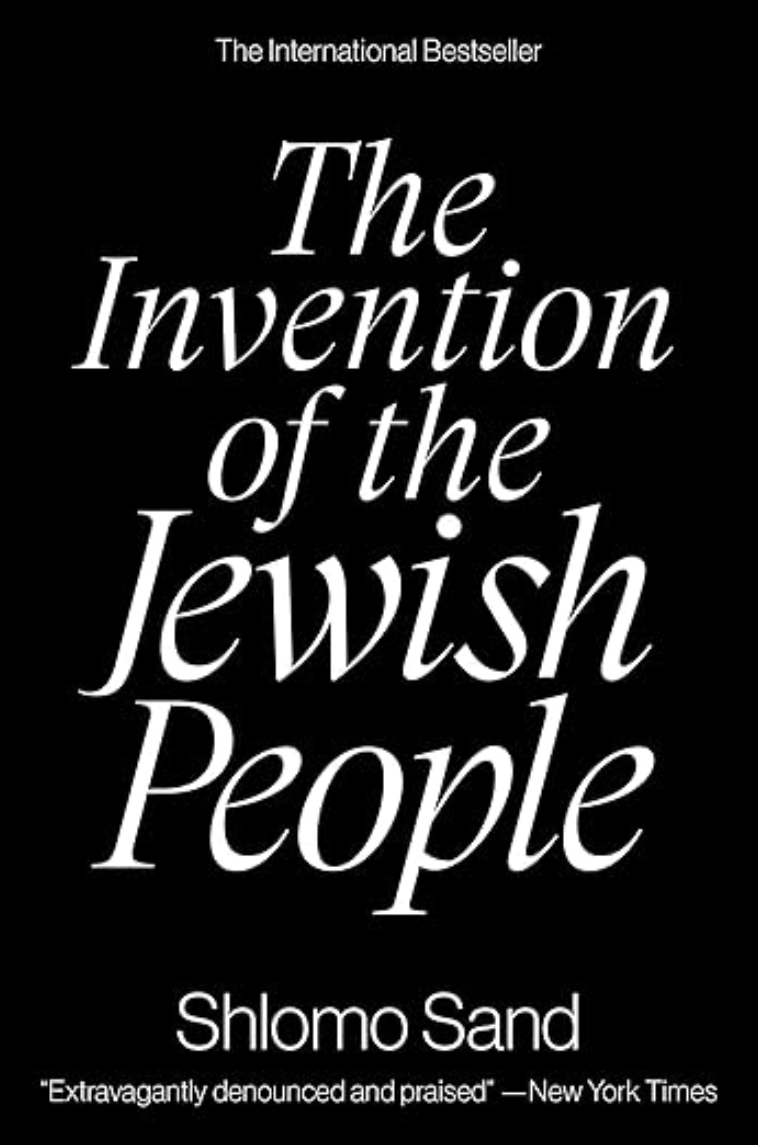
- The expulsion of Jews from Judea did not happen.
- Many Judean Jews accepted Islam and are the ancestors of today’s Palestinians.
- The “nation-race” of Jews with a common origin doesn’t exist and the “Jewish diaspora” is a modern invention.
- The ancestors of European Jews mostly converted to Judaism and have no origin in Palestine.
____________
Shlomo Sand is a Jewish Professor of History at Tel Aviv University
(Since 1982, Sand has taught at Tel Aviv University as well as at the University of California, Berkeley, and the École des hautes études en sciences sociales in Paris.)
Sand was born in Linz, Austria, to Polish Jewish survivors of the Holocaust. His cultural background was grounded in Yiddish culture. His father, having taken an aversion to rabbis, abandoned his Talmudic studies at a yeshiva and dropped attendance at synagogues, after his mother was denied a front seat after her husband’s death, and they could not afford the seat price.[6][7] Both his parents had communist and anti-imperialist views[citation needed] and refused to accept compensation from Germany for their suffering during the Second World War. Sand spent his first two years in a displaced persons camp near Munich, and moved with the family to Jaffa in 1948, where his father got a job as night porter in the headquarters of the local Communist party.[6] He was expelled from high school at the age of sixteen,[8][9] studied electronics by night and found employment by day in a radio repair business. Drafted in 1965, he served at the communist kibbutz of Yad Hanna.[6] According to one interview, “Sand spent the late 1960s and early 1970s working a series of odd jobs, including several years as a telephone lineman.” He completed his high-school work at age 25 and spent three years in the military.[10] The Six-Day War, in which he served – his unit conquered at heavy loss the Abu Tor area in East Jerusalem[6] – pushed him towards the radical left.[10] After the war he served in Jericho, where, he says, Palestinians trying to return to the country were gunned down if they infiltrated at night, but were arrested if caught doing so by day. Such experiences, particularly one incident in which he reports his fellow soldiers beat and tortured a restrained Palestinian man to death,[6] left him with a sense that he had lost his homeland.[6]
He was friends with the Palestinian poet Mahmoud Darwish, with whom he was involved in the Rakah communist party,[11] and a conversation between the two inspired Darwish’s 1967 poem “A Soldier Dreams Of White Lilies,”[a] though it was not revealed at the time that the soldier was Sand.[12][13][14]: 19
Quitting the Union of Israeli Communist Youth (Banki), Sand joined the more radical, and anti-Zionist, Matzpen in 1968. He resigned from Matzpen in 1970 due to his disillusionment with the organisation.[8][15][16]
Declining an offer by the Israeli Maki Communist Party to be sent to do cinema studies in Poland, Sand graduated with a BA in History from Tel Aviv University in 1975. Determined to “abandon everything” Israeli,[17] he moved to France, where, from 1975 to 1985, after winning a scholarship, he studied and taught in Paris, receiving an MA in French History and a PhD for his thesis on Georges Sorel and Marxism.[18] Since 1982, Sand has taught at Tel Aviv University as well as at the University of California, Berkeley, and the École des hautes études en sciences sociales in Paris.[4]
In 1983, according to one source, Sand “took part in a heated exchange over Zeev Sternhell‘s Ni droite, ni gauche: l’idéologie fasciste en France, and later drew the ire of Claude Lanzmann with his 2002 book in Hebrew, Film as History, in which he not only passed scathing judgement on Lanzmann’s Shoah, but also revealed that the film had been secretly funded by the Israeli government.”[9]
Vir: Wikipedia
 DAMIJAN blog
To knjigo imamo tudi v slovenščini – založba cf 2010.
Všeč mi jeVšeč mi je