Za Palestince Nakba predstavlja največjo kolektivno travmo, travmo vseh travm, takrat se je začel izraelski genocid nad njimi. Leta 1947 je bil z deklaracijo OZN na palestinskem ozemlju ustanovljen Izrael, leta 1948 pa so izraelska vojska in paravojaške skupine nasilno pregnale 750,000 Palestincev (polovica palestinskega prebivalstva in 80 % prebivalcev nove države Izrael) iz njihovih domov, z njihove zemlje v begunstvo. Izraelci so zradirali 11 arabskih mest in 500 vasi in zastrupili vodnjake, da se Palestinci ne bi mogli več vrniti. Kdor se je vrnil, je bil ubit ali pregnan.
Po Nakbi 1948 je sledila Naksa 1967, ko so Izraelci sistematično pregnali še ostalih nekaj sto tisoč Palestincev in jih pregnali v Jordanijo, preostale pa stisnili v dve okupirani enklavi – Gazo in Zahodni breg.
Nakba je izraelski izvirni greh. Kar se danes dogaja v Gazi in Zahodnem bregu, je zgolj nadaljevanje popolnega etničnega čiščenja, ki se je začelo z Nakbo in nadaljevalo z Nakso.
Poklon Rogerju Watersu (ex Pink Floyd) v spodnjem intervjuju, ki je ena redkih javnih osebnosti na zahodu, ki si upa to javno povedati.
Pod njim pa je še kratek povzetek iz Wikipedije (ja, kljub pristranskosti in vplivu ameriških in izraelskih obveščevalnih služb na njene vsebine je tekst o Nakbi še vedno travmatično branje; precej boljših in bolj objektivnih zgodovinskih tekstov je o Nakbi, vendar namerno objavljam najbolj izraelsko pristranskega).
The Nakba (Arabic: النَّكْبَة, romanized: an-Nakba, lit. ‘the catastrophe’) is the ethnic cleansing[2] of Palestinian Arabs through their violent displacement and dispossession of land, property, and belongings, along with the destruction of their society and the suppression of their culture, identity, political rights, and national aspirations.[3] The term is used to describe the events of the 1948 Palestine war in Mandatory Palestine as well as the ongoing persecution and displacement of Palestinians by Israel.[4] As a whole, it covers the fracturing of Palestinian society and the long-running rejection of the right of return for Palestinian refugees and their descendants.[5][6]
During the foundational events of the Nakba in 1948, approximately half of Palestine’s predominantly Arab population, or around 750,000 people,[7] were expelled from their homes or made to flee through various violent means, at first by Zionist paramilitaries, and after the establishment of the State of Israel, by its military. Dozens of massacres targeted Palestinian Arabs and over 500 Arab-majority towns, villages, and urban neighborhoods were depopulated,[8] with many of these being either completely destroyed or repopulated by Jews and given new Hebrew names. Israel employed biological warfare against Palestinians by poisoning village wells. By the end of the war, 78% of the total land area of the former Mandatory Palestine was controlled by Israel.
The Palestinian national narrative views the Nakba as a collective trauma that defines their national identity and political aspirations. The Israeli national narrative views the Nakba as a component of the War of Independence that established Israel’s statehood and sovereignty.[9] Also, they negate or deny the atrocities committed, claiming that many of the expelled Palestinians left willingly or that their expulsion was necessary and unavoidable. Nakba denial has been increasingly challenged since the 1970s in Israeli society, particularly by the New Historians, although the official narrative has not changed.[9][10][11]
Palestinians observe 15 May as Nakba Day, commemorating the war’s events one day after Israel’s Independence Day.[12][13] In 1967 following the Six-Day War, another series of Palestinian exodus occurred; this came to be known as the Naksa (lit. ‘Setback‘), and also has its own day, 5 June. The Nakba has greatly influenced Palestinian culture and is a foundational symbol of the current Palestinian national identity, together with the political cartoon character Handala, the Palestinian keffiyeh, and the Palestinian 1948 keys. Many books, songs, and poems have been written about the Nakba.
The 1948 Nakba
The central facts of the Nakba during the 1948 Palestine war are not disputed.[48]
About 750,000 Palestinians—over 80% of the population in what would become the State of Israel—were expelled or fled from their homes and became refugees.[7] Eleven Arab urban neighborhoods and over 500 villages were destroyed or depopulated.[8] Thousands of Palestinians were killed in dozens of massacres.[49] About a dozen rapes of Palestinians by regular and irregular Israeli military forces have been documented, and more are suspected.[50] Israelis used psychological warfare tactics to frighten Palestinians into flight, including targeted violence, whispering campaigns, radio broadcasts, and loudspeaker vans.[51] Looting by Israeli soldiers and civilians of Palestinian homes, business, farms, artwork, books, and archives was widespread.[52]
Nov 1947 – May 1948
Small-scale local skirmishes began on 30 November and gradually escalated until March 1948.[53] When the violence started, Palestinians had already begun fleeing, expecting to return after the war.[54] The massacre and expulsion of Palestinian Arabs and destruction of villages began in December,[55] including massacres at Al-Khisas (18 December 1947),[56] and Balad al-Shaykh (31 December).[57] By March, between 70,000 and 100,000 Palestinians, mostly middle- and upper-class urban elites, were expelled or fled.[58]
In early April 1948, the Israelis launched Plan Dalet, a large-scale offensive to capture land and empty it of Palestinian Arabs.[59] During the offensive, Israel captured and cleared land that was allocated to the Palestinians by the UN partition resolution.[60] Over 200 villages were destroyed during this period.[61] Massacres and expulsions continued,[62] including at Deir Yassin (9 April 1948).[63] Arab urban neighborhoods in Tiberias (18 April), Haifa (23 April), West Jerusalem (24 April), Acre (6-18 May), Safed (10 May), and Jaffa (13 May) were depopulated.[64] Israel began engaging in biological warfare in April, poisoning the water supplies of certain towns and villages, including a successful operation that caused a typhoid epidemic in Acre in early May, and an unsuccessful attempt in Gaza that was foiled by the Egyptians in late May.[65]
Under intense public anger over Palestinian losses in April, and seeking to take Palestinian territory for themselves in order to counter the Israeli-Jordanian deal, the remaining Arab League states decided in late April and early May to enter the war after the British left.[66] However, the armies of the newly independent Arab League states were still weak and unprepared for war,[67] and none of the Arab League states were interested in the establishment of an independent Palestinian state with Amin al-Husseini at its head. Neither the expansionist King Abdullah I of Jordan nor the British wanted the establishment of an independent Palestinian state.[68] On 14 May, the Mandate formally ended, the last British troops left, and Israel declared independence.[69] By that time, Palestinian society was destroyed and over 300,000 Palestinians had been expelled or fled.[70]
May 1948 – Oct 1948
.jpg)
On 15 May, Arab League armies entered the territory of former Mandatory Palestine, beginning the 1948 Arab–Israeli War, the second half of the 1948 Palestine war.[71] Most of the violence up to that point occurred in and around urban centers, in the Israeli portion of the partitioned land, while British troops were still present.[72] After the end of the Mandate, Israel seized more land allocated to the Palestinians by the UN partition plan, and expulsions, massacres, and the destruction of villages in rural areas increased,[73] including the Tantura massacre (22-23 May).[74]
The first truce between Israel and the Arab League nations was signed in early June and lasted about a month.[75] In the summer of 1948, Israel began implementing anti-repatriation policies to prevent the return of Palestinians to their homes.[76] A Transfer Committee coordinated and supervised efforts to prevent Palestinian return, including the destruction of villages, resettlement of Arab villages with Jewish immigrants, confiscation of land, and the dissemination of propaganda discouraging return.[77] During the ten days of renewed fighting between Israel and the Arab states after the first truce, over 50,000 Palestinians were expelled from Lydda and Ramle (9-13 July).[78] A second truce was signed in mid-July and lasted until October.[75] During the two truces, Palestinians who returned to their homes or crops, labelled “infiltrators” by the Israelis, were killed or expelled.[79]
Oct 1948 – Jul 1949
Expulsions, massacres, and Israeli expansion continued in the autumn of 1948,[80] including the depopulation of Beersheba (21 October),[81] the al-Dawayima massacre (29 October),[82] and the Safsaf massacre (also 29 October).[83] That month, Israel converted the ad hoc military governates ruling over Palestinian Arabs in Israel into a formal military government that controlled nearly all aspects of their lives, including curfews, travel restrictions, employment and other economic restrictions, arbitrary detention and other punishments, and political control.[84] Martial law assisted Israeli efforts to find and expel or kill “infiltrators” in order to prevent Palestinians from repopulating their villages.[85]
Most of the fighting between Israel and the Arab states ended by the winter of 1948.[86] On 11 December 1948, the UN passed Resolution 194, resolving that Palestinians should be permitted to return to their homes and be compensated for lost or damaged property, and establishing the United Nations Conciliation Commission.[87] Armistices formally ending the war were signed between February and July 1949,[88] but massacres and expulsions of Palestinians continued in 1949 and beyond.[89]
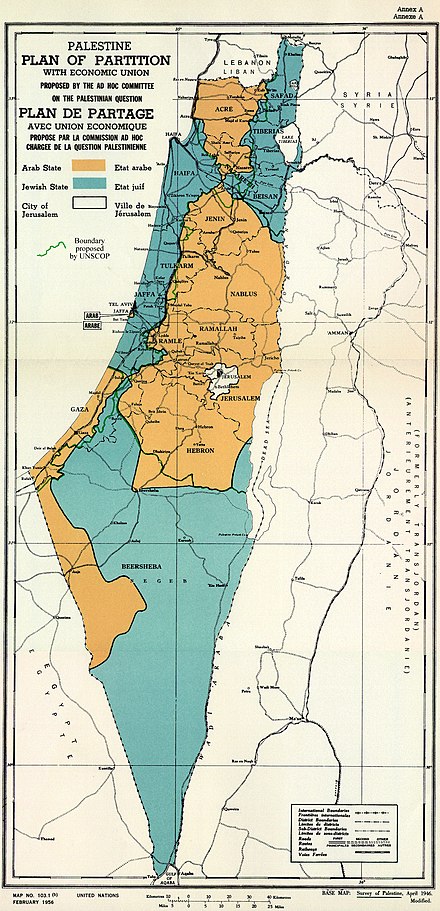
By the end of the war, Palestine was divided and Palestinians were scattered.[90] Israel held about 78% of Palestine,[91] including the 55% allocated to it by the UN partition plan and about half of the land allocated for a Palestinian state.[92] The West Bank and Gaza Strip comprised the remaining half, and were now held by Jordan and Egypt, respectively.[93] The internationally governed corpus separatum was divided between an Israeli-held West Jerusalem and a Jordanian-held East Jerusalem.[94] Israel with its expanded borders was admitted as a member to the United Nations in May 1949.[95] About 156,000 Palestinians remained under military rule in Israel, including many internally displaced persons.[96] The approximately 750,000 Palestinians who were expelled or fled from their homes were now living in refugee camps in the West Bank, Gaza Strip, Jordan, Syria, and Lebanon.[97] None were allowed to return.[98] No Palestinian state was created.[99]
Post-1948 Nakba
Martial law period (1949–1966)

Boundaries defined in the 1947 UN Partition Plan for Palestine:
Armistice Demarcation Lines of 1949 (Green Line):
The Nakba continued after the end of the war in 1949.[4] Israel prevented Palestinian refugees outside of Israel from returning.[100] Palestinians continued to be expelled, and more Palestinian towns and villages were destroyed, with new Israeli settlements established in their place.[101] Palestinian place names and the name “Palestine” itself were removed from maps and books.[102]
Sixty-nine Palestinians were killed in the 1953 Qibya massacre.[103] A few years later, 49 Palestinians were killed in the Kafr Qasim massacre, on the first day of the 1956 Suez Crisis.[104]
Palestinians in Israel remained under strict martial law until 1966.[105]
Naksa period (1967–1986)
During the 1967 Six-Day War, hundreds of thousands of Palestinian refugees were driven from the West Bank, Gaza, and East Jerusalem. Most were driven into Jordan.[106] This has become known as al-Naksa (the “setback”).[107] After the war, Israel occupied the West Bank and Gaza Strip.[108]
Some two thousand Palestinians were killed in a massacre led by the Lebanese Front at the Siege of Tel al-Zaatar in 1976, during the Lebanese Civil War.[109] Palestinian refugees in Lebanon were killed or displaced during the 1982 Lebanon War, including between 800 and 3,500 killed in the Sabra and Shatila massacre.[110]
Vir: Wikipedia


Jože P Damjan, z objavo tega članka si veliko upaš.
Židovski lobi je tako močan, da lahko v Evropi belo uradno spremeni v črno ali obratno. Ne v svojem imenu, ampak to naredijo osebki (ali sile), ki z Izraelom nimajo na videz nič skupnega. Samo spomnimo se kako so Varufakisa fizično onemogočili na javni in prilgašeni prireditvi v Namčiji: Nemci.
Tudi v Ameriki se posamezniki iz domače javnosti sprašujejo, kako je možno, da je Izrael onemogočeno javno kritizirati, v medijih. To je le vrh ledene gore. Izrael je uspel “svoje” ljudi (somišljenike, od njih odvisne, ipd.) plasirati na vsa pomembna mesta za odločanje, kar je osnova njihovega vpliva. Da bi to prikrili, so ustanovili AIPEC, ki se ukvarja s financiranjem ameriških politikov, če so po godu Izraelu. Ta AIPEC pa je legalna in transparentna pravna oseba, ki se ji ne da očitati nič protizakonitega, in nase pritegne vprašanja o vplivu Izaraela na Ameriko. Ameriškim domačinom gre to v nos, a ne morejo storiti ničesar. Zato se Izrael za uveljavljanje svojih koristi po svetu (tudi EU) poslužuje tudi pritiska s strani Ameriških subjektov, uradnih državnih institucij in finančnih korporacij.
Uspešnost Izraela je v tem, da dajejo njihov skupni interes (ki ga definira njihova religija) nad zasebni interes žepov udeleženih posameznikov. Drugod (beri: pri nas) pa je osebni interes (žep) politika – seveda neizražen, tiho – na prvem mestu. Pri Židih je to odločno na drugem mestu, vendar v razmerju do drugih kar precej izraženo. To jim njihova religija ne samo dopušča, ampak celo svetuje, usmerja. Imajo pač pokritje od njihovega boga, brezprizivno.
Všeč mi jeVšeč mi je
To so zgodovinska dejstva
Všeč mi jeLiked by 1 person
Pozdravljeni
samo opozorila bi na napačen naslov vašega prispevka: Nakba ni kraj, ampak dogodek: Nakba – katastrofa. Izraelski genocid se je začel z Nakbo ne v Nakbi.
Všeč mi jeVšeč mi je
Jasno, da je Nakba dogodek in ne kraj, kar je tudi razvidno iz teksta in citiranega odlomka iz zapisa v Wikipediji.
Sem pa bil očitno šlampast v naslovu. Popravljeno.
Hvala za opozorilo!
Všeč mi jeLiked by 1 person