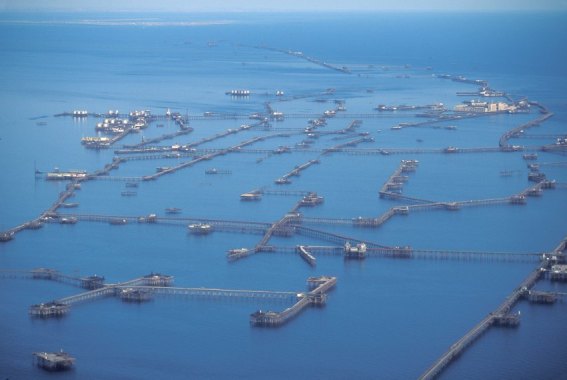
Tole se mi je zdelo zanimivo. Nekdanji sovjetski ponos, mesto Neft Dashlari, sestavljeno iz povezanih naftnih ploščadi in 300 km mostov in viadukotv sredi Kaspijskega morja. V najboljših časih je v mestu, kjer so imeli svojo kinodvorano, zelenjavni vrt in park, živelo po 5,000 ljudi. Danes ta naftna ploščad pridela le še majhen del skupne naftne proizvodnje Azerbejdžana, kamor spada. Mesto počasi propada, toda še vedno inspirira filmsko domišljijo, tudi Jamesa Bonda.
.
After the war, Soviet engineers took a closer look at a reef that mariners called the “Black Rock.” They built a shed on the tiny island and conducted test drilling. During the night of Nov. 7, 1949, they struck top-quality oil at a depth of 1,100 meters below the seabed and shortly thereafter, the world’s first offshore oil platform was built at the spot, now renamed Neft Dashlari, or “oily rock.” “Platform” is a hopelessly inadequate word for the many-armed monster of steel and timber that gradually spread across the waves of the sea, which is only 20 meters deep on average, over the following years.
The foundation of the main settlement consists of seven sunken ships including “Zoroaster,” the world’s first oil tanker, built in Sweden. In Neft Dashlari’s heyday, some 2,000 drilling platforms were spread in a 30-kilometer circle, joined by a network of bridge viaducts spanning 300 kilometers. Trucks thundered across the bridges and eight-story apartment blocks were built for the 5,000 workers who sometimes spent weeks on Neft Dashlari. The voyage back to the mainland could take anything between six and twelve hours, depending on the type of ship. The island had its own beverage factory, soccer pitch, library, bakery, laundry, 300-seat cinema, bathhouse, vegetable garden and even a tree-lined park for which the soil was brought from the mainland.
…
Dismantling Neft Dashlari properly would probably be more expensive than simply keeping it going with a scaled-down oil production. To the government, the place is still the proud, closely-guarded secret it was in Soviet times. It is still very hard for foreigners to gain access to the city, which isn’t even shown on Google Maps.
Vir: Spiegel
 DAMIJAN blog
You must be logged in to post a comment.